

Carte postale adressée à Man Ray
It is Monday, 26 July 1937, the day Picasso and Dora Maar set off with their friends for the Côte d’Azur. Traveling in the painter’s imposing Hispano-Suiza, driven by his personal chauffeur Marcel, the party included Paul Éluard, his daughter Cécile, and his wife Nusch.
Picasso had just emerged from a fertile and historic period: he had only just completed Guernica in his studio at 7 rue des Grands-Augustins. For the first time, he had painted in the presence of an observer, Dora Maar, who photographed the work as it progressed, images Picasso used to adjust the canvas, notably the balance of blacks and whites. Guernica was finished in early June and immediately shown to the public at the 1937 International Exposition in Paris, at the Spanish Pavilion, from 12 July 1937.
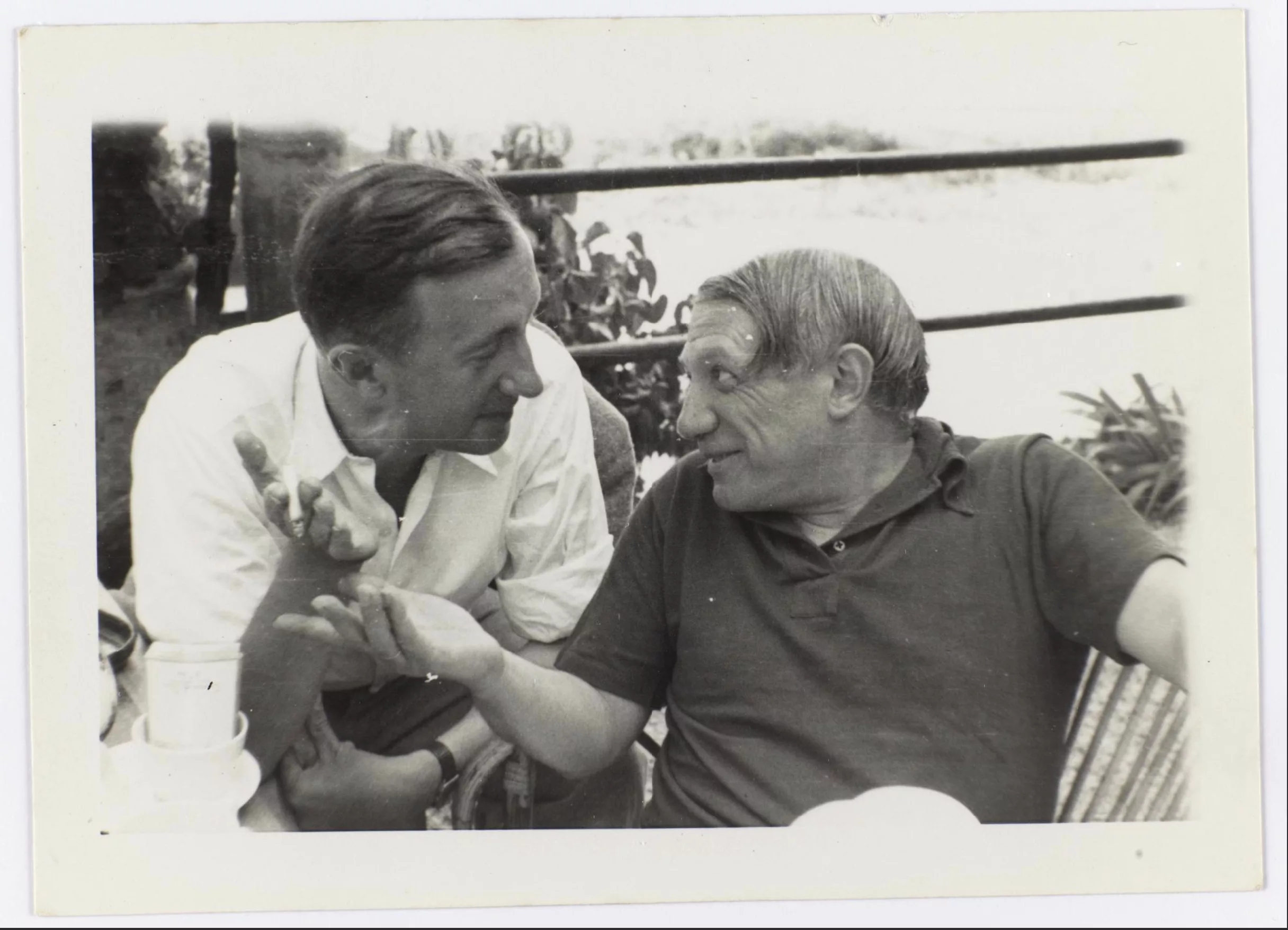
Éluard and Picasso had known each other since the 1920s, and it was through Éluard that Picasso met Dora Maar. Their fraternal sympathy and shared creative energy were such that the two men, with their companions and friends, spent their summer holidays together in the south of France for three consecutive summers beginning in 1936, always staying at a modest establishment in Mougins, the Hôtel Vaste Horizon. Dora Maar’s photographs from these summers are at once casual snapshots of a group of smiling friends enjoying the beach and the sea, and artistic chiaroscuro portraits. It was during that first summer that Éluard wrote, among other poems, “À Pablo Picasso,” later published in Les Yeux fertiles.
The following summer was eagerly awaited, and the group left Paris on 12 July for a journey partly made by night — “horribly tiring,” as Dora Maar later recalled — taking them south along the Rhône valley to a first stop at Hauterives, in the Drôme, between Vienne and Valence. The next day, after some rest, they headed for the Palais Idéal, built over more than thirty years by the postman Ferdinand Cheval, which Picasso wished to visit.
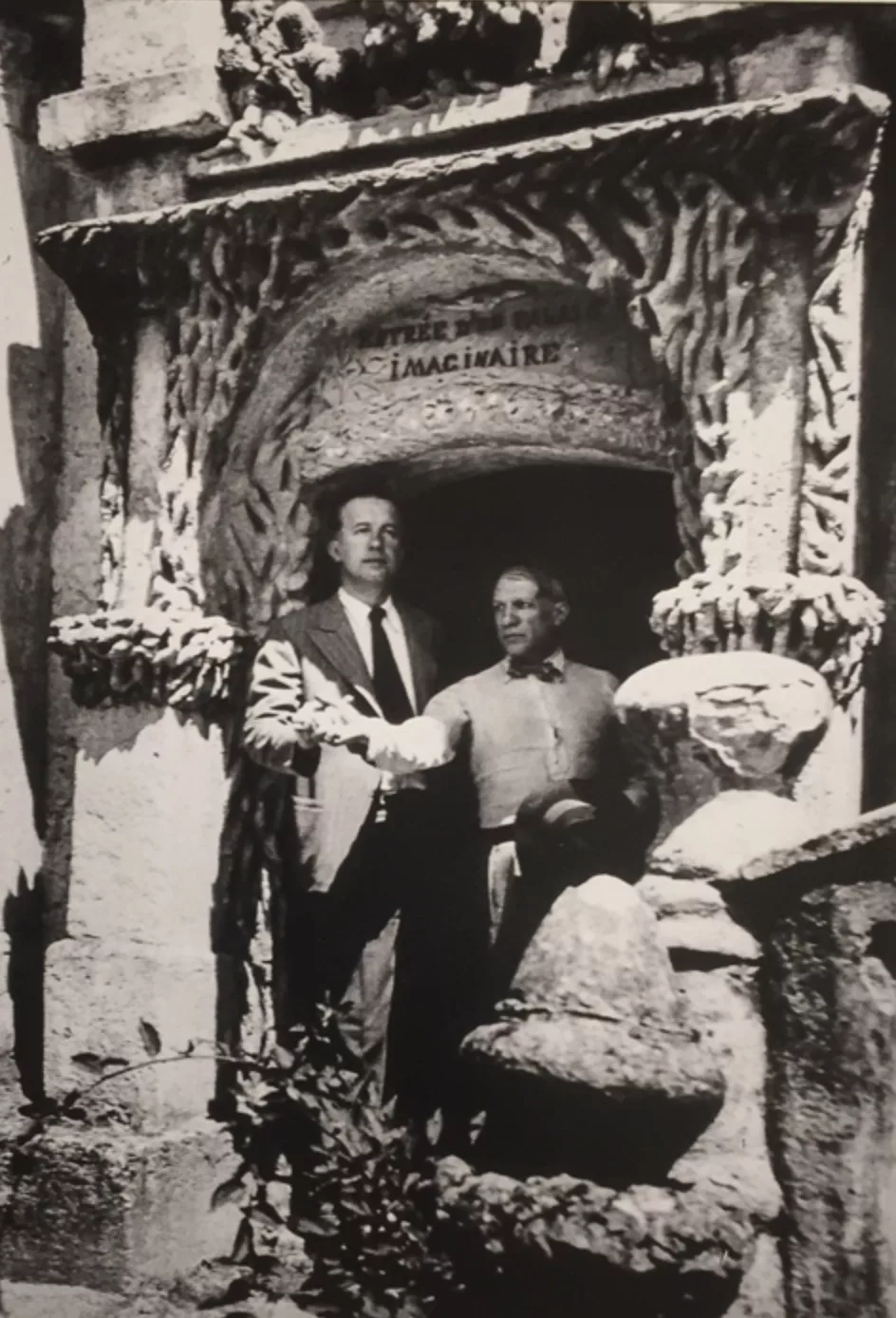
“Under the lens of Dora Maar’s medium-format Rolleiflex — whose tripod and case can be seen in Picasso’s hands in a photograph now in the collection of the Centre Pompidou — the two couples pose as they discover the terrace of the Palais Idéal, which they had no doubt just reached via the stairs of the East façade. A few days later, on 7 August, fascinated by the memory of the Palais Idéal and its illustrious creator, Picasso produced a series of pencil drawings known as the Carnet du facteur Cheval.” (Dora Maar et Pablo Picasso au Palais idéal, exhibition, September 2022–March 2023, held on the occasion of the display of original Dora Maar photographs on site during this visit.)
Dora Maar commemorated the moment with a photograph of the two friends at the entrance to the “Palais imaginaire.” Their shared taste for naïve art and the dreamlike world so dear to the Surrealists drew them together and found an echo in this singular monument. That same day, the group bought a postcard of the site, which was posted from Mougins a few days later to 40 rue Denfert-Rochereau in Paris, to Man Ray.
Signed by Dora Maar, Picasso, Paul Éluard, his daughter Cécile, and Nusch Éluard, the card carries the simple message: “on vous attend tous les deux.”
This is the very document presented here: the “Picasso–Éluard” group eagerly awaiting their friend Man Ray, still in Paris. The words “on vous attend tous les deux” are addressed to Man Ray and his companion Adrienne Fidelin, known as Ady. The card is signed by all five holidaymakers, with this note in Éluard’s hand: “Vaste Horizons, Mougins (Alpes Mmes).” Undated, it bears the Mougins postmark of 7 August 1937, struck three times.
Man Ray and Ady did indeed join them a few days later, on 15 August, along with Roland Penrose and Lee Miller, with whom Man Ray, Paul Éluard — then working on Les Mains libres, to appear in December — and Nusch had stayed in Cornwall in early July. Miller and Dora Maar captured numerous scenes from that summer, as did Picasso, who always carried a 35 mm camera.
And of course Man Ray, eager to take advantage of the Côte d’Azur light to test a new Kodachrome color film, filmed the village, his friends, and their outings on the beach at La Garoupe: “These are the very tests, recognizable by their color, that filmmaker François Lévy-Kuentz used as his starting point for Un été à la Garoupe. He intersperses them with excerpts from Man Ray’s short films (L’Étoile de mer, Les Mystères du château du Dé, Le Retour à la raison, featuring Kiki, the Queen of Montparnasse) and numerous photographs from the Ray, Miller and Maar archives, often still in the form of contact sheets.”