

Histoire intellectuelle de Louis Lambert
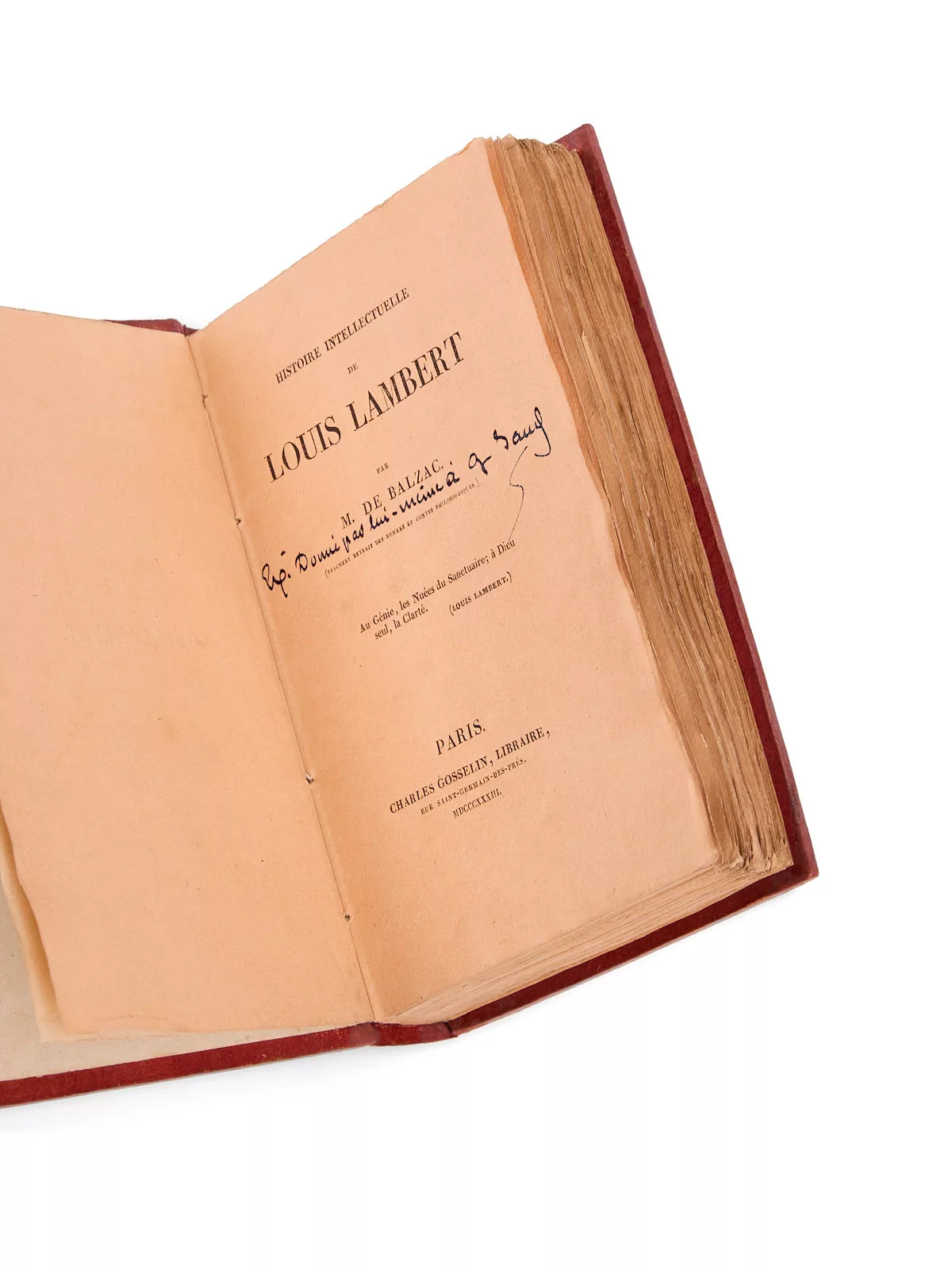
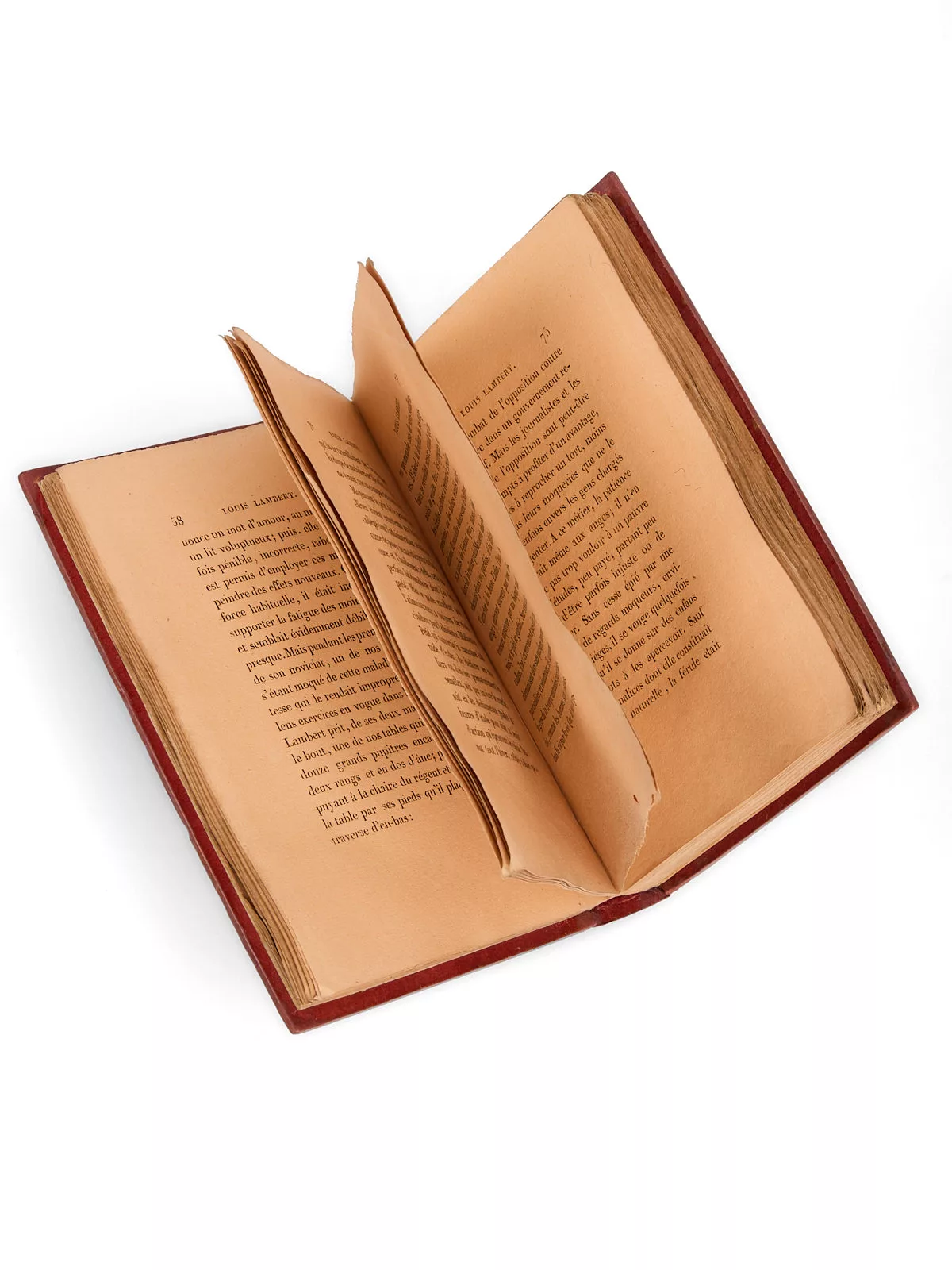
One of 12 extremely rare copies printed on strong salmon-colored paper.
A precious copy given to George Sand; on the title page, beneath the author's name, in the novelist's hand: “Ex. donné par lui-même à G. Sand.”
Louis Lambert is a rich and singular work by Balzac, portraying a wounded Romantic intellectual eventually overtaken by madness.
An initial publication in 1832 in Les Nouveaux Contes philosophiques left Balzac dissatisfied. On 25 November he wrote to his friend Zulma Carraud: “Alas, [Louis Lambert] is incomplete. I again rushed too much. It lacks developments and many things I am now working on, and in the next edition it will be much changed, much corrected.” (Corr., II, 178). Balzac then substantially reworked the text, notably adding the Traité de la volonté. This definitive version appeared two months later, in January 1833, printed in only 750 copies, a large part of which, according to Balzac himself in the preface to the collected edition of Le Livre mystique, were destroyed; he still lamented in 1835 the poor execution of this “defective edition which, to my misfortune, circulates through the world in a distressing state of imperfection” (Corr., II, 932).
Balzac remained deeply attached to this “cherished, much caressed” work, long meditated and carried, a devotion reflected in the exceptional luxury of the bindings that preserve the documents of its genesis — as shown by the copy kept at the Maison de Balzac, prepared by Balzac himself for Madame de Berny, bound in long-grained red morocco with gilt and blind-tooled compartments and blue and green morocco mosaic, bearing at the center of the upper cover “Et nunc et semper,” with extensive corrections and 25 inserted leaves of additions, notably on Vendôme and the Traité de la Volonté.
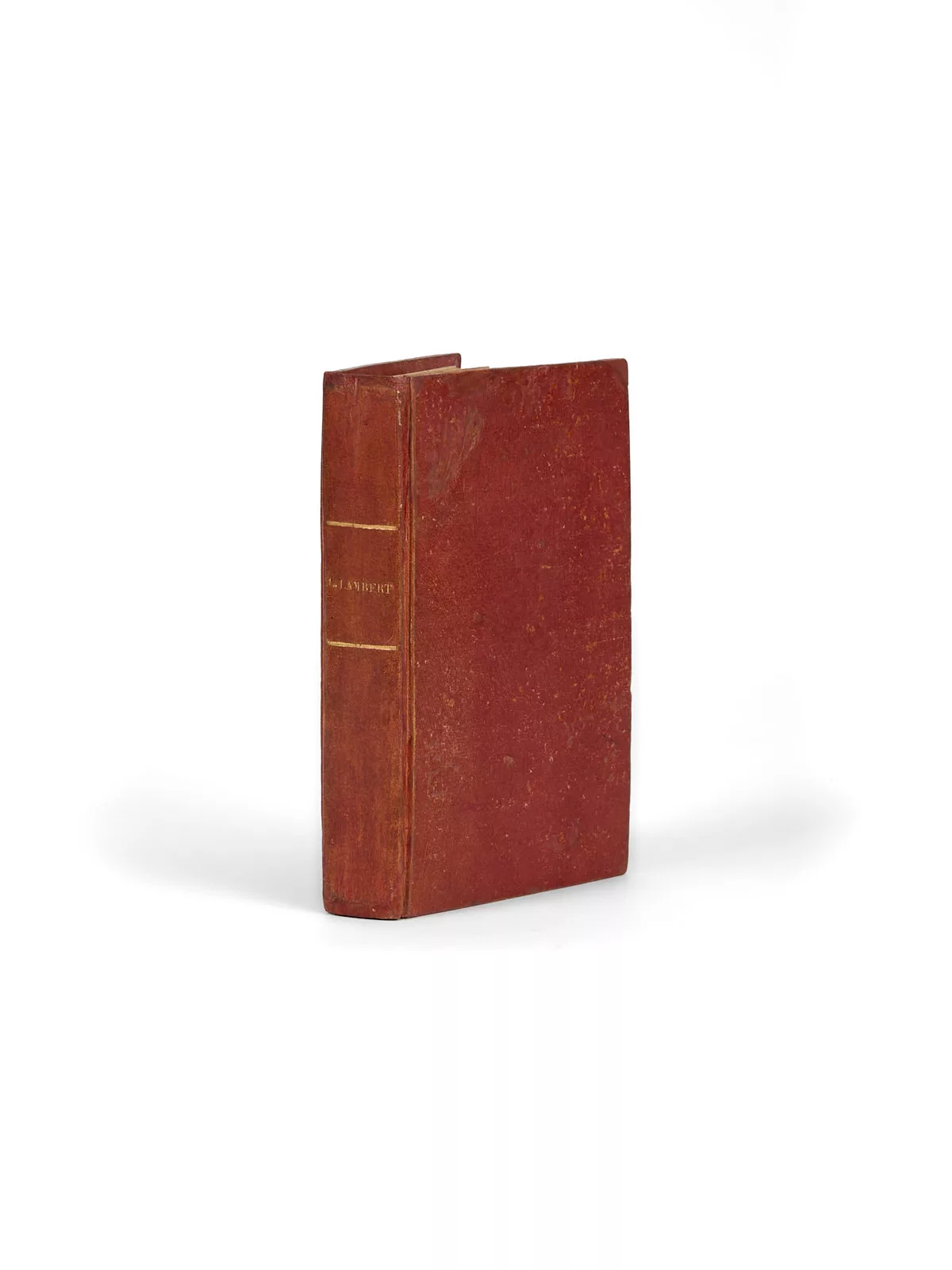
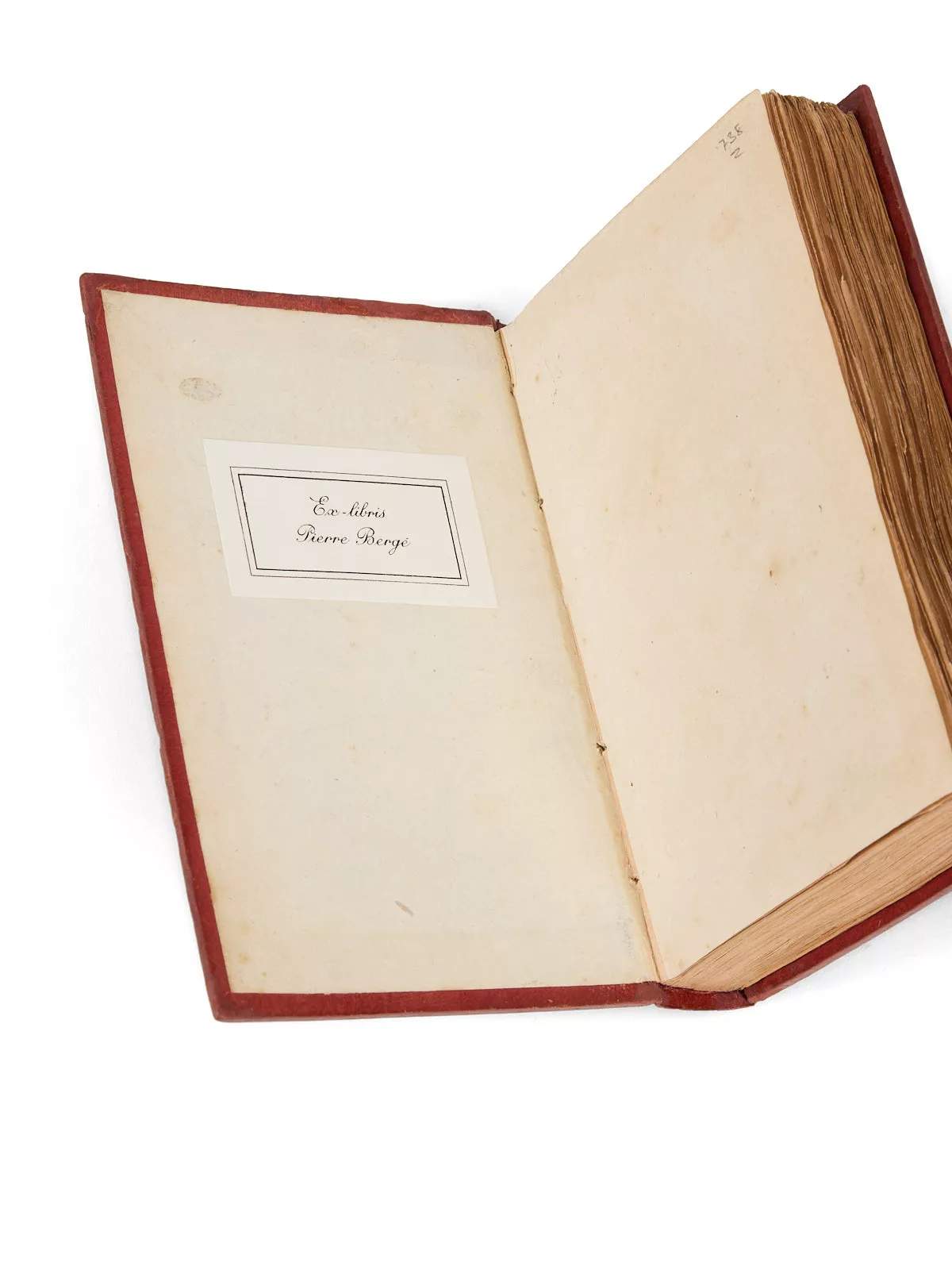
A very particular printing, financed by Balzac himself, offers further evidence of this devotion: twelve copies on strong salmon-colored paper, bound by the workshop of Wagner & Spachmann. The original invoice, preserved in the Lovenjoul collection at the Institut de France, dated 20 February 1833 and made out in Balzac’s name, tells us that all copies were identical, “paid for at 1 franc each; modest boards which are nonetheless in perfect harmony with the work. Sober, covered in brick-red paper, they bear on the spine only the title L. LAMBERT in gilt letters, between two gilt fillets. The endpapers are of white paper; the volume is uncut. Balzac clearly intended these copies for close friends” (Balzac imprimeur et défenseur du livre, 1995, p. 136).
Of these twelve copies, only three others have been located:
– the copy of Victor Ratier, former director of La Silhouette, with an autograph presentation inscription (Exposition Balzac, Pierre Berès, no. 255, private collection);
– the copy of Eugène Sue, with an autograph presentation inscription “au cher capitaine de la Salamandre” (Bibliothèque Jacques Guérin, 20 March 1985, no. 4, private collection);
– a copy without inscription (perhaps the one cited by Vicaire, from a Rouquette sale; Librairie Métamorphoses, 2016, no. 26, private collection, with a rebacked spine).
This copy, from George Sand’s library (Catalogue de la bibliothèque de Mme George Sand et de M. Maurice Sand, Paris, 1890, no. 47; Exposition Balzac, Pierre Berès, no. 254; Pierre Bergé collection, then sale, V, 2020, no. 965), is without question the most important known at present.
Two further copies were printed on China paper, one given to Madame Hanska, the other to Zulma Carraud, but neither bears an inscription. Balzac wrote to Carraud on 25 January 1833: “you will soon receive, at M. Sazerac’s, a small parcel containing my offering. For you there is a copy on China paper which the greatest binding artists are at this moment making worthy of you. I beg you, never lend it. You know that when you do needlework, every stitch is a thought. Well, every line of this new work has been, for me, an abyss. There will be secrets between the two of us in it. Keep it carefully; I shall give you an ordinary copy that you may lend, if indeed you can lend it to many people. Now the work is much more complete, more developed, better written; may I one day make of it a monument of glory!” A delightful survival, preserved in a marquetry rosewood case bearing his monogram, sold at auction in 2010 (Pierre Bergé et associés, Laucournet expert, 29 June, no. 150).
Provenance: George Sand; Pierre Bérès; Pierre Bergé.
Carteret, I, 62; Clouzot, 20; Lovenjoul, 190; copy cited by Vicaire (I, 194).