

[La Grande Peur des bien-pensants]
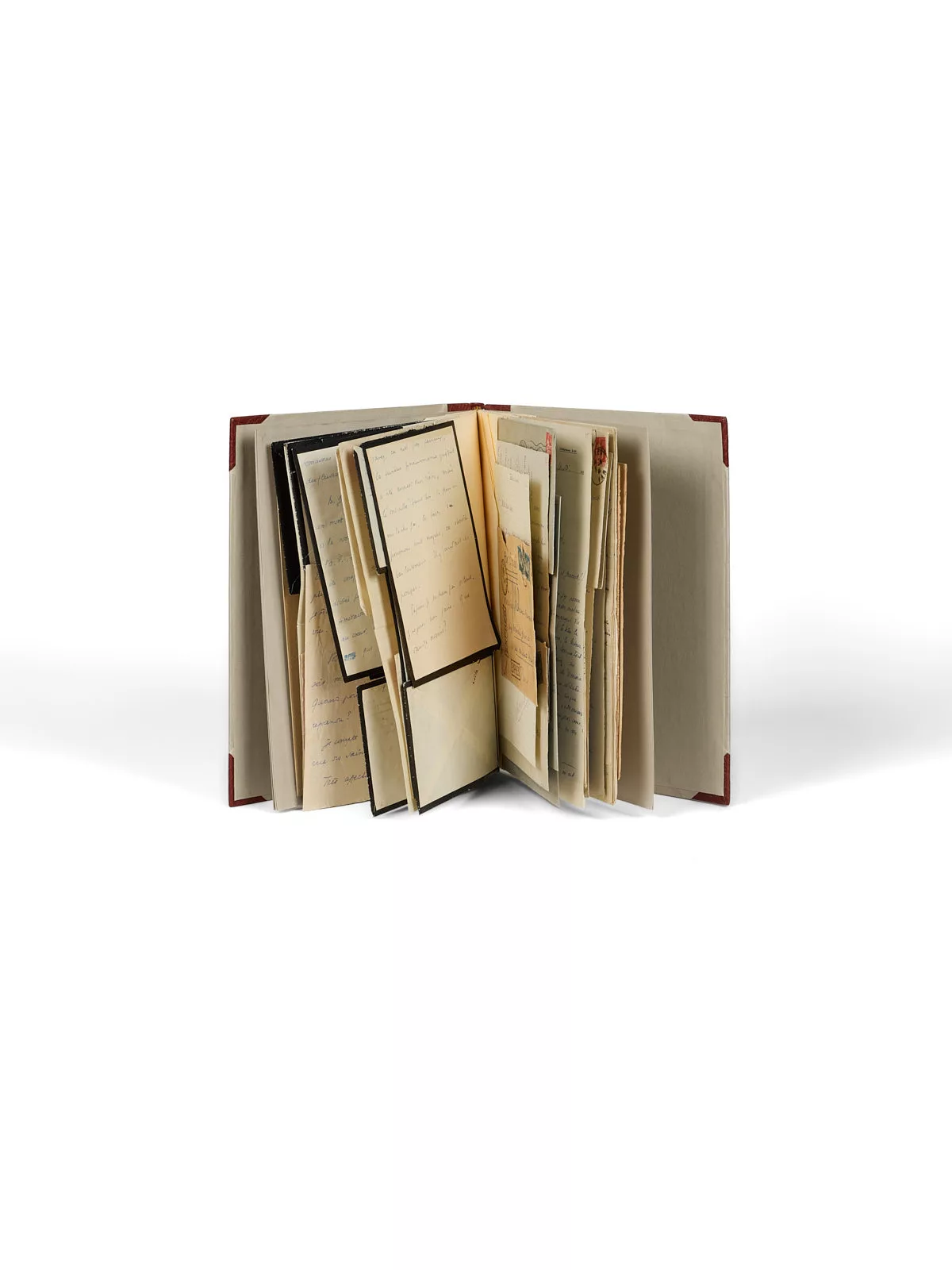
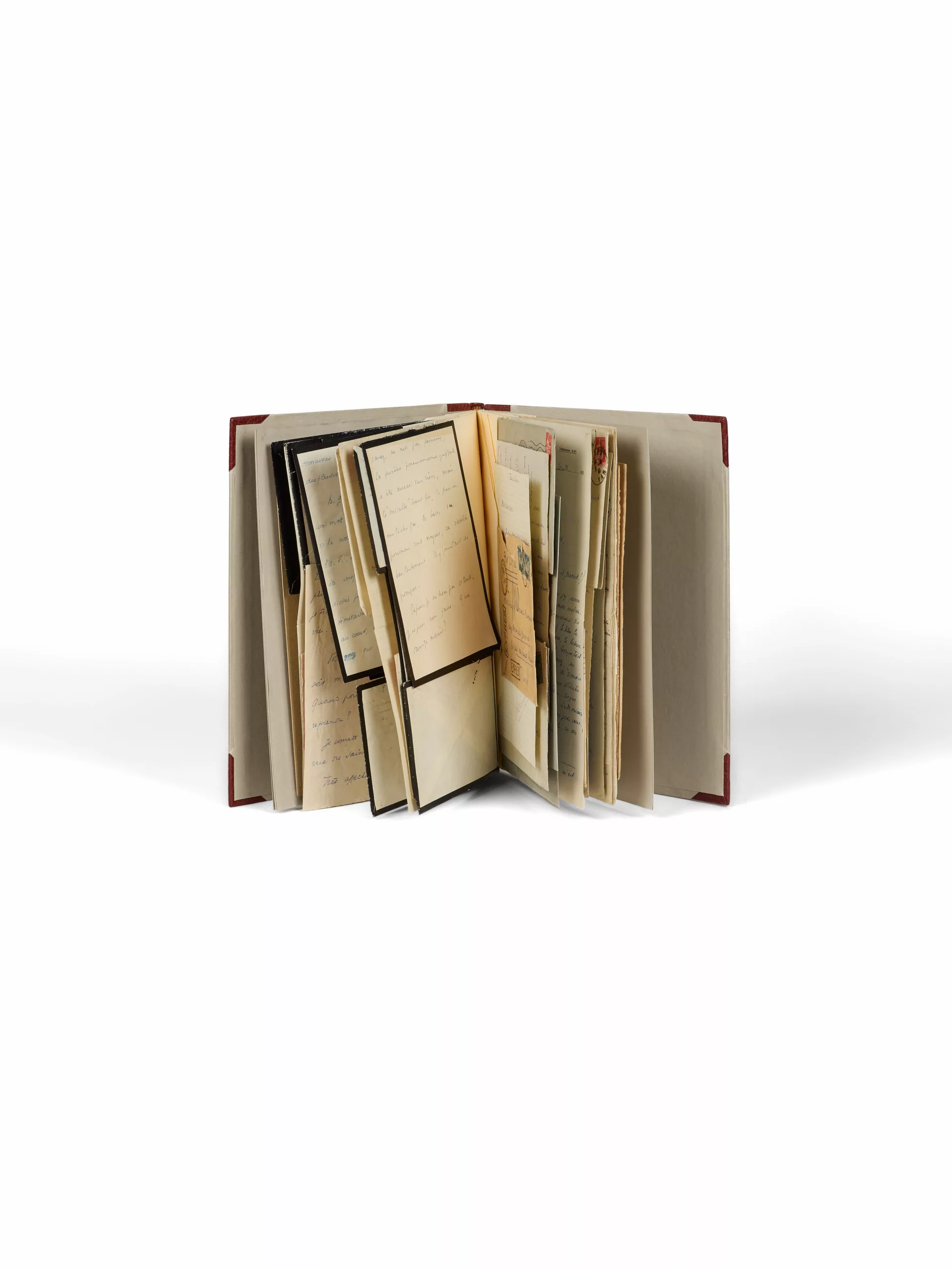
The group comprises the following elements:
- 1 portrait of the author by Laure Albin-Guillot (print on paper, 180 x 255 mm), signed in the plate and dated 1927, inscribed “à Pierre Bessand-Massenet, à son amitié si diligente et si discrète, avec ma très affectueuse gratitude, G. Bernanos”;
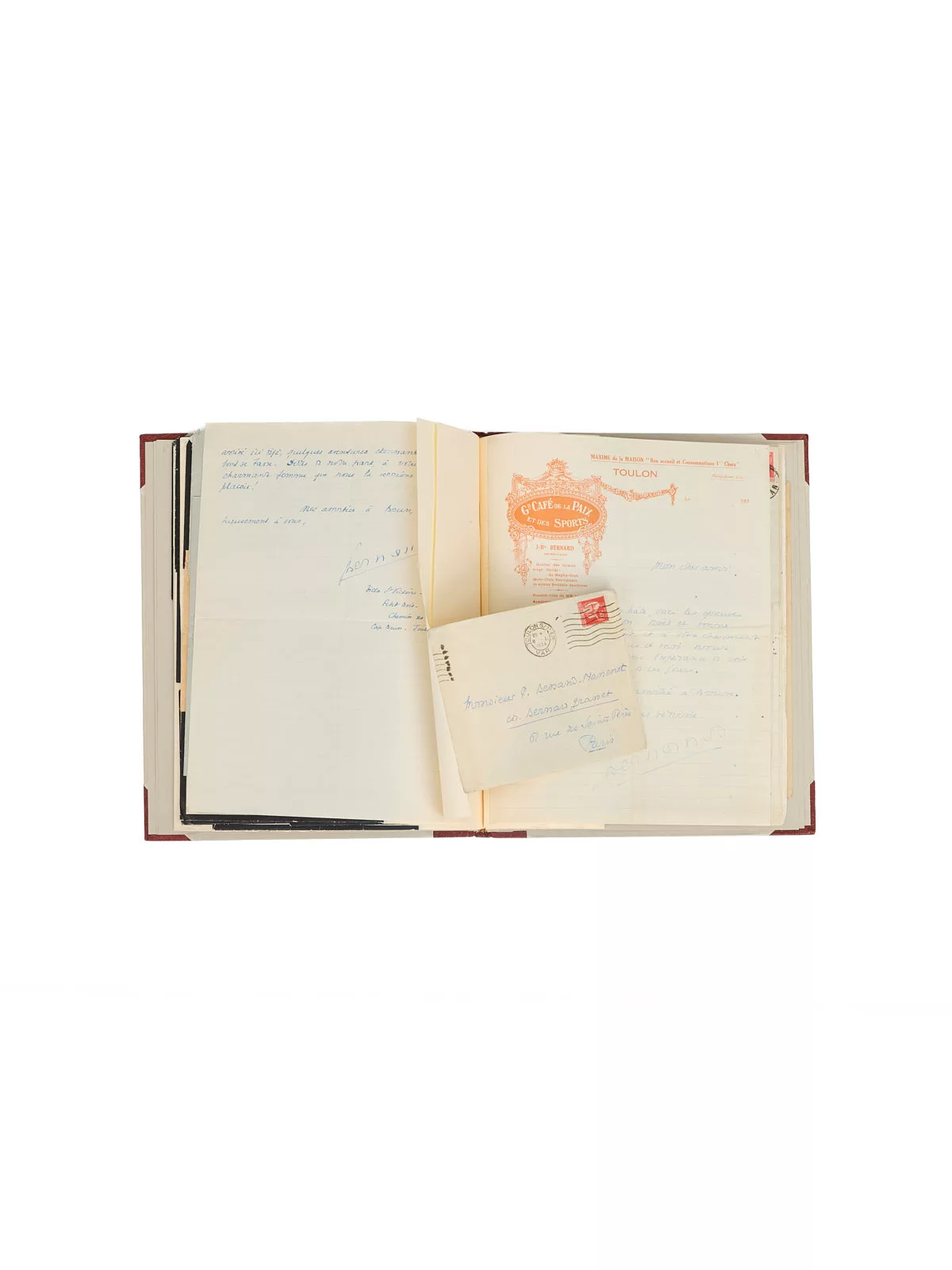
- 21 autograph letters signed (various formats), with envelopes preserved;
- 1 autograph manuscript of 3½ pages, written in blue ink: fragment of La Grande Peur des bien-pensants;
- 2 autograph pages, written in blue ink, concerning corrections to be made;
- 1 offprint of “Édouard Drumont. Conférence de M. Georges Bernanos,” from the Cours et conférences d'Action française (October 1929), of which this is the first edition.
An important unpublished correspondence with Pierre Bessand-Massenet (1899-1985), who worked at Grasset from 1926 to 1939, then at Plon, where under his impulse and that of Maurice Bourdel (with whom Bernanos also corresponded) the “La Palatine” series developed into a genuine publishing house.
In February 1933, during a visit to Paris, Bernanos and Bessand-Massenet formed the plan of periodic “cahiers,” which he would write alone as a kind of “journal” to be given to Grasset, reserving his novels for Plon.
The first letter is written from Vésenex on 22 August 1930, where Bernanos was staying during a course of treatment at the neighboring village of Divonne-les-Bains, being treated for an anxiety crisis that had gripped him since June. He had just lost, in quick succession, his mother and his friend the abbé Sudre — the letters of this period are accordingly written on mourning paper. As in most of the following letters, the subject is La Grande Peur des bien-pensants, begun in 1928. By the summer of 1930, Bernanos was nearing the end of two years’ work on the first of his polemical texts, whose original title, “Démission de la France,” was eventually abandoned in favor of La Grande Peur…, a change he conceded only after a long fight: “I am absolutely set on Démission de la France, with — as a subtitle, in letters as large as you like: Ed. Drumont, prophète en son pays” (letter of 28 November 1930).
A misunderstanding then arose between him and Grasset on this subject, which he asked Bessand-Massenet to clear up (letter of 19 March). Bernanos had also considered another title, “Au bord des prochains charniers,” an idea he had confided to Louis Brun (letter written from Vésenex in July). Leaving for Toulon at the end of the summer, he stayed with his family first at the villa “Sainte-Victoire,” then at the villa “Les Algues,” before settling more permanently at La Bayorre (near Hyères) in the villa “Fenouillet.” The Bernanos family would not leave the Côte d’Azur until October 1934, when they moved to the Balearic Islands; the letters in this group are written, with few exceptions, from Hyères or Toulon.
Throughout, the writer is seen struggling with serious financial difficulties: “the balance of my budget […] being a kind of weekly miracle,” he writes to Bessand-Massenet (Toulon, 2 December 1930), asking for cash instead of a check he evidently cannot wait to have cashed. It is known that the owner of the villa Fenouillet had the writer’s furniture, books and papers wrongfully sold at auction, which Bernanos, in disgust, did not oppose.
As the book was about to appear, Bernanos, asked for a portrait — a print of which is mounted in this manuscript group — noted: “the best negatives are held by Madame Albin-Guyot (sic). I believe there is a still-unpublished profile shot, capable of doing me great honor.” On 14 February 1931, once the book had finished printing, he confided to his friend: “Half of what I wanted to express is missing, alas! But there are some heartbreaking pages, which I wrote with such a clenching of the heart.” He harbored no illusions about Grasset: “I am afraid he cares no more for the book than for his first, long-forgotten mistress” (Toulon, 1 April). Amid countless difficulties, Bernanos, in touch with Drumont’s widow (who was in need), tried to help her (letter of 26 May 1931). On 22 June, from Hyères, where he had settled his whole family, he wrote to Bessand-Massenet — as he would later recount in one of his books — why he preferred working in a public place: “Alone within four walls, I can imagine myself a kind of genius. At the café, under the skeptical eyes of the waiters, that is simply not possible!” In the last letter of 1931 (4 November), he was recovering from an illness during which he had nearly “drifted gently out onto the shoreless sea, without the dictator Bernard Grasset’s permission.” Still from Hyères, on 28 June, Bernanos asked Bessand-Massenet to be godfather to the child Jeanne was expecting, confiding that their friendship “grew almost in spite of me, or at least almost without my thinking about it.” At the end of August, the subject was Germany: “do you believe, or not, that an inquiry into Hitler and German youth is possible? In any case, I would truly not want to die without having said something of the Wagnerian drama now unfolding over there.” His son Jean-Loup was born on 30 September 1933, and he renewed his request to Bessand-Massenet to be godfather. Two further letters close this period before the departure for the Balearics. Bernanos, who had suffered a very serious motorcycle accident in July that would leave him permanently disabled, already suspected as much: “Yesterday I saw the ‘electrologist’ and the radiologist (or -graph). Clearly, I am beginning — or rather continuing — to believe that I shall drag my leg for the rest of my life.”
This precious group of letters to Pierre Bessand-Massenet closes with a long letter written from the Balearic Islands in 1935. Bernanos is furious with the publisher Plon, the “veuve Garancière,” from whom he has not received all he hoped for in advances, even though he has completed a good part of Un crime and M. Ouine, and mentions “another novel of which she has more than two hundred pages, and which I could very easily finish in fifty,” as well as 110 pages “of another book [Journal d’un curé de campagne], pages which are certainly the most moving I have written […]. All this work (except M. Ouine) has been done since the end of April 1934, that is, in eight months, despite a month of illness and five or six weeks lost to moving (!), the sale of my furniture, and settling in here.” He wishes he could “work at once on [his] journal,” provided he is paid by the page: “I swear to you, it seems to me that this journal would be beautiful. And tomorrow it will probably be too late. Everyone dead, even the bastards!”
Finally, two letters: one to Pierre Gaxotte recommending Pierre Bessand-Massenet, “one of the truly proudest hearts I know,” and another to a “friend” announcing the birth of Jean-Loup: “A little boy has just tumbled down into this world — ‘tumbled’ is the word for it. A quarter of an hour was enough. […] If only I could give a book to Posterity as quickly!”
The present manuscript of La Grande Peur…, of which the final pages of the conclusion are preserved here, is to our knowledge the only known autograph fragment of this text, since nothing is known of the manuscript itself, which has never been seen and was probably destroyed. It is a fair copy with few corrections, signed by Bernanos, followed by two manuscript pages of corrections noted from the proofs. Bernanos recorded the page and line number and the correction required — pages 411 to 447.
A group of the first importance for the composition and elaboration of La Grande Peur. It was again to Bessand-Massenet, also a historian, that Bernanos would turn for documentary information when working (1938) on Jeanne d’Arc, relapse et sainte. He was among those Bernanos considered his true friends, a witness to these crucial years — including the definitive break with Action française — before he left France.