

Lettre à Lou
In the summer of 1914, the poet sought to enlist as soon as general mobilization was declared on 2 August. But, lacking French nationality, the recruitment board deferred his request. Deeply distressed, Apollinaire accepted the invitation of his friend Siegler-Pascal to join him in Nice. In late September, he met Louise there: “Barely twenty-four hours have passed since this event, and already love lifts me up and casts me down in turn, so low and so high that I wonder whether I have ever truly loved before” (Lettres à Lou, 28 September 1914). Thus began the romance, and their correspondence.
Two months later, on 5 December, Apollinaire finally succeeded in being enlisted in the 38th field artillery regiment at Nîmes. The very next day, without warning, Lou was waiting for him outside the barracks on the route d’Uzès. Ten days of idyll followed at the Hôtel du Midi, on the square de la Couronne, where “they exchanged vows and tokens — a lock of hair, a chain adorned with medals. He forgot the suffering that had haunted the memory of his past loves. He forgot the war that would eventually overcome him. He forgot the distant, irremediable separation” (Laurence Campa, “Guillaume Apollinaire entre amour et souvenir,” in Balade dans le Gard, Sur le pas des écrivains, Éditions Alexandrines).
That separation came on 16 December, when Lou had to return to Nice. It was then that one of the most legendary love correspondences of twentieth-century literature truly began. Apollinaire wrote to her, sending on 17 December the poem “Je pense à toi mon Lou,” then another letter on the 20th, another on the 23rd, and yet another on the 24th — promising to delay volunteering for the front, which he would finally do at the end of March 1915, after their breakup.
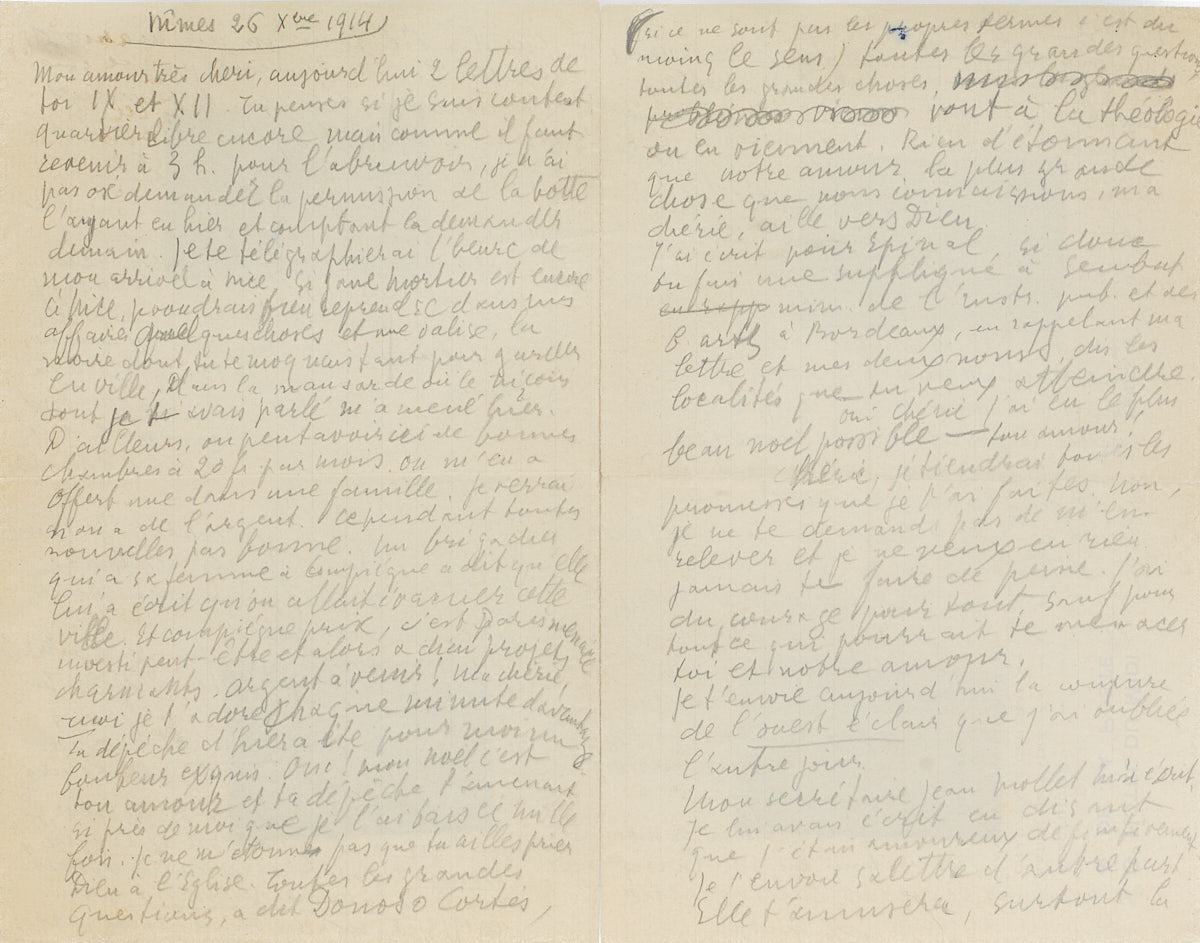
Our letter is the fifth sent since Lou’s departure, and the first written after Apollinaire received a reply to his earlier ones. In the letter of the 24th he had complained: “Why don’t you write? It is madness to leave me without news like this. My nerves are shattered because of it. In the end I shall get my leave for Nice, and it will be forty-eight hours, much of which will be spent travelling. I shall telegraph you shortly. But you, Lou, write to me, tell me what is wrong, what is happening, do not leave me anxious. This evening there were forty-two letters for me in the post. I seem to have broken the record of all the regiments in Nîmes, where there are currently 17,000 men. But among those forty-two letters, not one from my Lou — my Lou is forgetting me. My Lou does not realize she is making me unhappy.”
Happiness came two days later, and Apollinaire found his smile again: “Darling, today two letters from you […] You can imagine how pleased I am. Still free this afternoon, but since I must be back at 3 o’clock for the watering of the horses, I did not dare ask for overnight leave, having had it yesterday and planning to ask again tomorrow. I shall telegraph you the time of my arrival in Nice. […] one can get good rooms here for 20 francs a month”… But the news was “not good. A corporal whose wife is in Compiègne said she wrote that the town is about to be evacuated. And if Compiègne falls, Paris is threatened, perhaps besieged, and then farewell to our charming plans, to the money to come! My darling, I love you more with every passing minute. Your telegram yesterday was an exquisite joy to me. Yes! My Christmas is your love, and your telegram brought you so close to me that I kissed it a thousand times. I am not surprised that you go to pray to God at church. All great questions, said Donoso Cortés (if these are not his exact words, they are at least his meaning), all great questions, all great things, come from theology or lead back to it. It is no wonder that our love, the greatest thing we know, my darling, should lead toward God. […] Yes, darling, I have had the most beautiful Christmas possible — your love! Darling, I shall keep every promise I have made you. No, I do not ask you to raise me up, and I never wish to cause you any pain whatsoever. I have courage for everything, except for anything that might threaten you and our love.”
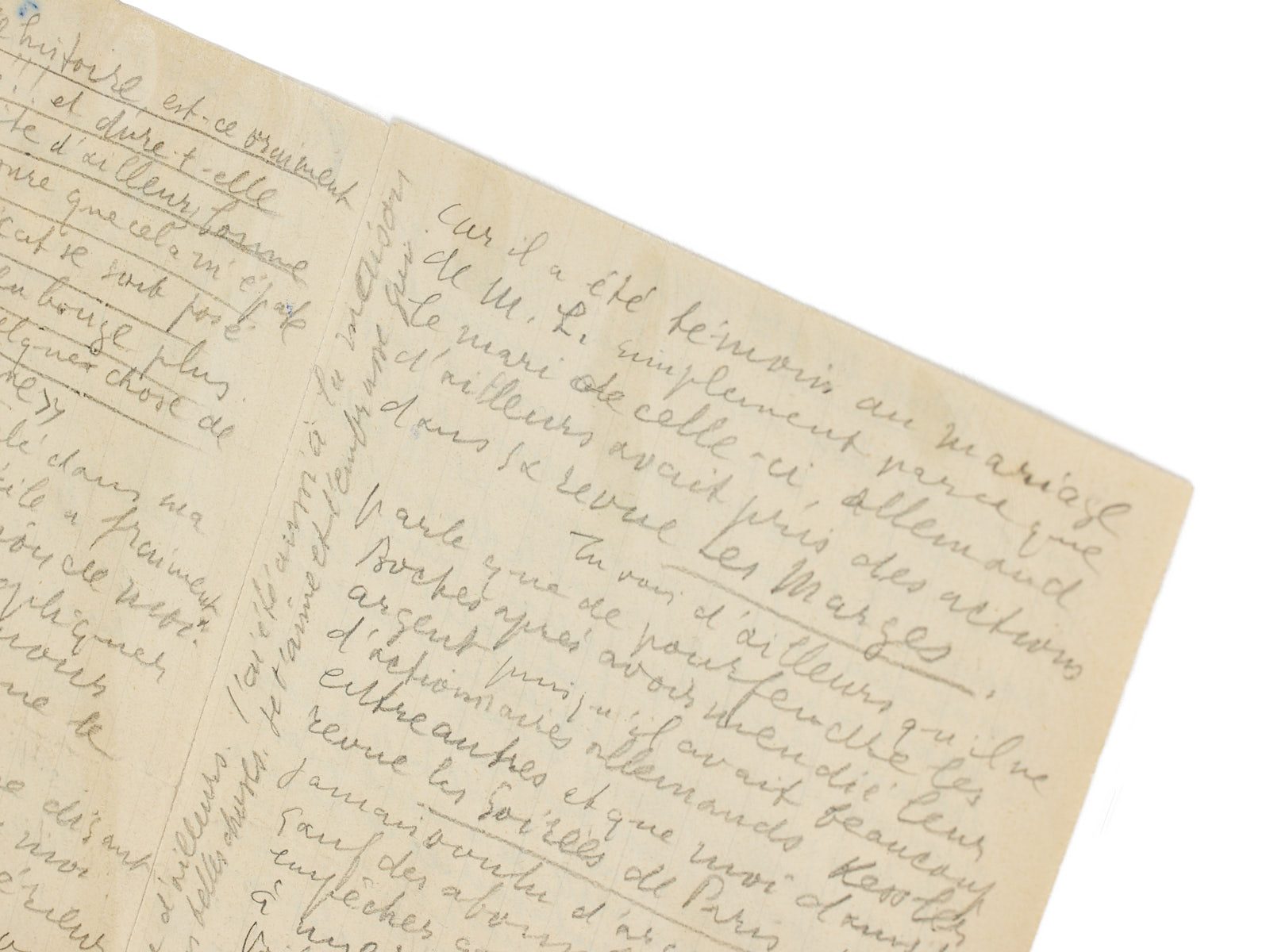
His secretary Jean Mollet had expressed skepticism about his love: “I laughed heartily and scolded him in my reply. This good fool really has a poor opinion of me. But I cannot explain to him the full strength of this love, which is for me greater than heaven, my darling.” He then speaks of Eugène Montfort, whose review Les Marges had been partly financed by the German husband of Marie Laurencin: “he speaks only of striking down the Boches after having begged for their money, since he had many German shareholders, Kessler among others, while I, in my review Les Soirées de Paris, never wanted German money, except from subscribers, since one cannot prevent anyone from subscribing to a review.” He adds that he visited the Maison Carrée and the museum of Nîmes, “to see the original portrait of Lucrezia Borgia, a reproduction of which illustrated my book La Rome des Borgia, published in 1913, which was very successful.” He closes: “I love you with all my strength, with all my soul, with all my heart, with all my being. It is bitterly cold. I kiss you everywhere and bite your lips. You bask like a lizard in the sun, beautiful and languid one.”
The two lovers saw each other again for the New Year, then at the end of January, and finally, briefly, in March. The ten days in Nîmes would remain the longest time they ever spent together.
The Poèmes à Lou were first published in 1947 by the Geneva publisher Pierre Cailler, under the title Ombre de mon amour.