


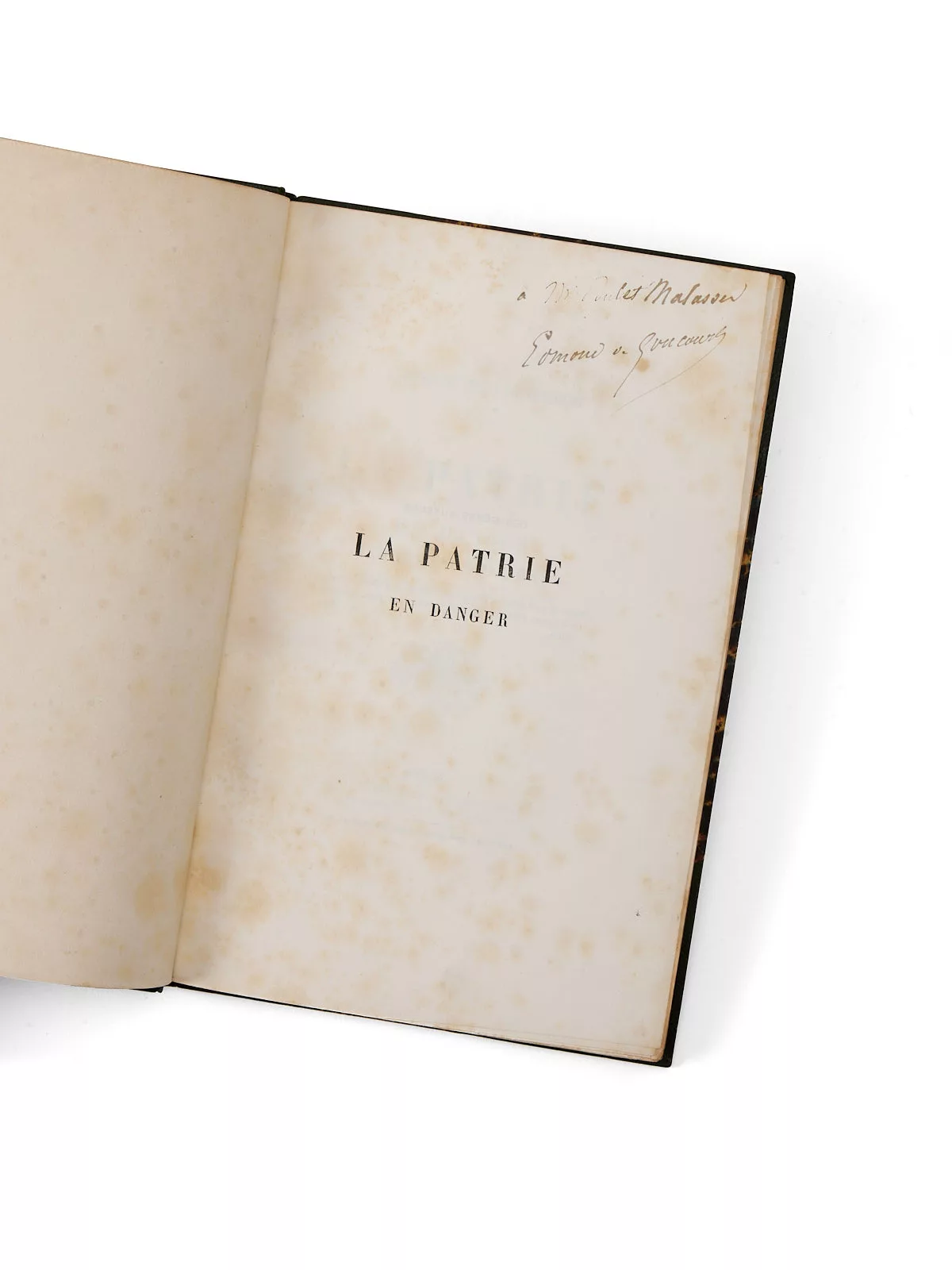
La Patrie en danger
One of 100 large octavo copies on vélin.
Signed presentation inscription: “à Poulet-Malassis, Edmond de Goncourt.”
1857. Les Hommes de lettres, the last theatrical work by the Goncourt brothers, was rejected by the Gymnase, then by the Vaudeville. Discouraged, the Goncourts temporarily gave up writing for the stage. But they had plans: on 27 December 1860, they mention their forthcoming “play about the Revolution,” which would become Blanche de la Rochedragon (later renamed La Patrie en danger), finally completed on 11 October 1867. On 26 December, they submitted the play to Thierry, at the Théâtre-Français. It was received “à correction,” that is, rejected by the reading committee, on 7 March 1868.
But the Goncourts were persistent: Mademoiselle de la Rochedragon was finally published in 1873, by Dentu; the play then took its definitive title, La Patrie en danger — a marquise de la Rochedragon having protested when the newspapers announced the play under its earlier name! “Rereading … La Patrie en Danger gave me an intense desire to see these works on stage. I am convinced that both would today enjoy a resounding success, owing as much to their literature as to the very great interest of the action.” (Guy de Maupassant, 18 July 1879). It would nevertheless take nearly ten years for this wish to be realized: it was only on 16 January 1889 that Léon Hennique and André Antoine read La Patrie en danger at the headquarters of Antoine’s Théâtre-Libre, 96 rue Blanche, where rehearsals had been taking place since 1 November 1887.
The first performance was given on 19 March by the Théâtre-Libre. In the preface to the 1879 collected edition, the one to which Maupassant refers, Edmond de Goncourt states that this new drama and La Patrie en danger together represent the result of a new theatrical approach, in which the technique of “heavy-handed devices,” “coups de théâtre” or plot “twists” was entirely abandoned in favor of a “historical documentation” that, according to the author, had the merit of never having been attempted before on stage.
The Poulet-Malassis copy does not appear in Les Goncourt dédicateurs, 650 ex-dono de Christian Galantaris.
A good copy despite some foxing.