

[Sous le soleil de Satan]
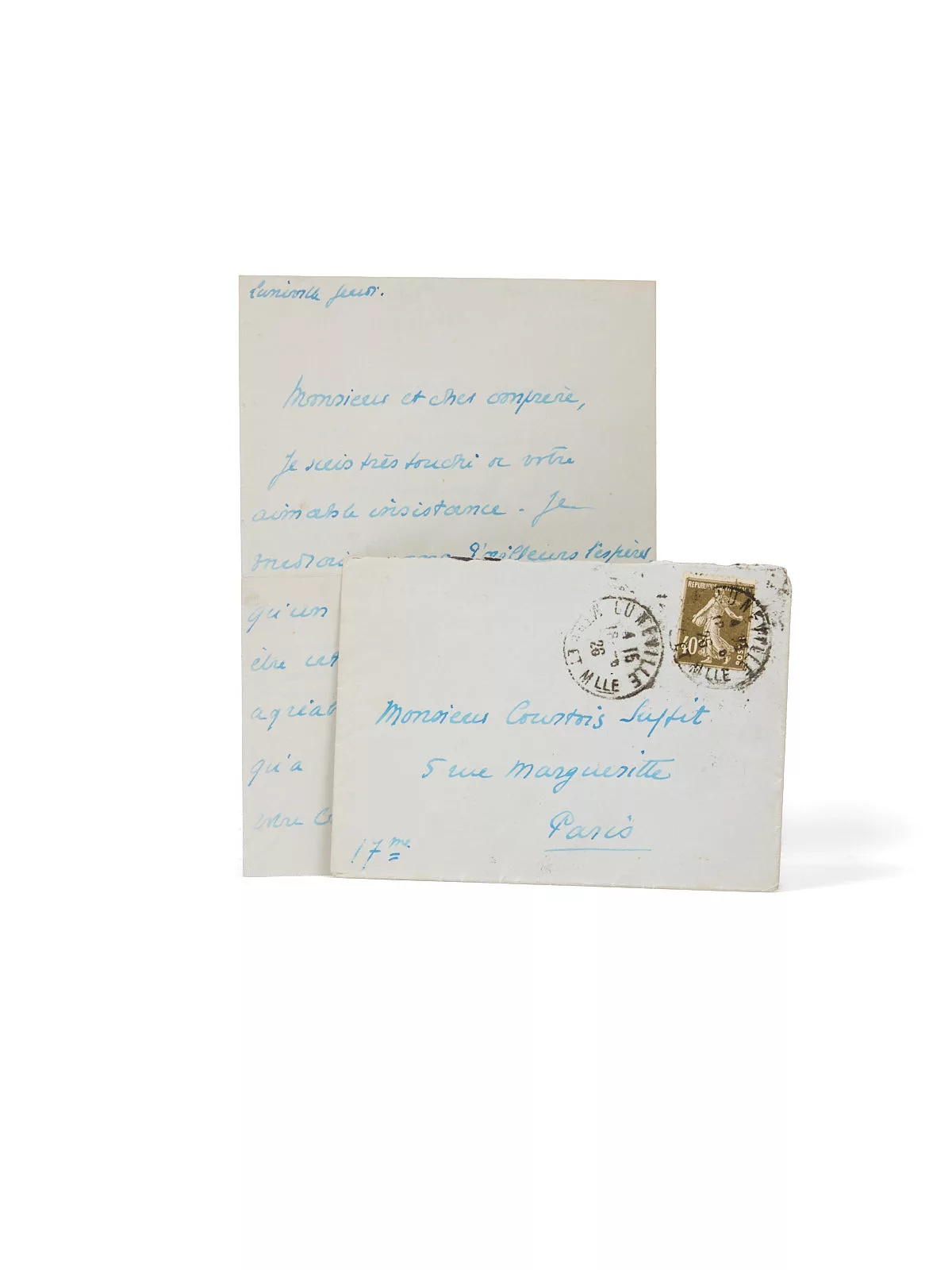
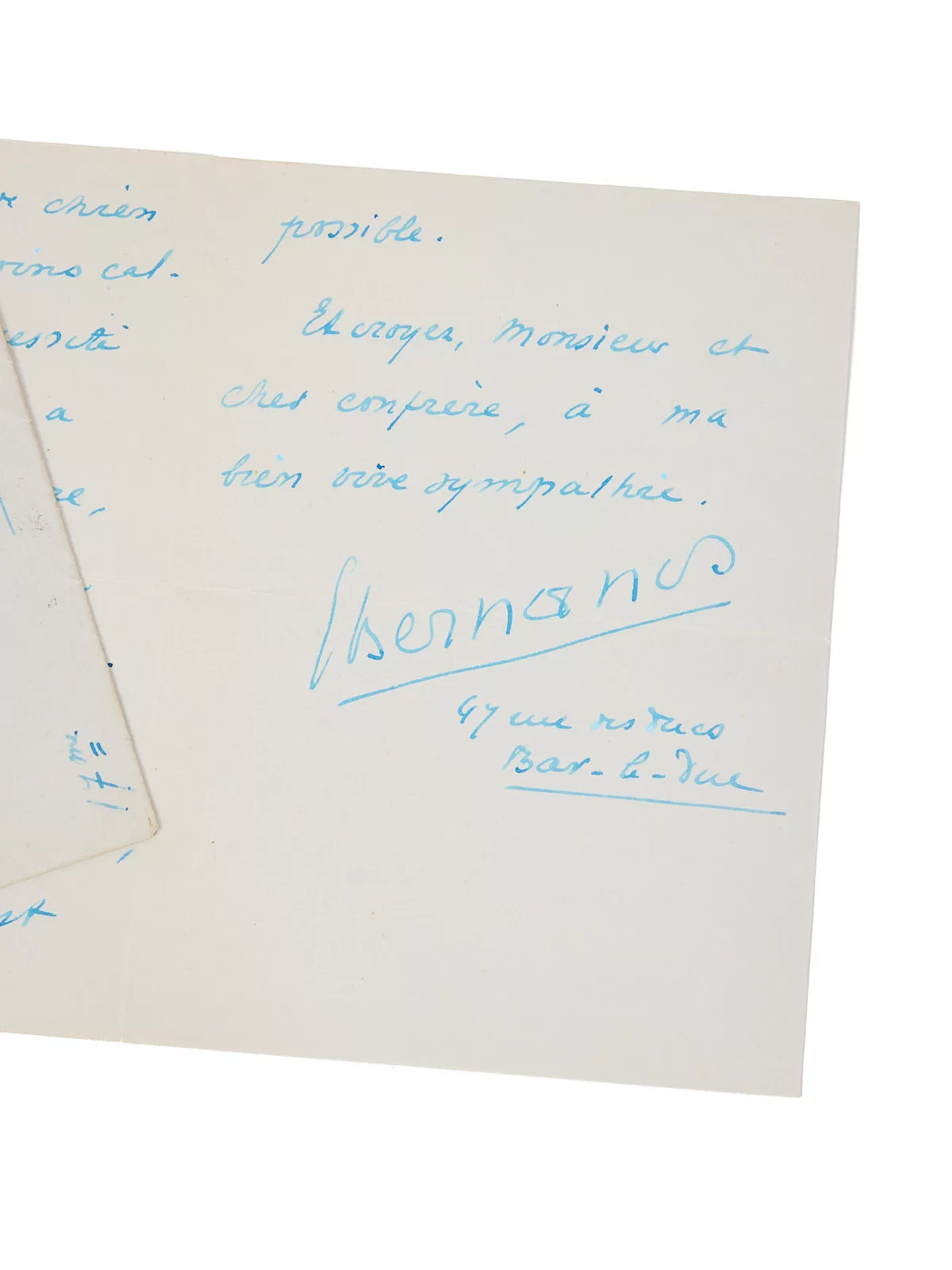
“Monsieur et cher confrère, Je suis très touché de votre aimable insistance. Je me doutais, sans d'ailleurs l'espérer, qu'un article de moi pouvait être utile à votre Revue, et agréable à vous-même, ainsi qu'à certains membres de votre conseil de rédaction envers lesquels j'ai une dette particulière de reconnaissance et d'admiration. Mais… mais à la veille de résilier mes fonctions d'inspecteur de la Nationale, je dois revoir les comptes de toutes mes agences. C'est un métier de chien, et même de chien savant – ou du moins calculateur. Triste nécessité pour moi qui, il y a quelques années encore, comptais sur mes doigts, comme tout le monde !… Accordez-moi donc un sursis de quelques semaines, si toutefois la chose est possible. Et croyez, Monsieur et cher confrère, à ma bien vive sympathie. G. Bernanos. 47 rue des Ducs, Bar-le-Duc.”
In 1919, on returning from a war that had profoundly marked him, Bernanos agreed to join the insurance company “La Nationale,” on the recommendation of his father-in-law Maurice Talbert, himself an insurer. In 1917 Bernanos had married Jehanne Talbert d’Arc — a direct descendant of Pierre d’Arc, brother of the saint — an accomplished athlete who would later be Suzanne Lenglen’s doubles partner and one of the best French tennis players of the 1920s.
His abilities quickly recognized at La Nationale, Bernanos was placed in charge of inspecting all the departments of eastern France, which he covered from Bar-le-Duc, where the family had settled. It was during his tours of the Grand Est that he wrote, in the evenings and at night, the future Sous le soleil de Satan: “Forced to earn my living by insuring people’s lives against their own, I spend most of my time in hotels or railway stations. A page here, a page there, amid pipe smoke or the innocent storm unleashed by card players under the impassive gaze of the cashier. When a book is torn out of oneself line by line in this way, one can be sure it is sincere; there was no leisure to compose it before a mirror” (letter to Frédéric Lefèvre, February 1925). Once the manuscript was finished, he sent it to Plon, where the chief reader, Jacques Maritain, demanded cuts — which the author refused. Against all expectations, the book was an immediate success, in a year that also saw the publication of Montherlant’s Les Bestiaires, Gide’s Les Faux-Monnayeurs and Malraux’s La Tentation de l’Occident.
Yielding to pressure from his publisher and those around him, Bernanos then joyfully abandoned his career as an insurer: “I no longer have any interest in insuring the lives of my contemporaries, which, besides, are not worth the trouble.”
This letter confirms his imminent departure from La Nationale, and postpones delivery of an article for the journal to which Dr. Maurice Courtois-Suffit regularly contributed: La Revue européenne, distributed by Librairie Kra.