

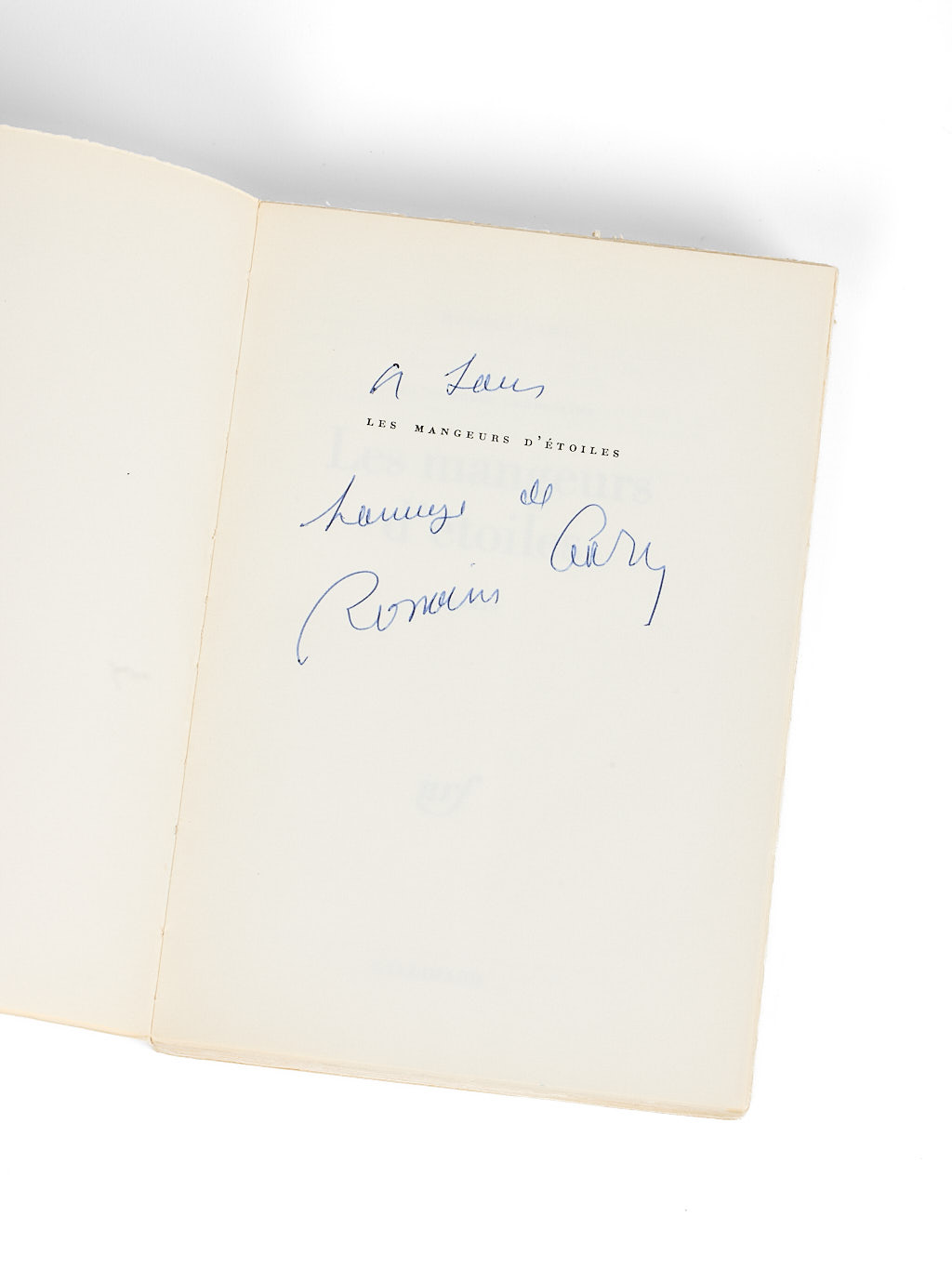

Les Mangeurs d’étoiles
One of 60 copies reserved for the “Club de l'édition originale” on pur fil paper (no. 24).
Signed presentation inscription: “à tous [Les Mangeurs d'étoiles], hommage de Romain Gary.”
“Star eaters” was the nickname given to Native Americans of the southern hemisphere who consumed hallucinogenic plants: Gary applies it here to the dream and irresistible rise of a Cujon Indian, Al Mayo, dictator of a Caribbean republic, in search of a pact with the devil. It is a modern transposition of Goethe’s Faust, with the United States cast in the role of Mephistopheles.
Gary was particularly well placed to write it. The novel’s geographical setting came to him when he was appointed French consul general in Los Angeles in 1961. Sent on a temporary mission, he spent three months in La Paz, Bolivia, which had had no ambassador for six months, and “this vacancy displeased the dictator of the moment” (M. Anissimov, Romain Gary le caméléon, Denoël, 2004, p. 284). He absorbed the South American atmosphere there, which also gave rise to two short stories: “Les oiseaux vont mourir au Pérou” and “La plus vieille histoire du monde.”
In an interview given to Pierre Desgraupes on 2 November 1966, Gary explained what he had sought to show, summing it up thus: “Goethe frankly lied. Faust’s true tragedy is not that he sold his soul to the Devil, but that there is no Devil to buy it from you.” The title forms the first part of La Comédie américaine, completed in 1969 by Adieu Gary Cooper: both had first been published in English, under the titles The Talent Scout in 1961 and The Ski Bum in 1965.
As with Lady L. three years earlier, the French translation was prepared by Jean Rosenthal with the author’s assistance.
When the novel was published in London in 1961, it was presented as a translation by a certain John Markham Beach, who was also said to have translated La Promesse de l’aube (Promise at Dawn) into English — one more pseudonym to Gary’s credit!
A fine copy.