

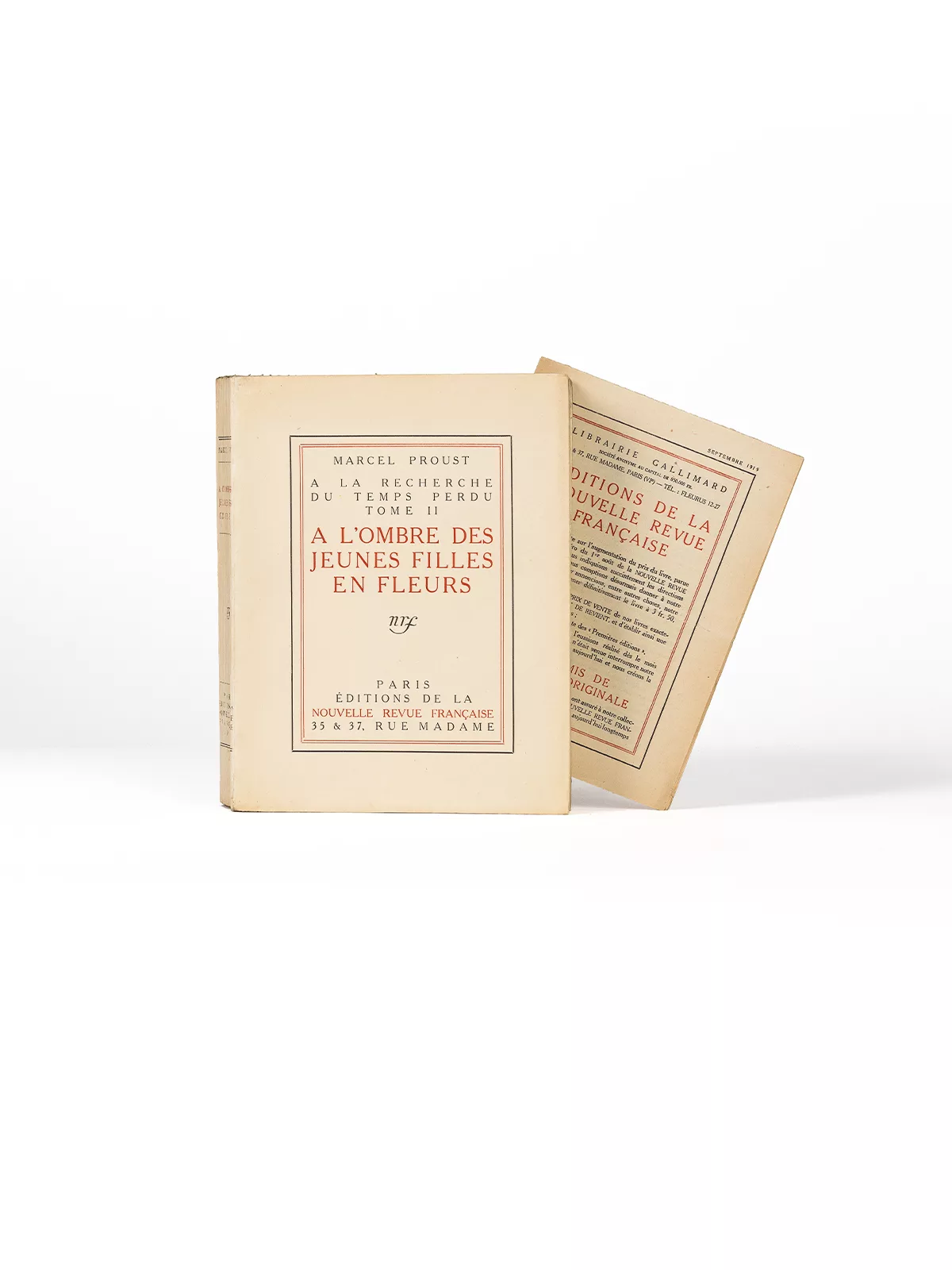
À l’ombre des jeunes filles en fleurs
One of 128 réimposé copies on vergé Lafuma-Navarre paper, this copy no. 88. The only deluxe paper issue of À l'ombre des jeunes filles en fleurs, the first Prix Goncourt awarded to Gallimard.
Accompanied by the rare subscription bulletin of the Éditions de la NRF.
Prix Goncourt 1919. Since 1916, Gaston Gallimard had officially been Marcel Proust’s new publisher.
From October 1917, Gallimard wished to print the forthcoming volumes of À la recherche du temps perdu, and to that end bought back from Bernard Grasset the roughly six hundred surviving copies of his stock on the rue des Saint-Pères, which were prepared for resale under an Éditions de la NRF cover as early as the winter of 1917. A new “house” typesetting was then planned, with a few amendments made necessary by later developments in the work, but printing was repeatedly delayed by Proust’s endless corrections, which in turn delayed the publication of volume II of the series, À l’ombre des jeunes filles en fleurs. The volume was ready by the autumn of 1918, and a first ordinary printing of 500 copies with no edition statement was produced, followed by six further printings bearing statements from “second” to “seventh edition.” These carry the imprint date of 28 November 1918, and these copies announce 70 réimposé copies, printed separately on Lafuma de Voiron pur fil paper — copies that would, in the end, never be printed (64 plus six hors commerce). They were never printed.
The reason was that Gaston Gallimard wanted to print, at the same time, the new edition of Du côté de chez Swann, which would not be ready until the very end of May. Delays lengthened because, since the spring, the publishing house directed by Gallimard was undergoing major upheaval: back from a tour of the United States with the Vieux-Colombier company, Gallimard wanted to give the NRF fresh momentum and to attach his own name more closely to the firm, deciding to create the “Librairie Gallimard,” a company combining the activities of the review and the publishing house. A bookshop was to open on the boulevard Raspail (directed from 1921 by Roland Saucier), and a printing works was acquired — the one that, since 1911, had printed the majority of its publications: the Imprimerie Sainte-Catherine, in Bruges.
Proust, awaiting the long-anticipated double publication, expressed his frustration in a letter sent around 9 June to Gustave Tronche, the NRF’s administrator: he complained of the harm done to him by the repeated delays, and of his despair that readers would once again have to make the pilgrimage to the rue Madame to obtain his books.
In the 1 August issue of La NRF, the Librairie Gallimard announced its intention to regulate the sale of “first editions,” on the model established since 1911 with the “Bibliophiles de la Nouvelle Revue française” collection. This was accomplished the following month, when Gallimard issued a two-leaf insert bound into La NRF announcing the creation of the “Amis de l’édition originale” collection, intended for readers who wished to own, in first edition, the works the firm published. The insert explained that first editions, however sought after, were usually distinguishable from later printings only by the absence of a printing number on the cover, and that it had therefore seemed necessary to make the originality of “our” editions materially recognizable. The specifics of the collection — print run, paper, price — followed, together with a subscription form “valid for one year.”
This founding document of the “new-style” deluxe printings is a historically important record, allowing the precise dating of the introduction of these titles. From the spring of 1919, Gaston Gallimard was refining what would become the standard réimposé printings, reserved for the “Bibliophiles de la N.R.F.” on subscription. And what better way to inaugurate this new standard than with Marcel Proust? It was too late for Pastiches et mélanges, whose 70 réimposé copies had already been printed in February. But for the two volumes of À la recherche du temps perdu, there was still time: the 70 copies of Jeunes filles and of Swann had not yet been printed.
A new — and unique — typesetting was accordingly undertaken, the famous “in-quarto Tellière”: Du côté de chez Swann would bear the imprint date of 14 June. À l’ombre des jeunes filles en fleurs, however, kept the original imprint date (8 November 1918): only the covers betray the true date, bearing the year 1919, produced alongside Swann.
These two volumes were to spearhead this editorial and commercial renewal. They were in fact the first two to benefit from the “new-formula” réimposé printings, that of Du côté de chez Swann effectively becoming the first réimposé printing in the NRF’s new history. Both volumes went on sale the following week, at the time the Librairie Gallimard opened, alongside the ordinary editions, printed in runs of 3,300 (Du côté de chez Swann) and 3,000 copies (À l’ombre des jeunes filles en fleurs), which had been waiting since November 1918.
It was a winning move for the house of Gallimard: on 10 December 1919, Marcel Proust received the seventeenth Prix Goncourt for À l’ombre des jeunes filles en fleurs, the second volume of À la recherche du temps perdu, beating the great favorite Roland Dorgelès. On the strength of this success, further printings followed from 16 December 1919.
A very fine copy in wrappers of the first Prix Goncourt from Éditions Gallimard, in this réimposé printing reserved for subscribers. Few individual copies survive, as many were later incorporated into the réimposé sets of À la recherche du temps perdu.
Accompanied by the two-leaf insert dated September 1919, officially launching subscriptions for the “Amis de l’édition originale.” It also announces the forthcoming titles of À la recherche du temps perdu, and informs subscribers of an imminent change in the status of the first editions and of the creation of the “Amis de l’édition originale,” in addition to the “Bibliophiles de la NRF,” effective from 1 September 1919.
The remaining volumes of the Recherche would be printed on Lafuma-Navarre pur fil laid paper (133-133-108-112-128-129 réimposé copies), with, from Du côté de Guermantes onward, roman-numeral numbering, apparently reserved for subscription copies (whether nominative or not).