

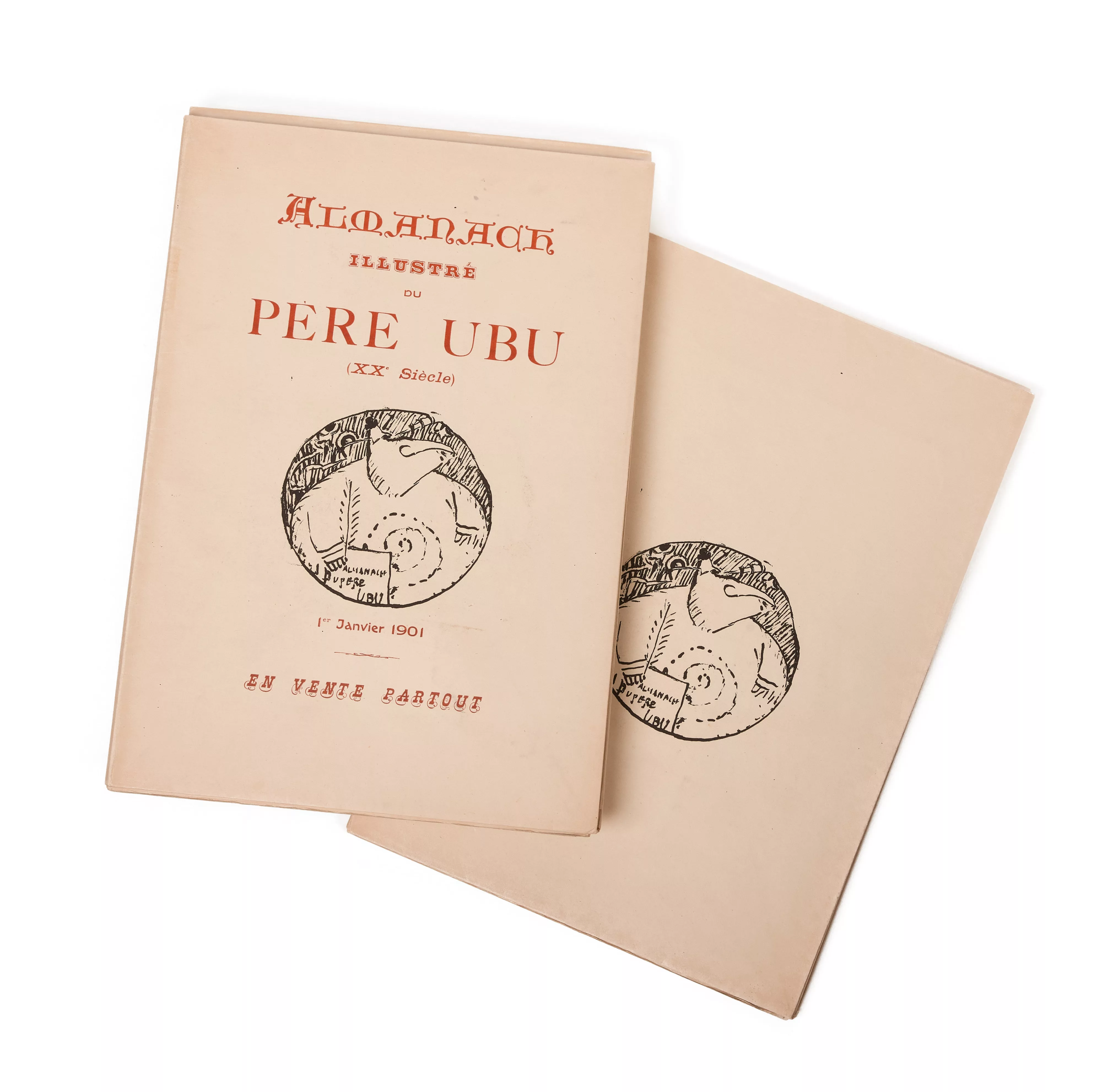
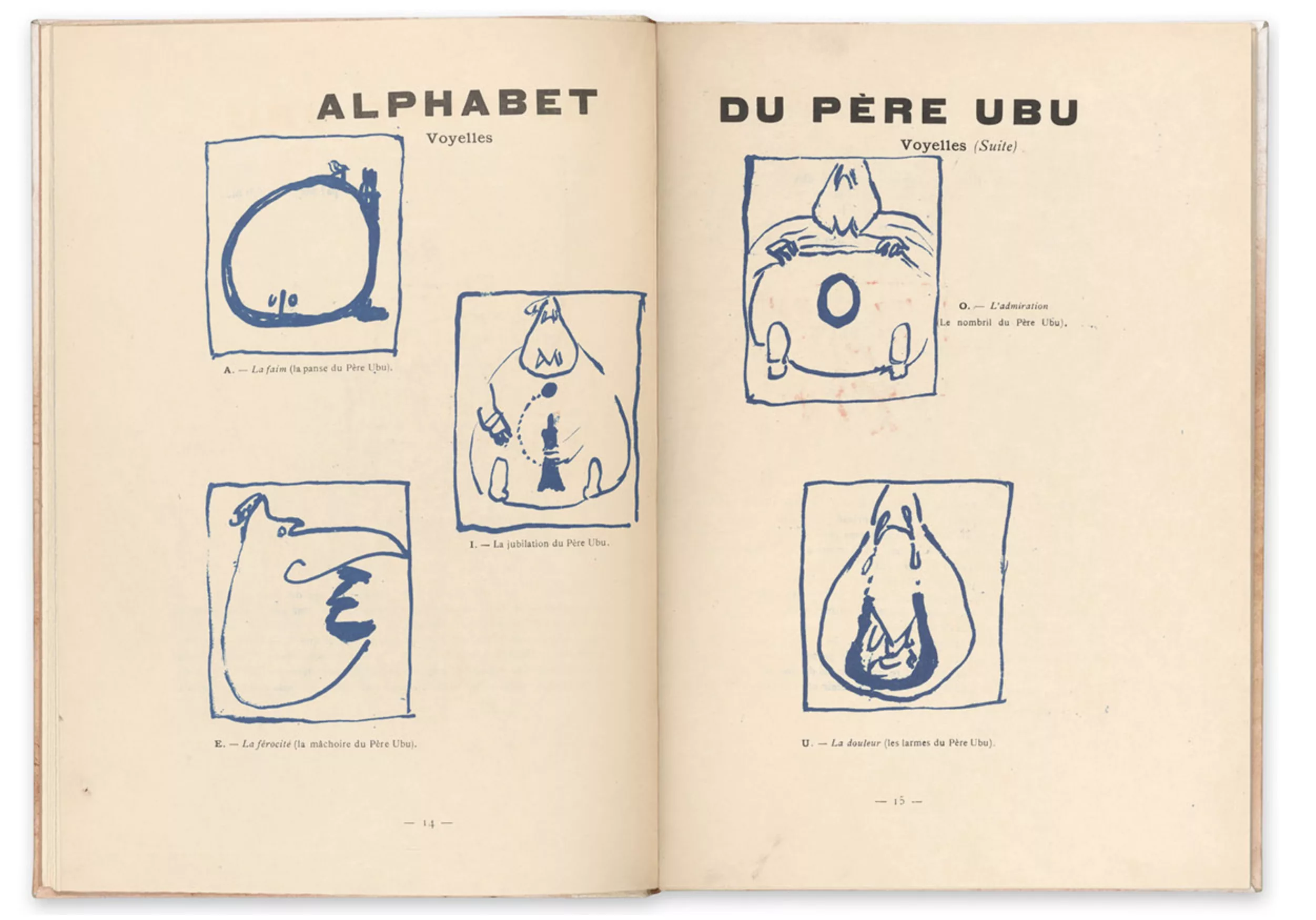
Illustrated with 83 lithographs printed in bistre, blue and black (for the cover) by Pierre Bonnard.
One of the first 25 copies on Imperial Japan paper, in a special cover, the only copies to include the suite in black of the 83 lithographs, before letters, also printed on Imperial Japan paper.
Conceived as a genuine almanac, the book opens with the calendar for the new year, entirely reinvented by Jarry: feast days and the names of saints are diverted according to Père Ubu’s whims. Printed on January 1, 1901, it ranks among the very first books of the twentieth century, if not the first.
This “great almanac,” so nicknamed to distinguish it from its predecessor, published at the end of 1898, marks a singular moment in the Ubu saga. For the first time, one of Jarry’s creations took the form of a deluxe illustrated book, thanks to the meeting of three figures: the poet, the painter Pierre Bonnard, and the dealer Ambroise Vollard.
The project took shape in the basement of Vollard’s gallery, where he was then beginning his activity as a publisher of illustrated books, intended to bring literature together with the research of contemporary artists. The previous year he had published Verlaine’s Parallèlement, sumptuously illustrated by Bonnard, whose sensual lithographs had made that volume one of the milestones of the modern illustrated book.
For the Almanach, Bonnard deployed an illustration as abundant as it is free, accompanying and extending Jarry’s burlesque universe. His figures, silhouettes and comical scenes fully participate in the invention of a world ruled entirely by the absurd, satire and fantasy. The text itself is a collective work: Fagus contributed to it, as did Claude Terrasse, composer notably of the music for Tatane and the Chanson pour faire rougir les nègres et glorifier le Père Ubu.
Vollard, who told the story of this publication in his Souvenirs d’un marchand de tableaux, did not dare to put his name on the title page. He contented himself with placing, at the end of the volume, advertisements for his own publications, ahead of those for Jarry’s works published by the Mercure de France and the Revue blanche.
The hoped-for commercial success never came. The print run, which apparently did not exceed a thousand copies, remained largely unsold. On 12 February 1902, Jarry wrote playfully to Claude Terrasse: “Palotin Sylvain Lévi, professor at the Collège de France, approached me to obtain the almanac: I sent him one as an outright gift, and so now have only seven hundred and ninety-nine… and a few more.” (Œuvres complètes, I, p. 1077.)
A copy in perfect condition, as issued.
Terrasse, Pierre Bonnard Illustrator, New York, 1988, no. 10; Keller, Sammlung Vollard, Winterthur Kunstmuseum, 1949, no. 9; Johnson, Ambroise Vollard, éditeur, Museum of Modern Art, 1977, no. 167; Ives et al., Pierre Bonnard: The Graphic Art, Metropolitan Museum of Art, 1990, p. 162, fig. 220–221; Expojarrysition, no. 289.