

La Bible d’Amiens
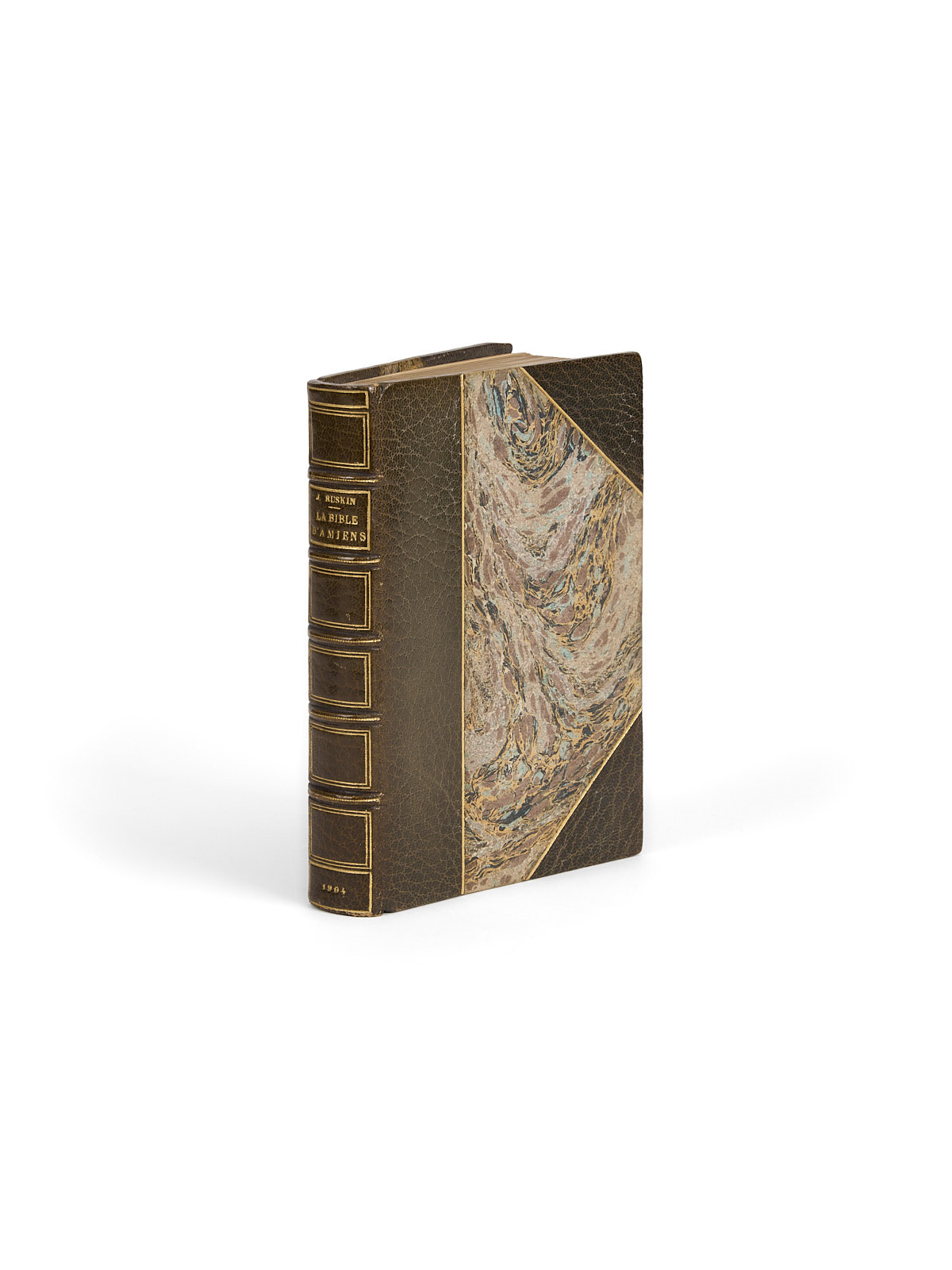
Copy of the first printing and first issue, numbered on the press, without statement (no. 555).
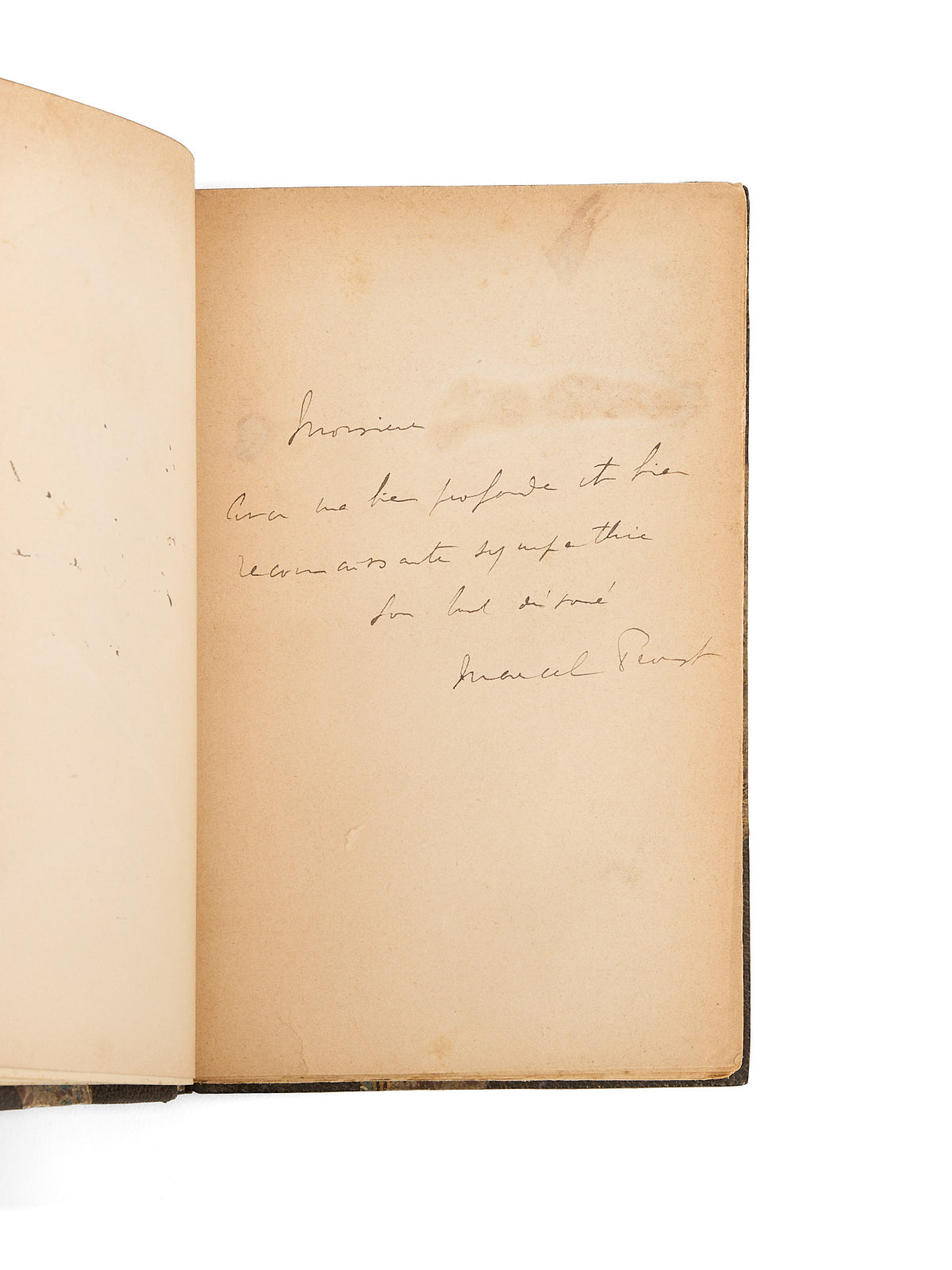
Signed presentation inscription: “À Monsieur [name of dedicatee cut off], avec ma bien profonde et bien reconnaissante sympathie, son tout dévoué, Marcel Proust.”
Marcel Proust began reading Ruskin in the autumn of 1899, upon his return from Évian-les-Bains, immersing himself in the work of the man he called “that great man” after discovering the chapter entitled “The Lamp of Memory” in The Seven Lamps of Architecture. A few months later, he learned of the critic’s death from Le Figaro of 21 January 1900 and wrote immediately to Marie Nordlinger, an English friend from Manchester and cousin of Reynaldo Hahn, expressing both his sorrow and his wish to see Ruskin’s work endure. He then began preparing several tributes to Ruskin in the form of obituary articles and notes, which, considerably expanded, would become the surrounding texts of his future translation of La Bible d’Amiens.
It was an arduous task, since Proust barely knew English: his mother produced a literal word-for-word version, which he reworked with the advice of Marie Nordlinger and Robert d’Humières, Kipling’s translator. After four long years of painstaking labor and personal reflection on art and creation, Proust completed his preface, translation and notes, some of which run to several pages. The book carries a dedication to Adrien Proust rather than the one originally intended for Reynaldo Hahn: “à la mémoire de MON PÈRE, frappé en travaillant le 24 novembre 1903, mort le 26 novembre, cette traduction est dédiée.” He apologized for this when he gave Hahn a copy, explaining in a personal dedication that “his little Papa” had so wished to see the book appear that he preferred to withdraw the dedication and offer it to him instead. Proust would nonetheless dedicate to Hahn the second Ruskin text he translated three years later, Les Sésames et les Lys.
Only two extracts appeared in periodical form, in February and March 1903, a year before publication in book form, in the Prince de Brancovan’s La Renaissance latine. To Brancovan, who had mocked his poor command of English, Proust replied that his translation, thanks not to any talent — which he claimed to lack entirely — but to his boundless conscientiousness, would be a translation unlike almost any other, a true reconstruction: after four years of work he knew La Bible d’Amiens entirely by heart, and it had reached for him a degree of complete assimilation and absolute transparency.
Only seven copies were printed on deluxe paper.
This copy was probably bound by the bookseller Ronald Davis in the 1920s–1930s, when he had an entire set of Proust’s works bound uniformly (Christie’s, London, 2007, lot 133), including a copy of Swann and a Hollande-paper copy of La Bible d’Amiens.