


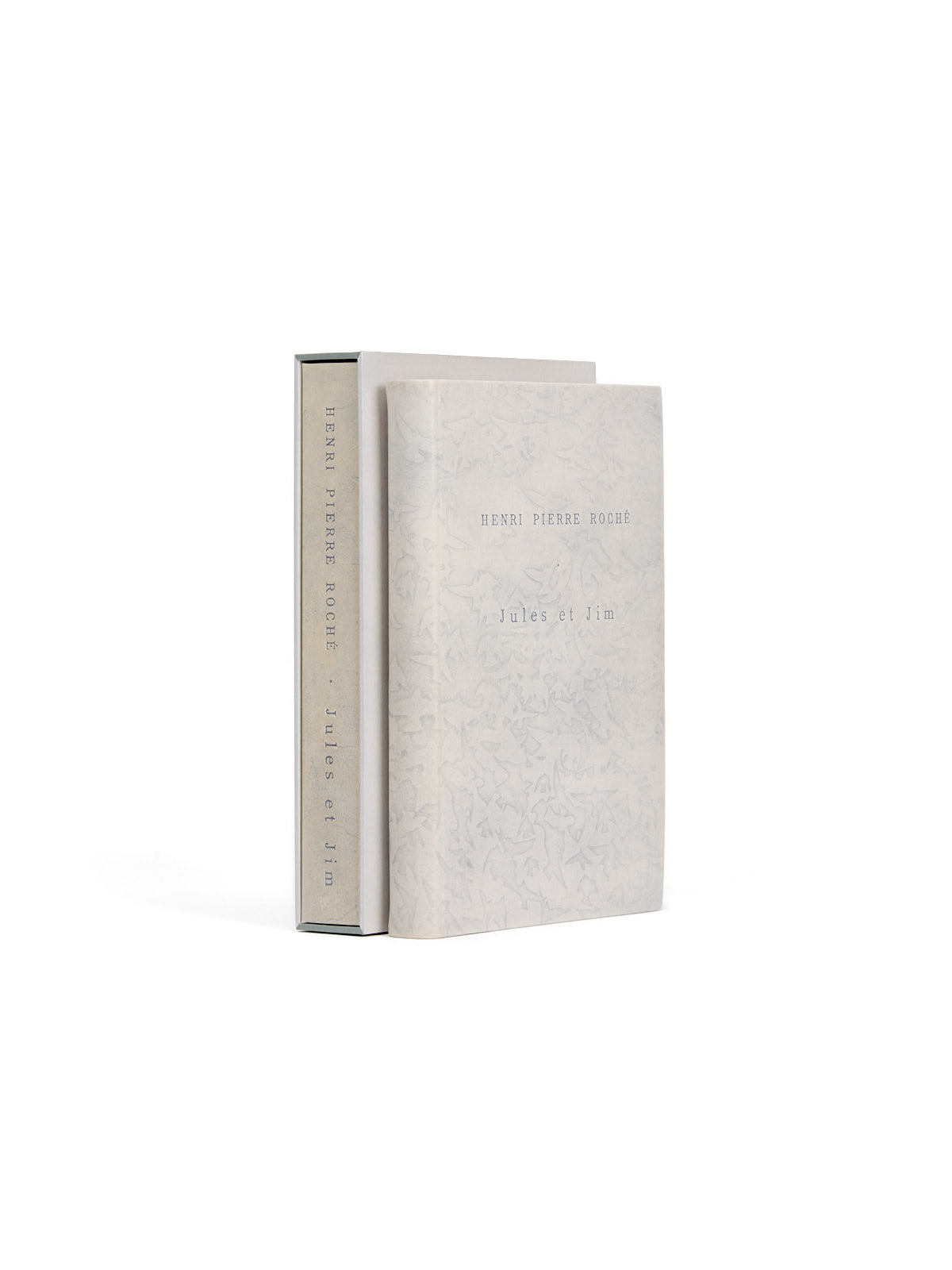
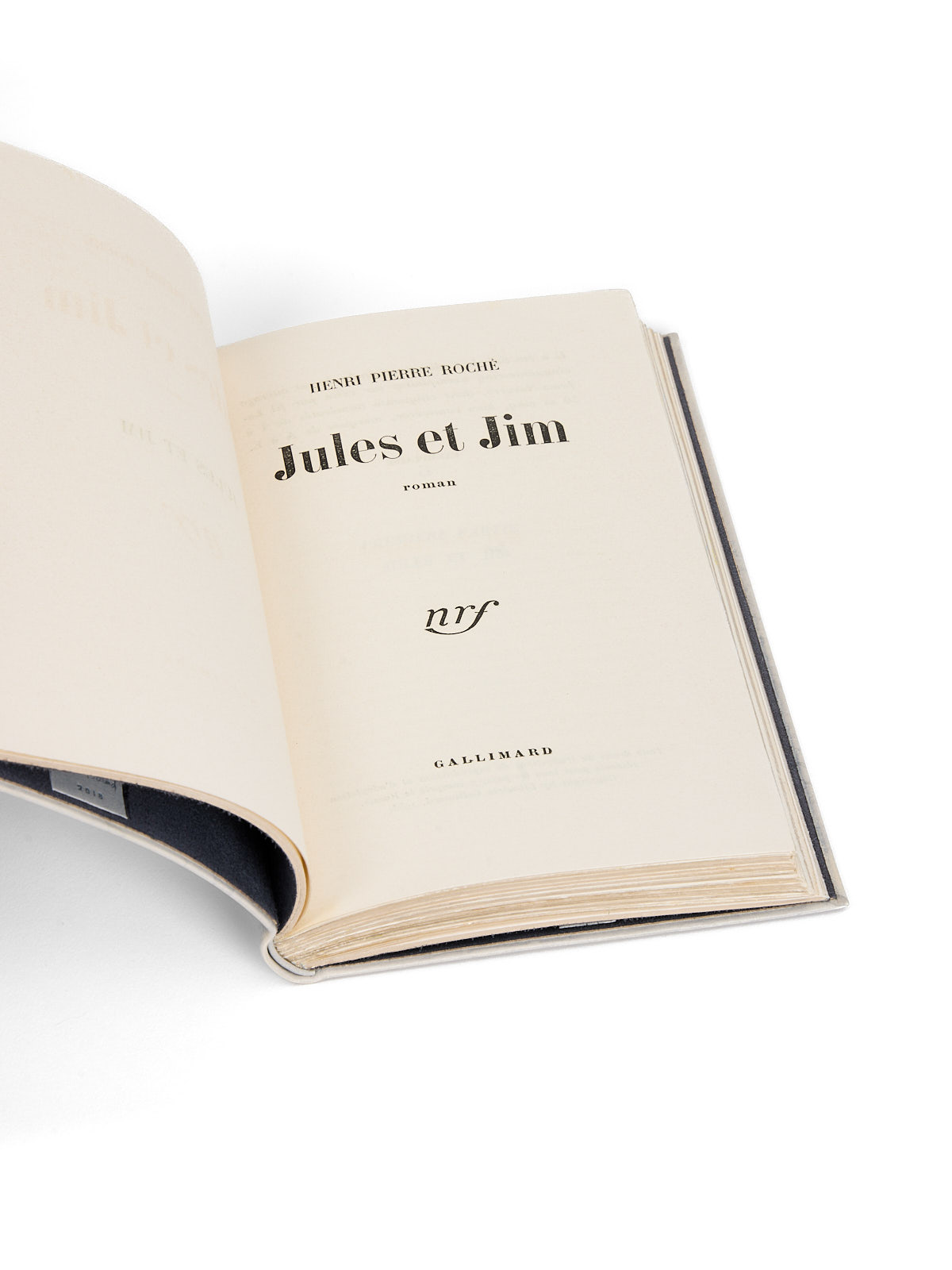

Jules et Jim
One of 55 copies on vélin pur fil (no. 6).
A remarkable example of a first novel written at the age of seventy-four, Jules et Jim inspired François Truffaut’s celebrated film, and Truffaut would later also adapt Les Deux Anglaises et le continent. “I can say that reading Jules et Jim in 1953, the first novel of a seventy-four-year-old man, determined my vocation as a filmmaker. I was twenty-one and working as a film critic. I fell in love with the book at once and thought: if I ever manage to make films, I will film Jules et Jim. I met the author shortly afterward, and he was delighted by the idea of a connection with cinema. In early 1961, I felt the time had come to make that old dream real. I tried to remain faithful to this beautiful book, which Gallimard had described as ‘a pure love between three people.’” Before being enshrined in the pantheon of French cinema, the film narrowly avoided an outright ban for alleged immorality, and was released in France restricted to viewers over eighteen.
Jules et Jim tells the famous story of a love triangle: Jules, a German-Jewish poet living in Paris before the First World War, meets Jim, a French poet who becomes his inseparable friend. Together they pursue various romantic conquests, until Jules marries Kathe, also German and visiting France on a cultural trip — though Jules’s love for Kathe only truly functions when completed by Jim’s. A foundational text of polyamory, the novel is largely autobiographical: Roché and his real-life counterpart met in Paris while studying together. Henri-Pierre Roché recounts the story of their friendship and loves between France and Germany, far removed from the upheavals of the Great War. Jim is Roché himself, or nearly so; Jules and Kathe are directly inspired by the Austrian writer Franz Hessel and Helen Grund (a Berliner, daughter of a Prussian Protestant banker) — the parents of Stéphane Hessel.
The story’s roots go back further still. Henri-Pierre Roché, a notorious heartbreaker, painter, writer and art dealer, met Marcel Duchamp in 1916. In Paris, Roché had acted as patron to the women artists he seduced, frequented the Bateau-Lavoir circle in Montmartre, before being sent to the United States on a mission for the French High Commission tasked with encouraging America’s entry into the war. It was there that he met Marcel Duchamp, then the darling of New York’s elite. Duchamp had just met Beatrice Wood, on 27 September 1916, for whom he immediately developed a strong attraction — which did not stop him from introducing her to Roché, who became the young woman’s first lover and initiator, all while officially remaining with Duchamp. Roché almost certainly drew on this strange Franco-American trio when writing his novel, as he did on many other episodes from his youth: during his studies in Paris between 1898 and 1900, “Hachep,” as Duchamp called him, led “a double life in which he systematically buried his bachelor existence through the cunning use of matrimonial advertisements […] and various emotional manipulations that would remain a constant throughout his life […]. The experience was destabilizing enough that in March his mother sent him for several weeks to take the waters at the Sonnenberg hydrotherapy institute in Carspach, Alsace.”