




Album du repérage
One of 10 deluxe copies on Rives paper (no. 6), signed, with an original watercolor by Dezeuze.
The edition is limited to 335 copies: 10 deluxe copies on Rives paper, 100 copies on Vidalon paper and 225 on Bouffant paper.
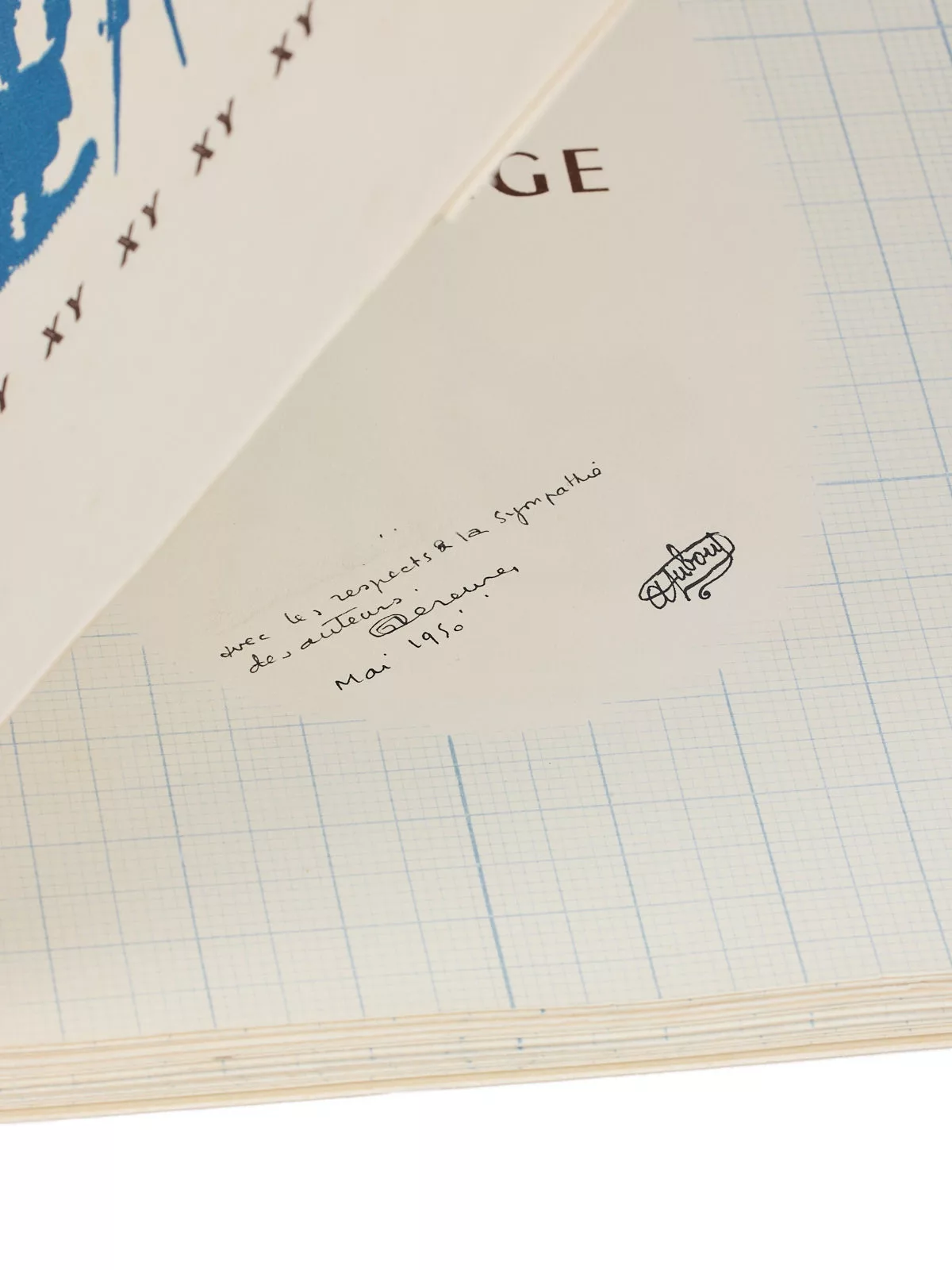
Signed presentation inscription: “[dedicatee's name erased] avec les respects & la sympathie des auteurs, Dezeuze, mai 1950,” countersigned by Albert Dubout.
A rare album conceived and published by the author Georges Dezeuze, with a preface by Francis Ambrière and texts by Poulain, Dezeuze and Quencez. It was created for veterans of the 6th regiment of the G.A.A. (Groupe autonome d’artillerie), the principal French regiment specializing in artillery spotting.
Enemy artillery was located from its own gunfire, using two complementary techniques developed simultaneously from the First World War onward: sound ranging and ground observation. Spotting thus became an essential tool of artillery intelligence. The first such group was created in 1921 and took the name 6th GAA in 1924; it concentrated all the personnel and equipment of this “new weapon” and survived until the Second World War — sixteen years, during which it was based at the Sully barracks in Saint-Cloud. It was there that Dubout did his military service, in the late 1920s.
After the war, the painter Georges Dezeuze — who had served in the same class as Dubout — conceived the idea of compiling an album of drawings by former members of the regiment, and called upon all his fellow veterans who had served between 1924 and 1942. Francis Ambrière, for instance, joined the regiment in September 1937 as a reserve sergeant. His novel Les Grandes Vacances, awarded the Prix Goncourt for 1940 (given in 1946), would later revisit this period.
Dubout’s contributions — all in Indian ink, including the one used for the cover — are recorded in L’Œuvre intégral de Dubout (IV, pp. 294–295).