

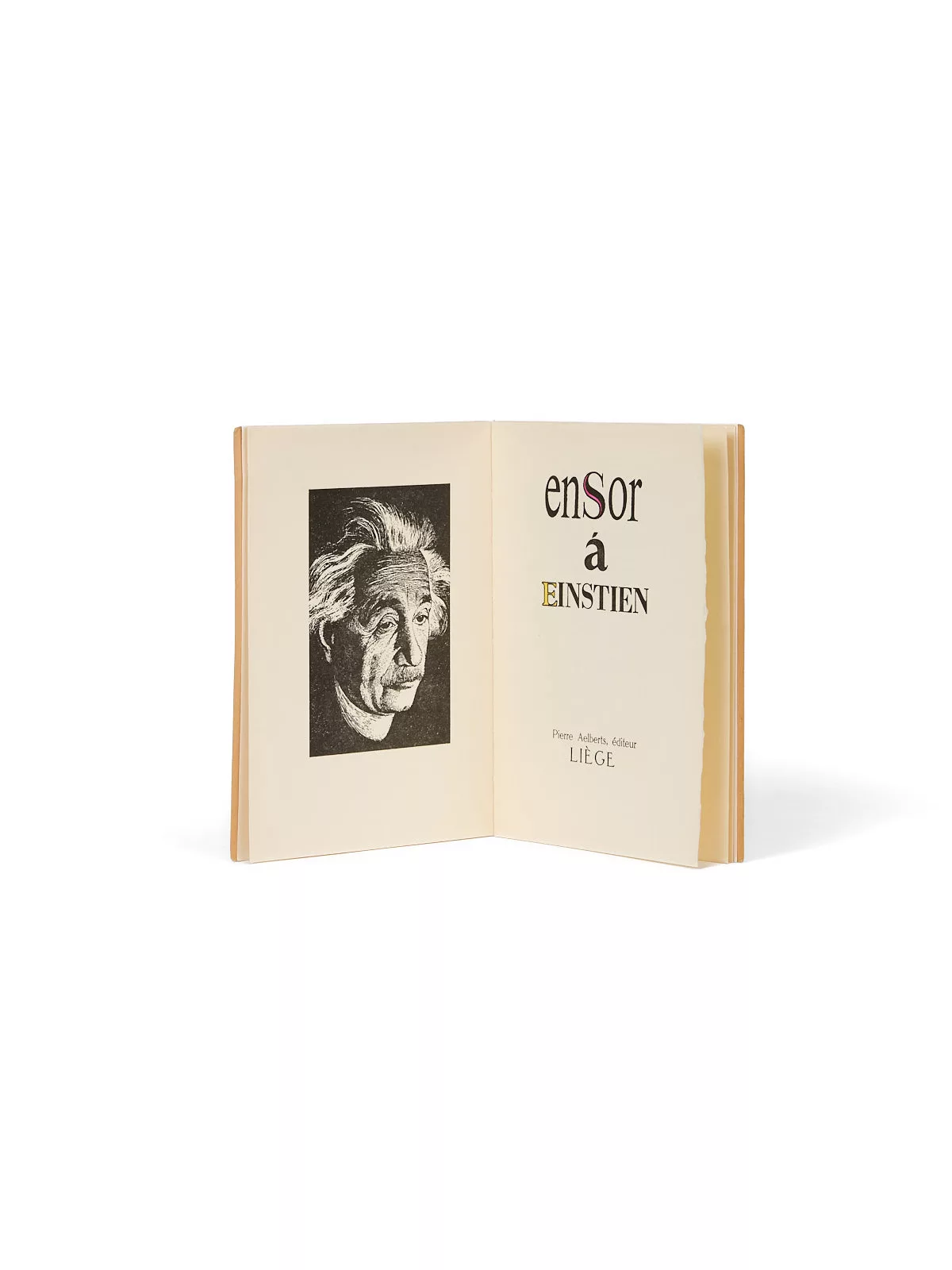
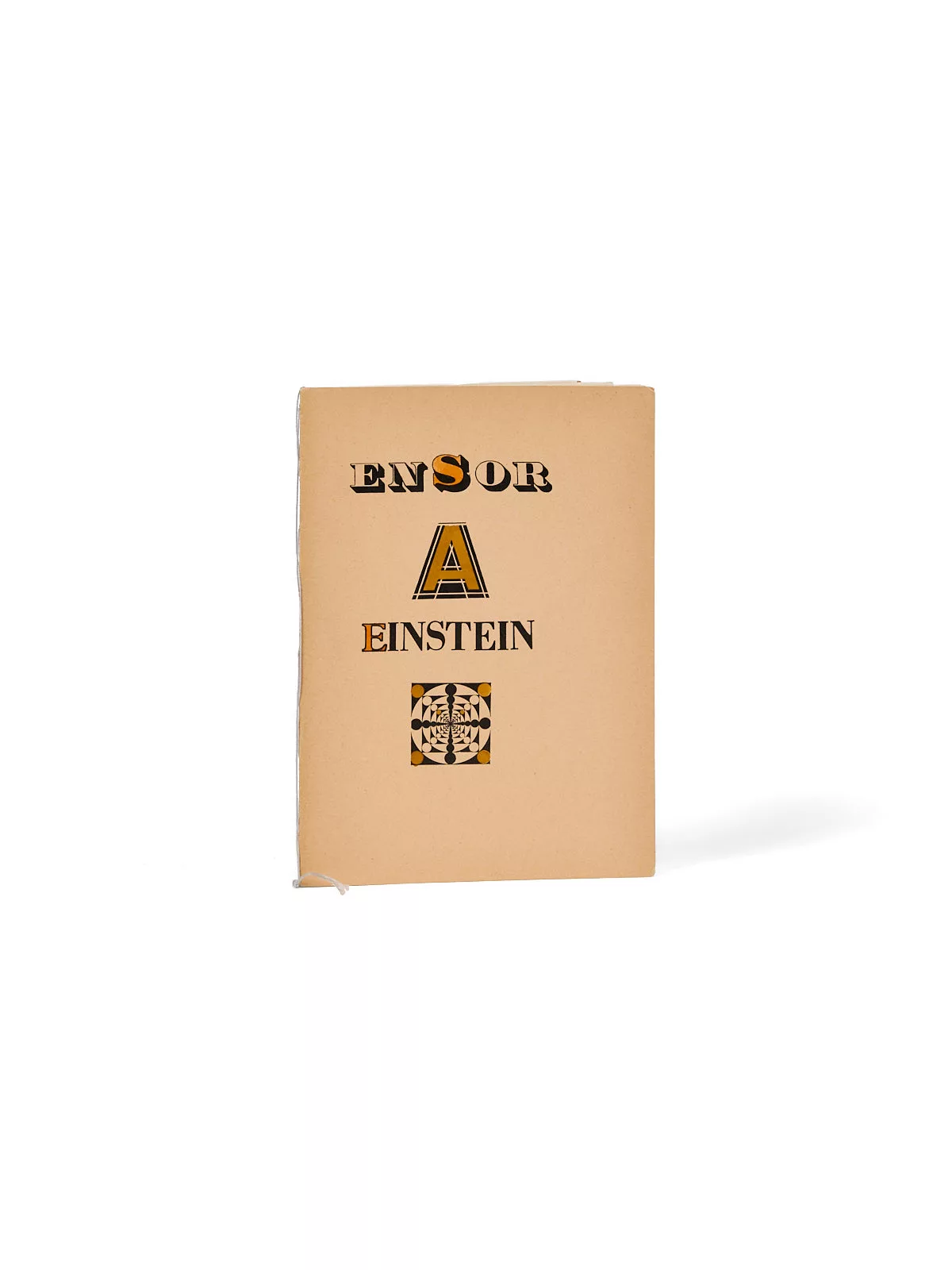
Ensor à Einstein
One of 11 deluxe copies on hollande, this copy no. 5.
When Hitler seized power in 1933, Albert Einstein was in New York teaching his theory of relativity. His Jewish origins prevented him from returning to his native country, even though he had been appointed to the University of Berlin. The Nazis had already ransacked his house, and in May 1933 his books would feed the flames of their book-burnings. A convinced pacifist, the Nobel laureate in Physics did not spare his criticism of the new regime from Pasadena, where he was then teaching.
At the end of March, sailing back to Europe aboard the SS Belgenland of the Red Star Line, he decided he would end his journey in Antwerp: “I will live only in a country where political freedom, tolerance and equality of all citizens before the law prevail.” While still aboard, he sent his letter of resignation to the Prussian Academy of Sciences, and in Southampton he signed “an appeal to the civilized peoples of the world” to prevent “a regression into barbarism.” On arriving in Antwerp on 18 March, he learned that the Nazis had raided his house in Caputh and seized all his property. He renounced his German citizenship and took refuge for three days in the home of a colleague, Professor Arthur De Groodt, before renting the Villa Savoyarde from 1 April, a residence in the fashionable seaside resort of Le Coq-sur-Mer. It was there that Einstein met the leading Expressionist painter James Ensor, in a restaurant, during the summer of 1933.
On 2 August 1933, a photograph shows four men sipping a digestif in the gardens of the Hôtellerie du Cœur Volant, in Le Coq. That morning, the “prince of painters” had welcomed Anatole de Monzie, the French Minister of Education, and his chief of staff, Marcel Abraham, who had come to Ostend to award him the Légion d’Honneur, before heading to the Cœur Volant, where they invited Einstein to dinner. Chilled melon, sole meunière and crêpes Suzette, according to the menu. It is said that the meal, generously accompanied by wine, gave rise to lively arguments, with Einstein accusing Ensor of understanding nothing about colors, and Ensor retorting that he knew nothing about mathematics!
The increasingly severe threats of Hitler’s regime, and the assassination of several of his close associates in Germany and Czechoslovakia, convinced him to leave Europe. After a stay in London, he settled in Princeton, New Jersey. In September 1933, Albert Einstein finally moved to the United States. He would never see Europe again.