

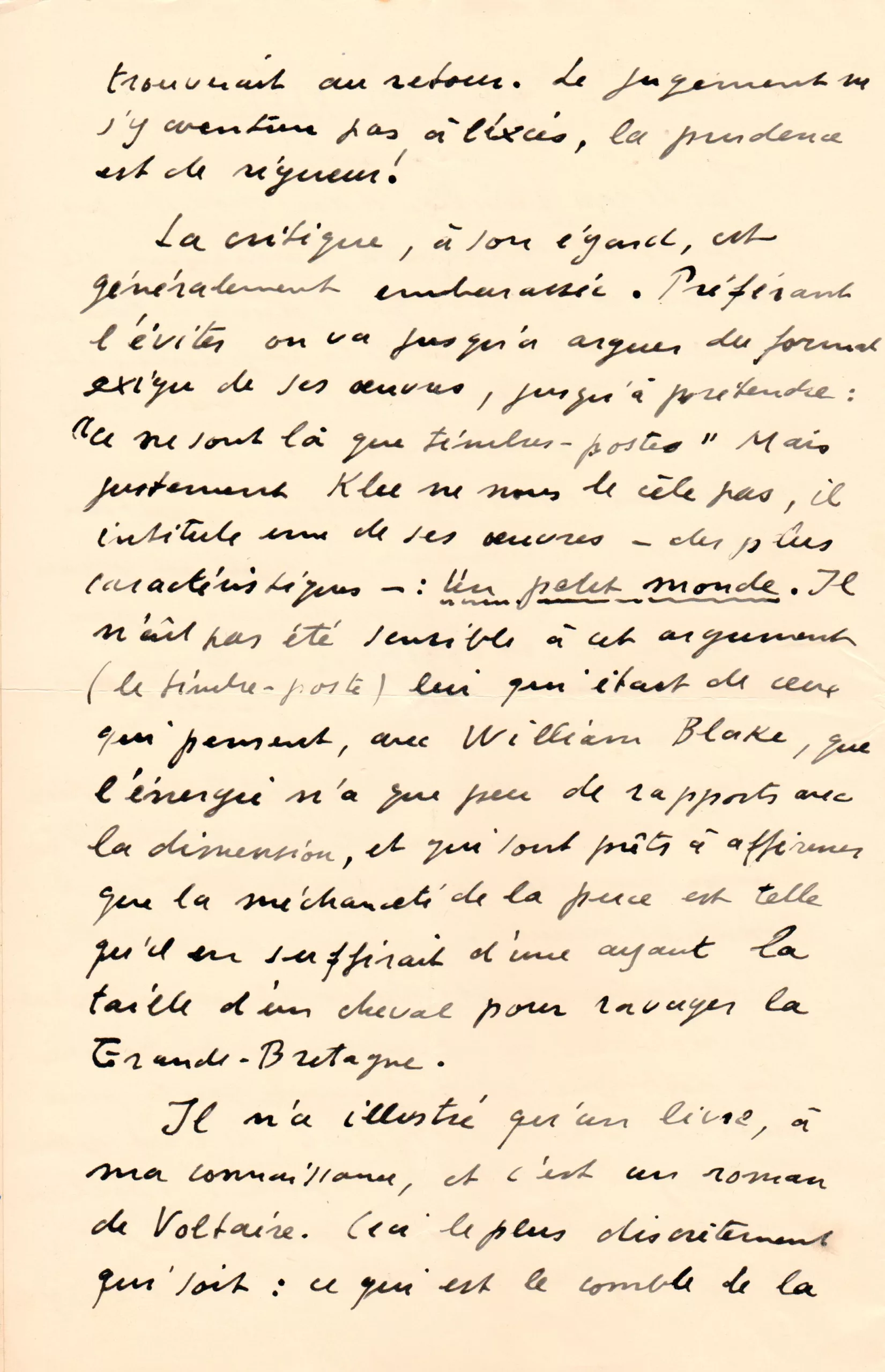
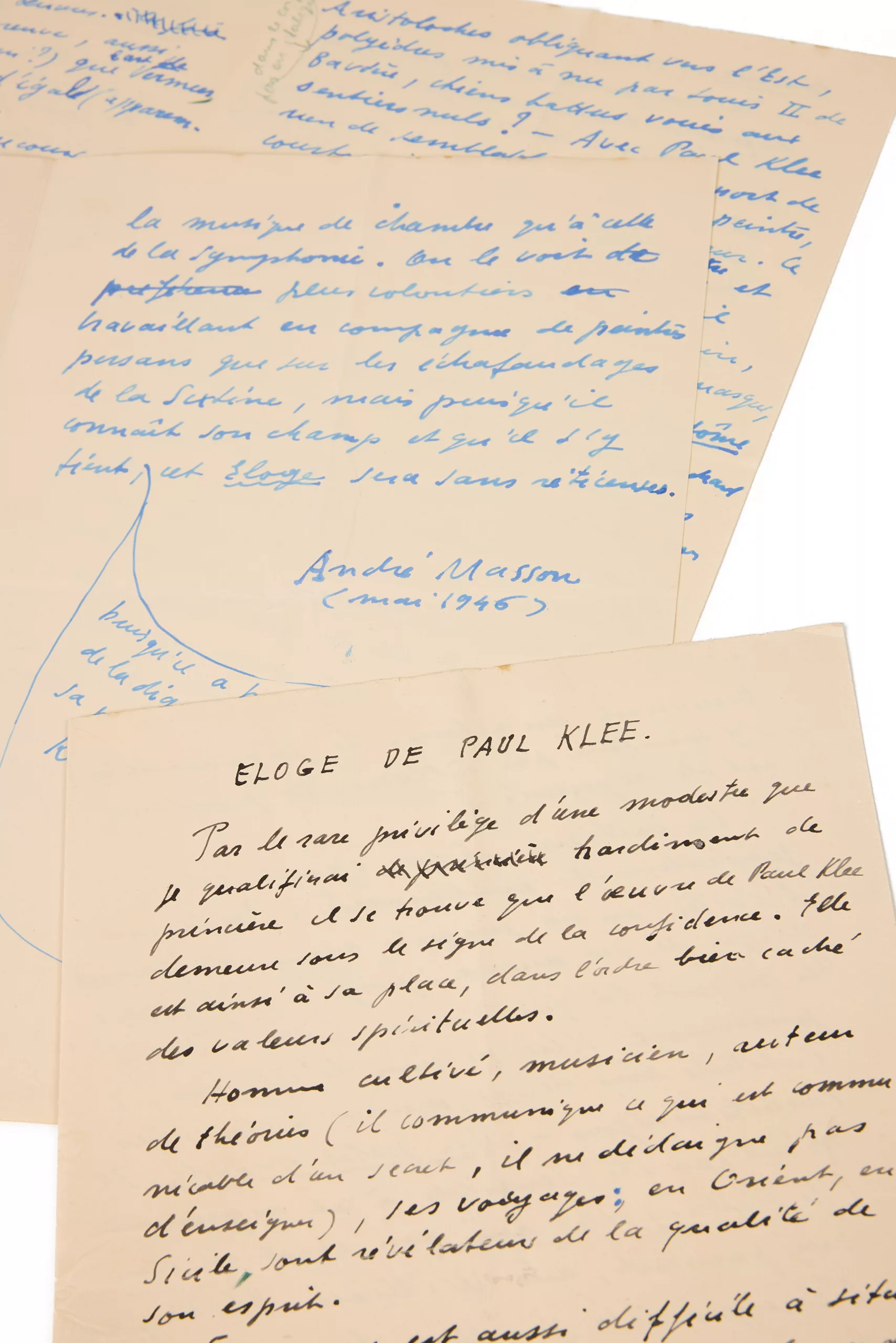
« Éloge de Paul Klee »
Paul Klee (1879–1940) was both a gifted painter and a great watercolorist. Born in Switzerland, near Bern, he moved to Germany in 1898 to study art in Munich, where he was struck by Post-Impressionism and discovered Vincent Van Gogh and Paul Cézanne at an exhibition — a revelation. He subsequently met the members of Der Blaue Reiter, led by Wassily Kandinsky, and in 1912 took part in the group’s second exhibition, devoted exclusively to graphic works. Thanks to his friend, the designer, urban planner and architect Walter Gropius, Klee began teaching abstract art at the Bauhaus in 1921, remaining there for ten years and developing a distinctive approach to color. Classified by the Nazis as Jewish and branded a “degenerate” painter, he was forced to flee Germany and died at the outset of the Second World War.
Masson discovered Klee’s work in 1922, before the formation of the Surrealist movement. He was then working in the studio on the rue Blomet in Paris, alongside Joan Miró, with whom he shared his discovery: “I am especially grateful to André Masson for introducing me to Paul Klee’s painting. One day, when he showed me plates in one of his albums… I was overwhelmed! I rushed to the only Parisian gallery exhibiting his gouaches and watercolors. From that day, my work took a completely different turn — it became Surrealist, so to speak. My encounter with Klee’s work was the most important event of my life. Thanks to his influence, my painting freed itself from all earthly constraints. Klee taught me that a simple stain, a spiral, even a dot, could constitute the subject of a painting, just as much as a face, a landscape or a monument…”
“Éloge de Paul Klee” was written in response to the critical essay “Paul Klee, ou la passivité” by René Renne and Claude Serbanne, published the previous year in the Cahiers du Sud. In praising Klee, Masson projects his own ideas: the emancipation from conventional values and the use of original techniques exploiting accidental results. He coins the term “infinir,” discerning in Klee’s work a particular conception of time and a constantly dynamic energy in perpetual transformation.
The manuscript is signed and dated “André Masson (mai 1946)”; with a few deletions and additions, and a note in green colored pencil concerning the layout of the text.
Will Grohmann, Paul Klee, Paris: Cahiers d’art, 1929; André Masson, “Éloge de Paul Klee,” in: Fontaine, no. 53, June 1946, pp. 105–108; Renne-Serbanne, “Paul Klee ou la passivité,” in: Les Cahiers du Sud, no. 273, September 1945, pp. 670–676.