

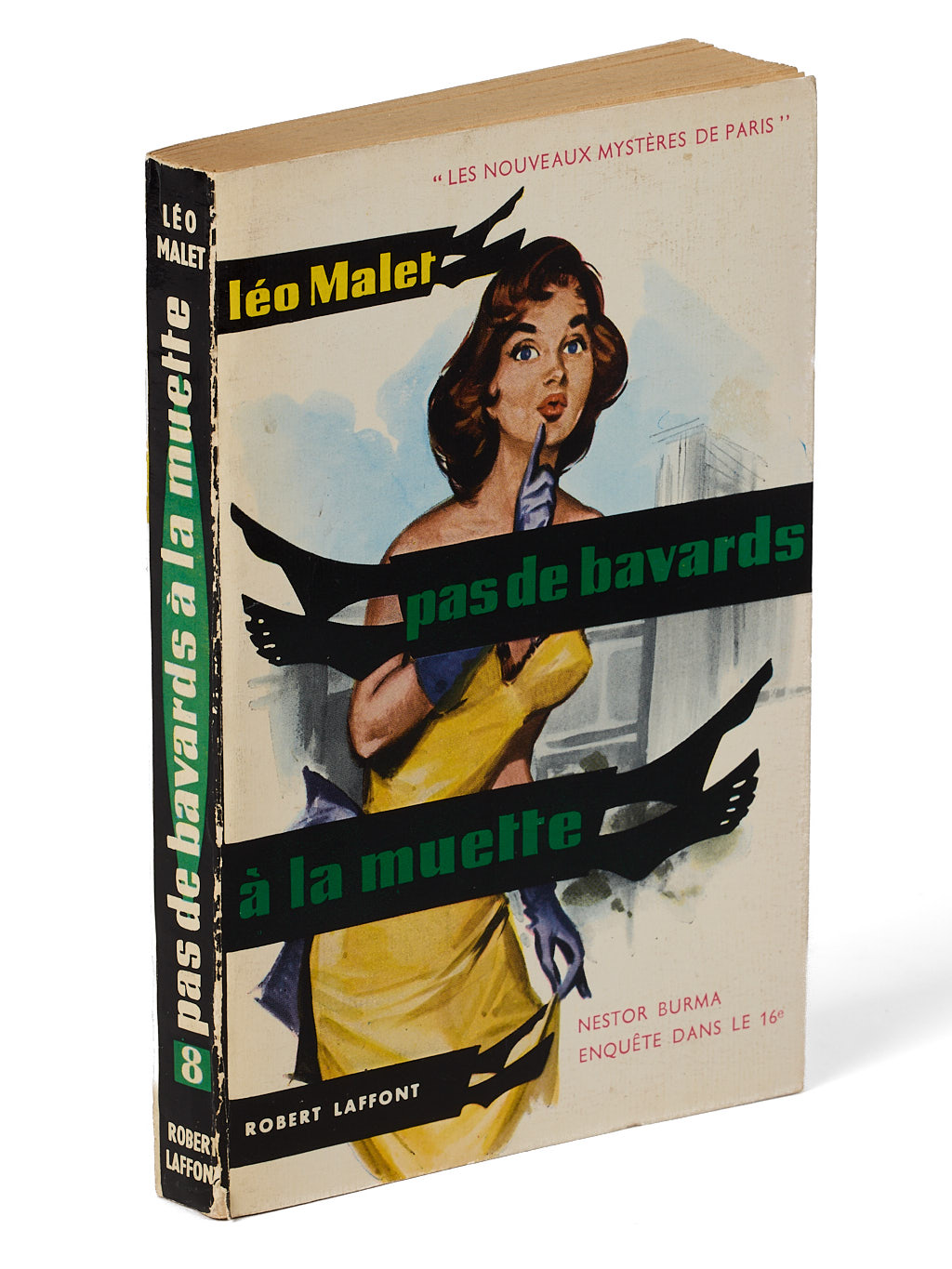
Pas de bavards à la Muette
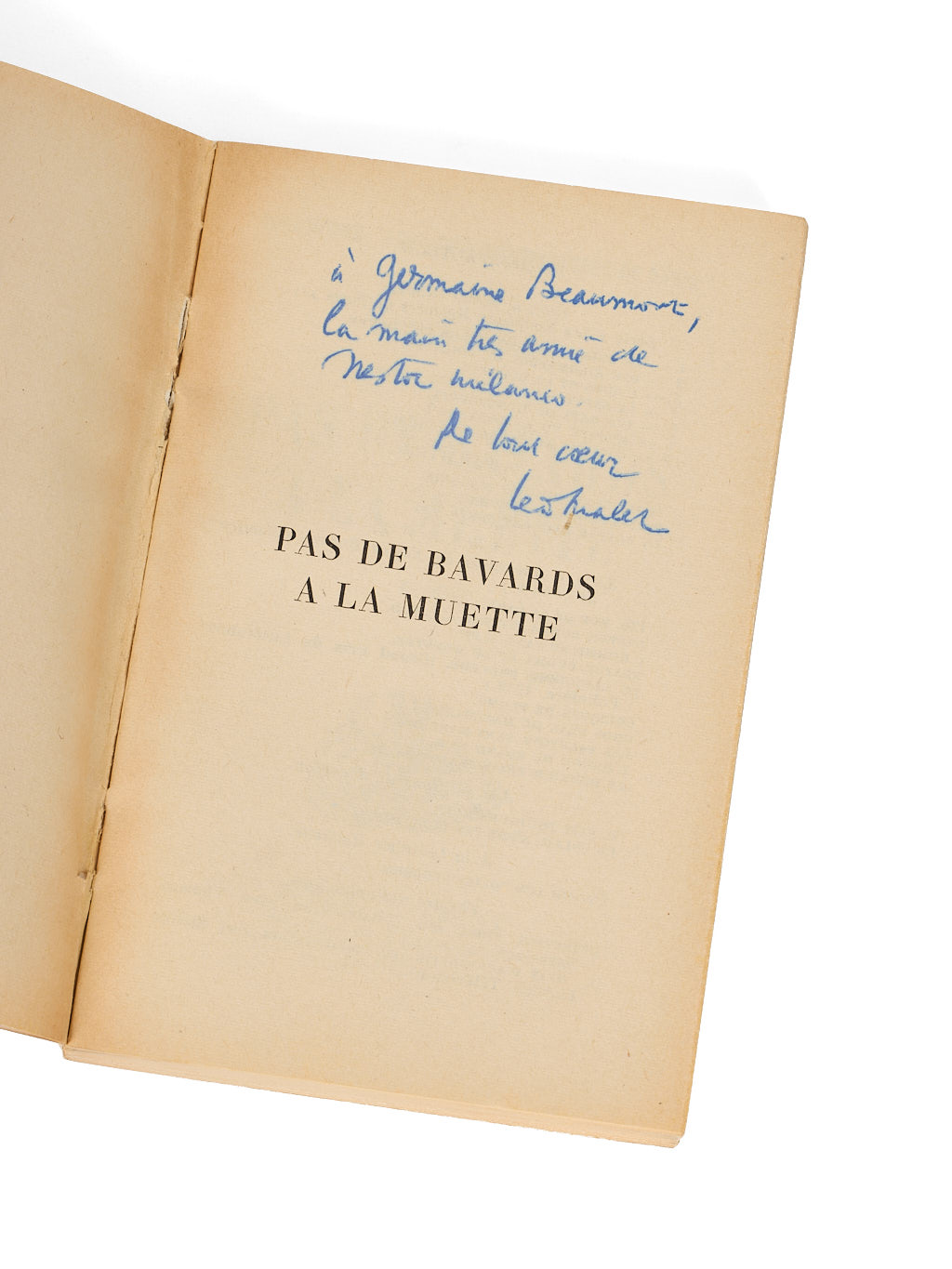
Signed presentation inscription: “à Germaine Beaumont, la main très amie de Nestor mélanco., de tout cœur, Léo Malet.”
Set in the sixteenth arrondissement of Paris, the novel is the eighth in Léo Malet’s Nouveaux Mystères de Paris, a cycle of fifteen detective novels published between 1954 and 1959. It features his signature detective, Nestor Burma, created in 1943 in 120, rue de la Gare. Each novel is set in a different arrondissement of Paris: “The idea came to me on the Bir-Hakeim bridge. Looking out over that view of Paris, I thought it was extraordinary that no one, apart from Louis Feuillade, had ever made a true film about the city. I had the vague idea of detective novels very different from Fantômas, each set in a different quarter or arrondissement, and there would be several of them.” His friend Maurice Renault, publisher of many postwar detective and popular novels, suggested the title, in reference to Eugène Sue’s serial Les Mystères de Paris.
The project was never completed, for reasons of health: while writing the sixteenth title of the Nouveaux Mystères, to be set in the eleventh arrondissement and entitled La Méprise de la Bastille, Malet felt a great fatigue that forced him to rest. He never returned to the series, as he explains in his autobiography, La Vache enragée (p. 221). Five arrondissements of the French capital were never treated: the seventh, eleventh, eighteenth, nineteenth and twentieth.
A rare edition, here of fine provenance: influenced by the work of Colette and Virginia Woolf, Germaine Beaumont was the first woman to win the Prix Renaudot. She later presided over the Prix Femina, where she notably championed André Dhôtel with Le Pays où l’on n’arrive jamais. An English speaker, she translated major books, including Truman Capote’s Breakfast at Tiffany’s and Virginia Woolf’s A Writer’s Diary. A close friend of Malet, she took a keen interest in the world of detective fiction, writing literary criticism for Mystère Magazine between 1966 and 1977, in which “she argued for the detective novel to leave its marginal status behind and become a novel in its own right.” As Colette put it, she wrote “detective novels without detectives.”