

Lazare
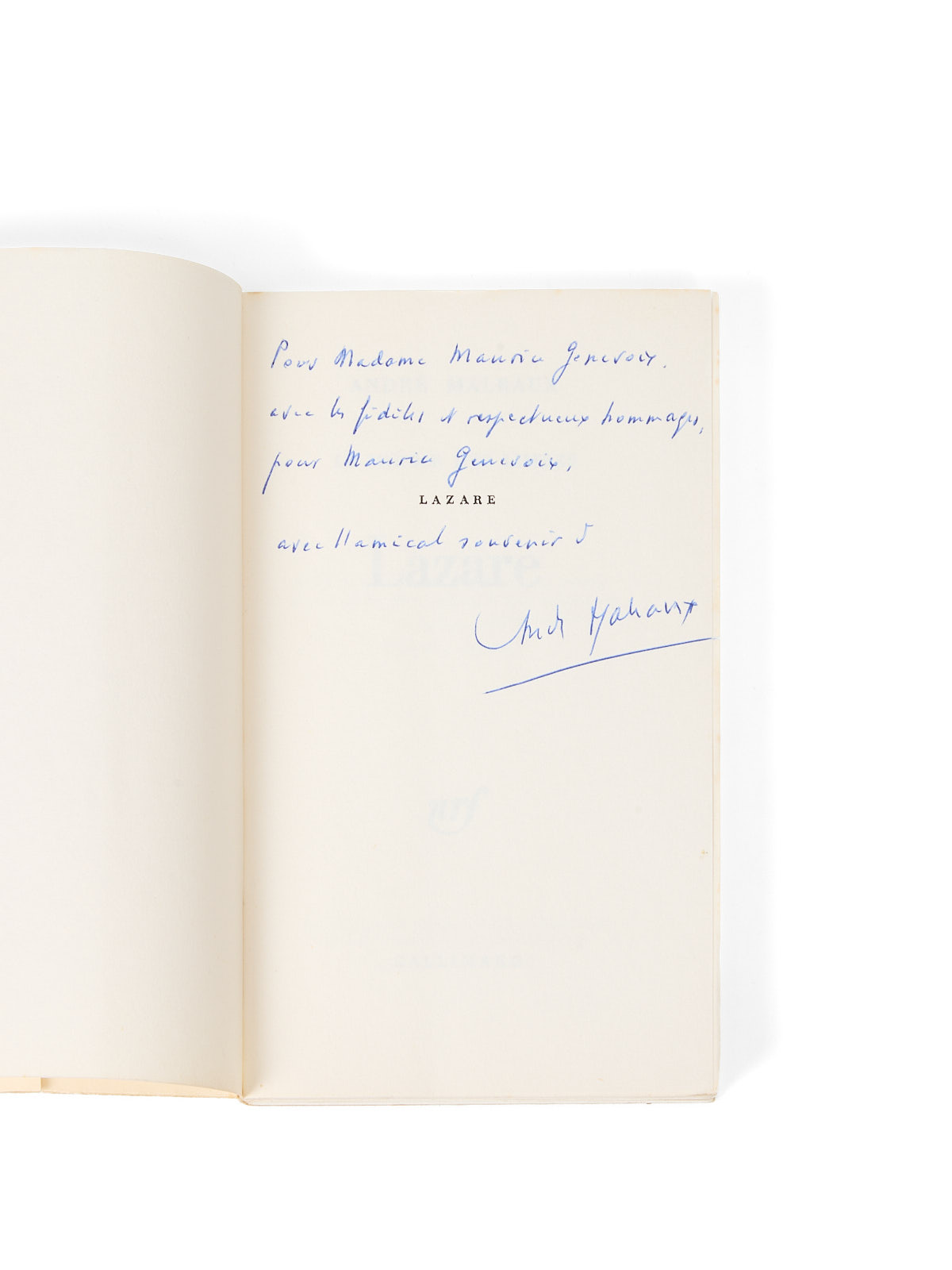
Signed presentation inscription: “Pour Madame Maurice Genevoix, avec les fidèle et respectueux hommages; pour Maurice Genevoix, avec l'amical souvenir d'André Malraux.”
Operated on urgently in 1972, Malraux — attended by Sophie de Vilmorin, Louise’s niece — was forced to give up tobacco and alcohol, “stricken with a sleeping sickness.” From this experience he drew Lazare, a masterful testament of a book, a fragmented synthesis of his life written in answer to Perken’s famous line in La Voie royale: “There is no death. There is only me. I who am going to die.”
“Any man who writes, and writes well, serves France,” General de Gaulle once told André Malraux. Maurice Genevoix thus served his country twice over: in body and in spirit. Severely wounded in the fighting at Rupt-en-Woëvre near the hill of Les Éparges in 1915, he lost the use of his left arm and was discharged with 70% disability. His very first war narrative, Sous Verdun, published in 1916, was partly censored. In 1949, three years after his election to the Académie française, he published Ceux de 14, which established his reputation as a tragic storyteller — a reputation Malraux, the unforgettable orator of the transfer of Jean Moulin’s ashes to the Panthéon on 19 December 1964, would surely not have disowned. Genevoix would join him there fifty-six years later, on 11 November 2020.
From the library of Maurice Genevoix (with presentation inscription and bookplate).