

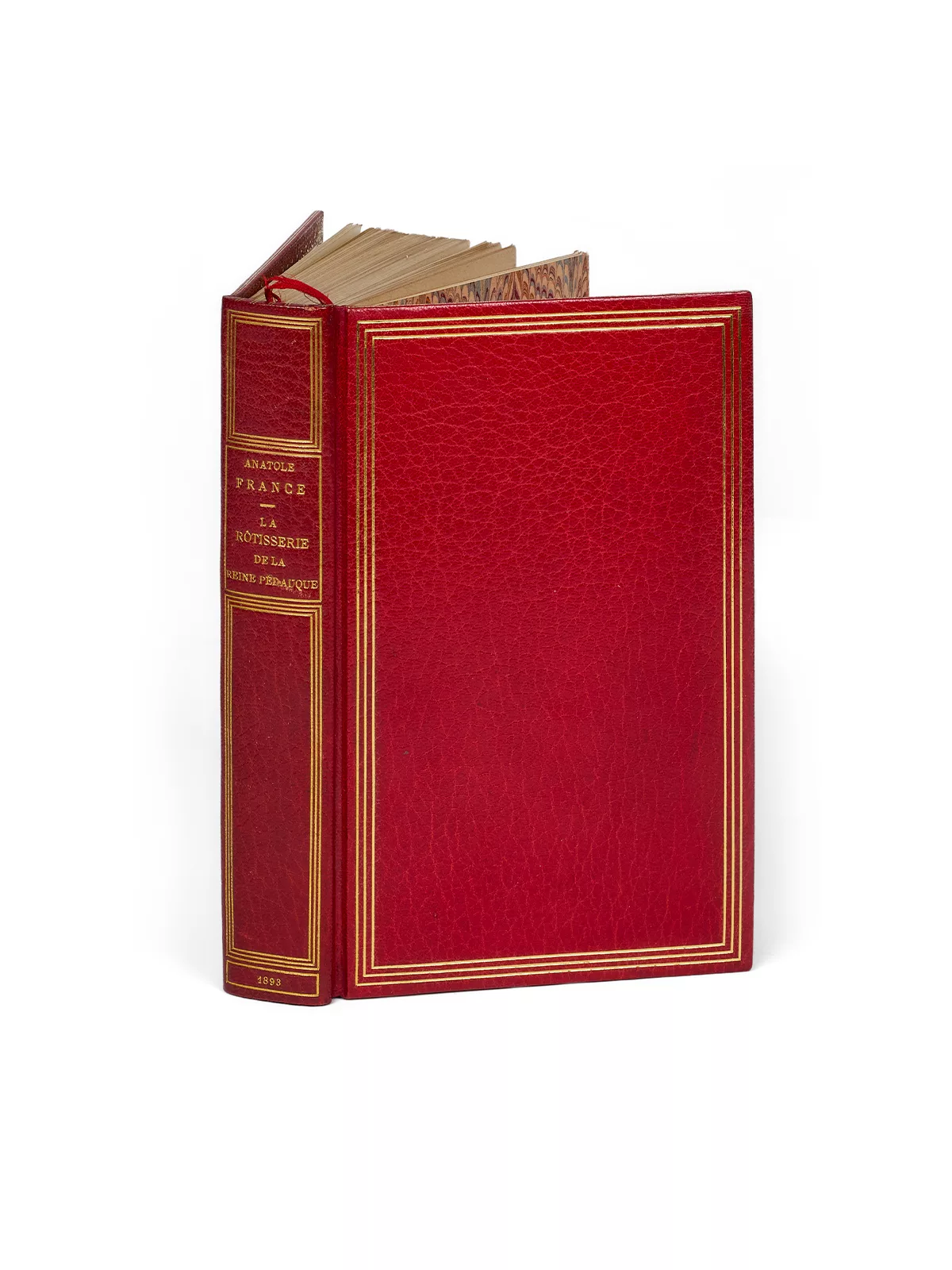
La Rôtisserie de la Reine Pédauque
With an autograph note: “à Albert Tustes, jeune prince charmant et, déjà, Prince de la Forme. Anatole France.”
La Rôtisserie de la Reine Pédauque, described as “the most significant of his works,” was also a resounding success and a work of Anatole France’s full maturity. In the summer of 1892, France, spending the season with his daughter Suzanne at Saint-Thomas, a small village in the Aisne, completed this substantial novel of more than 600 pages. On August 10 he wrote to a friend that his Reine Pédauque had “reached leaf 496 … the novelist has brought his manuscript along in his suitcase.” By September La Rôtisserie was finished, and from October 6 it began appearing in serial form in L’Écho de Paris.
The origins of France’s most celebrated novel draw freely on the most singular works of the eighteenth century, an era he always preferred. The figure of the Abbé Coignard, the rôtisseur of the rue Saint-Jacques, Maître Léonard and other equally colorful characters populate this work, which nonetheless troubled its author right up to its first publication. On October 5, 1892, seized with terrible doubt just as L’Écho began publishing the opening pages, he wrote to his confidante Madame de Caillavet: “La Rôtisserie needs to be entirely redone. I am overwhelmed…”
On March 22, 1893, the text appeared in book form from Calmann Lévy. The rest is well known, as is its success. Few titles in late nineteenth-century literature enjoyed such enthusiasm, including among bibliophiles. Beyond the numerous reprintings and illustrated editions, collectors entrusted this Rôtisserie to the finest binding workshops, producing splendid and precious bindings. The publisher printed 20 copies on Japanese paper and 40 on Hollande paper under an orange wrapper — one example being the Bourg de Bozas copy on Japanese paper, bound by Meunier in a style typical of the period.
It is amusing to note that the bookseller Conquet, shrewd and cautious, subscribed with the publisher to all of France’s future deluxe-paper editions following this impressive success.
The note preserved in this copy is addressed to the Algerianist poet Albert Tustes (1888–1943), author of Les Sirénéennes, winner of the Grand Prix de l’Algérie in 1927.