

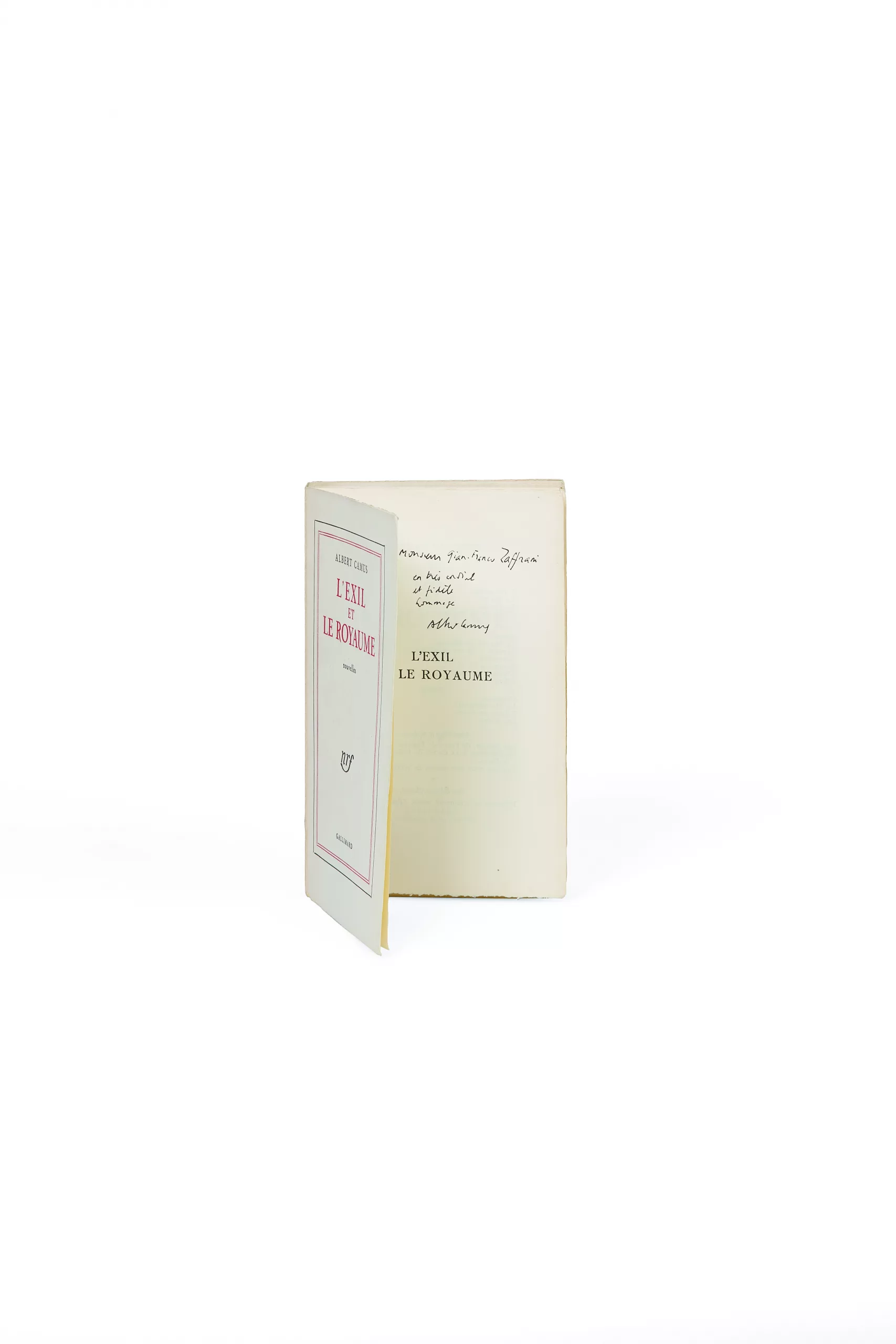
L’Exil et le Royaume
One of 210 copies on pur fil paper (no. 146).
Signed presentation inscription: “à Monsieur Gian-Franco Zaffrani, en très cordial et fidèle hommage, Albert Camus.”
Camus here pays tribute to a central figure of the postwar European intellectual world: Gian-Franco Zaffrani, a senior RAI official, man of culture and founder of the Prix Italia, a prestigious award recognizing innovations in radio and television broadcasting. Author and dedicatee had met during Camus’s stay in Italy in 1954, at the invitation of the Association culturelle italienne. In his Carnets (III), Camus recalled this return to Italy with emotion: “I had not seen it since 1938, the date of my last visit. The war, the Resistance, Combat, and all those years of repugnant seriousness. Travels, but instructive ones, in which the heart remained silent. It seemed to me that my youth was waiting for me in Italy, along with new strength, and the light I had lost.”
This collection of six short stories (La Femme adultère, Le Renégat, Les Muets, L’Hôte, Jonas and La Pierre qui pousse) is dedicated — uniquely — to his wife, Francine. Its guiding thread is indeed exile, whether forced or voluntary, of a central character who, “whether encountered in the working-class neighborhoods of Algiers, a bourgeois district of Paris or a village in Brazil, struggles to find meaning in life. Camus’s men and women exist in perpetual questioning, if not introspection — true throughout, and perhaps most striking in Janine, La Femme adultère, who seems exiled from herself and yet remains the agent of her own destiny” (in Dictionnaire amoureux de Camus, p. 164). “In this vast land that he had loved so much, he was alone,” concludes L’Hôte, perhaps the most famous story in the collection, in which Camus condenses all the tension between justice, fatality and freedom, at the heart of the nascent Algerian War. As though confiding his own unhappiness.