

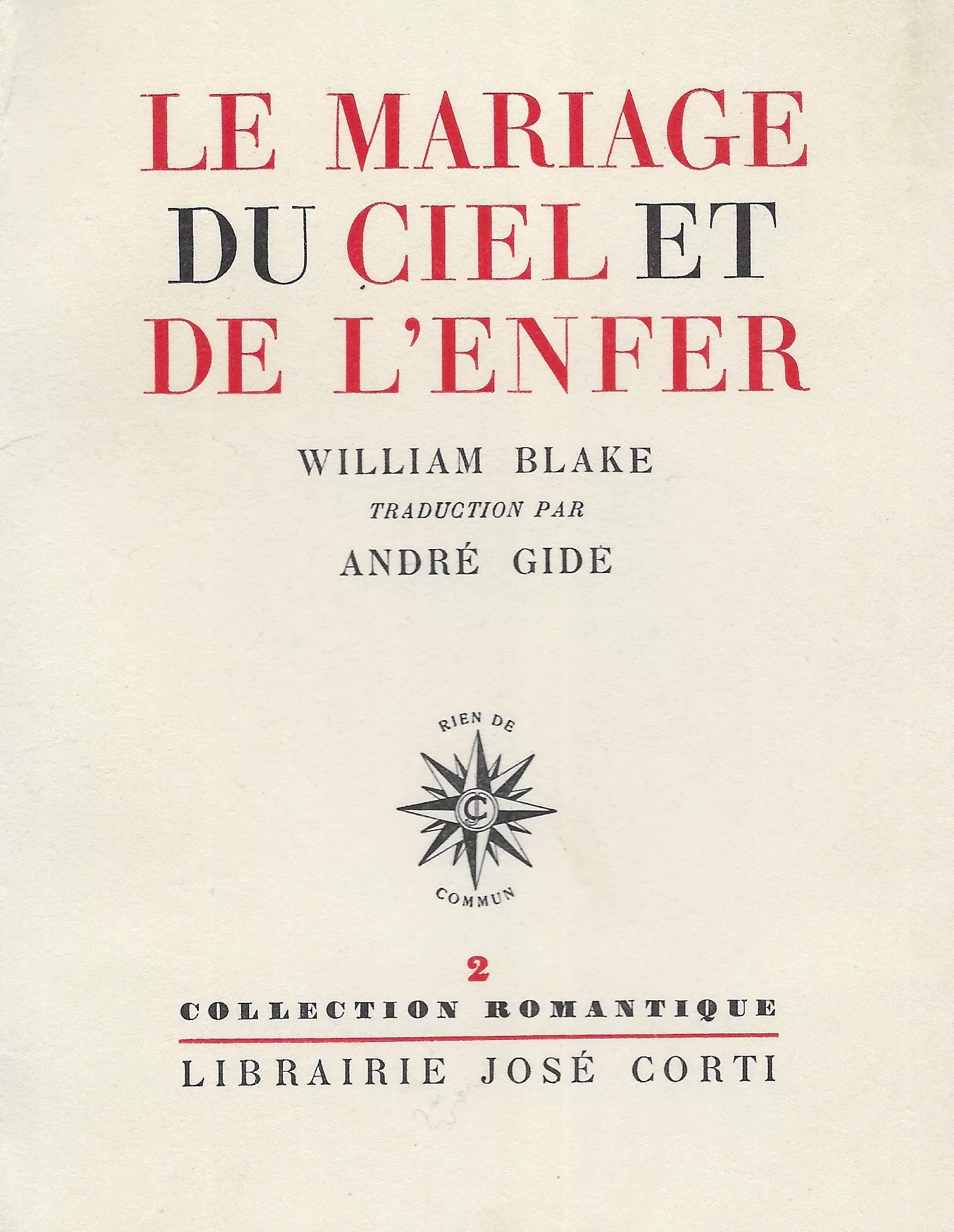
Le Mariage du ciel et de l’enfer.
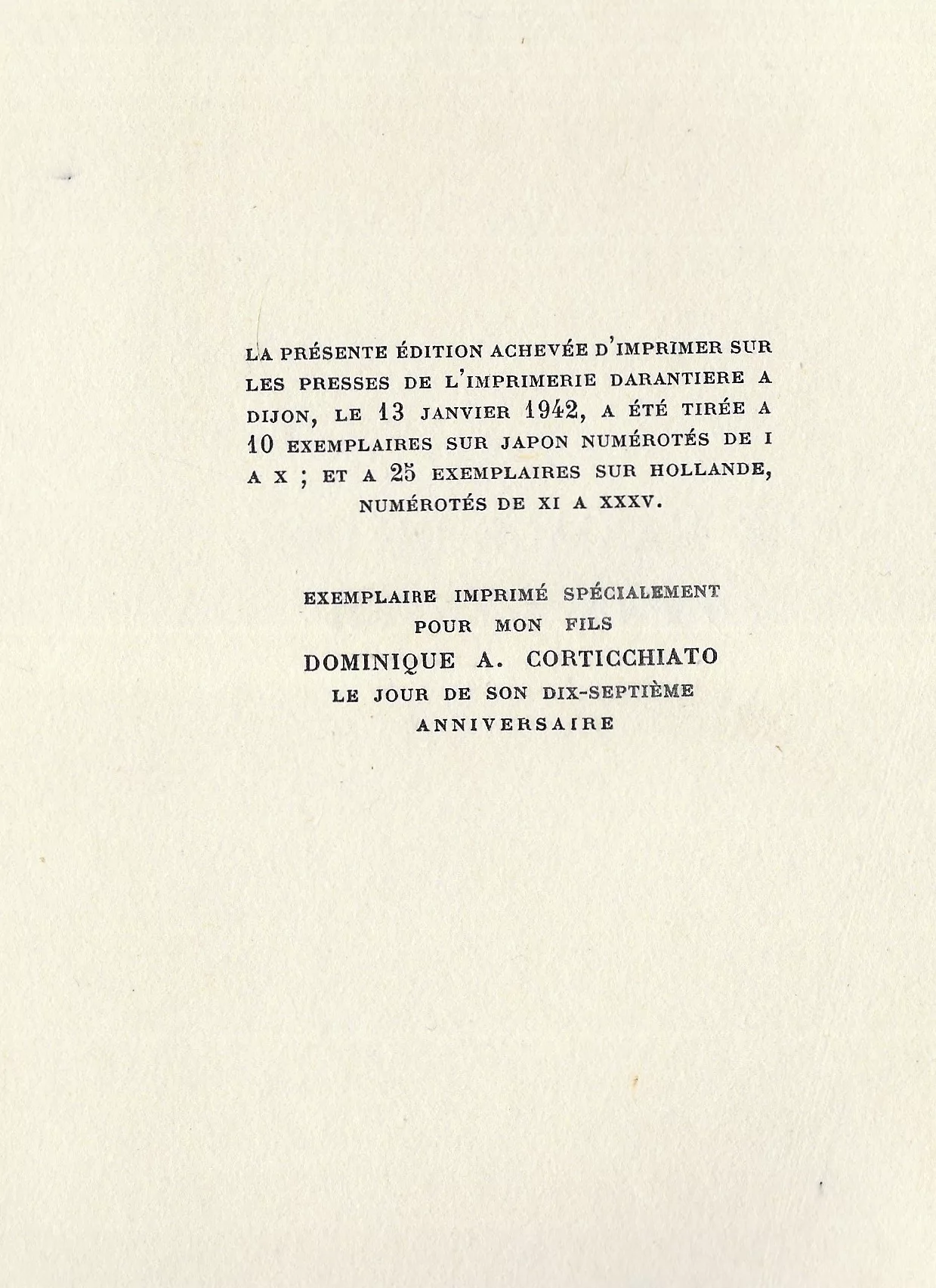
Rare edition, printed in 35 copies. One of the first 10 copies on Japanese paper, this one specially “printed for my son Dominique A. Corticchiato, on the day of his seventeenth birthday.”
A remarkable gift from a publisher to his son, of a text close to his heart, in a series that celebrated English literature as a challenge to the Occupier.
Born on 13 January 1925, Dominique Corticchiato had begun studies in English language and literature. As a translator, he would produce, in 1944, the edition of Horace Walpole’s Le Château d’Otrante, with a preface by Paul Éluard, the fourth title in the same series. A Communist resistant, he was arrested in May 1944, then deported to Buchenwald and then to Ellrich, where he died at the age of nineteen. This was the great tragedy of José Corti’s life, to which he would return at length in his Souvenirs désordonnés.
Corti continued to honor his son’s memory in his publications, having personal copies printed for him.
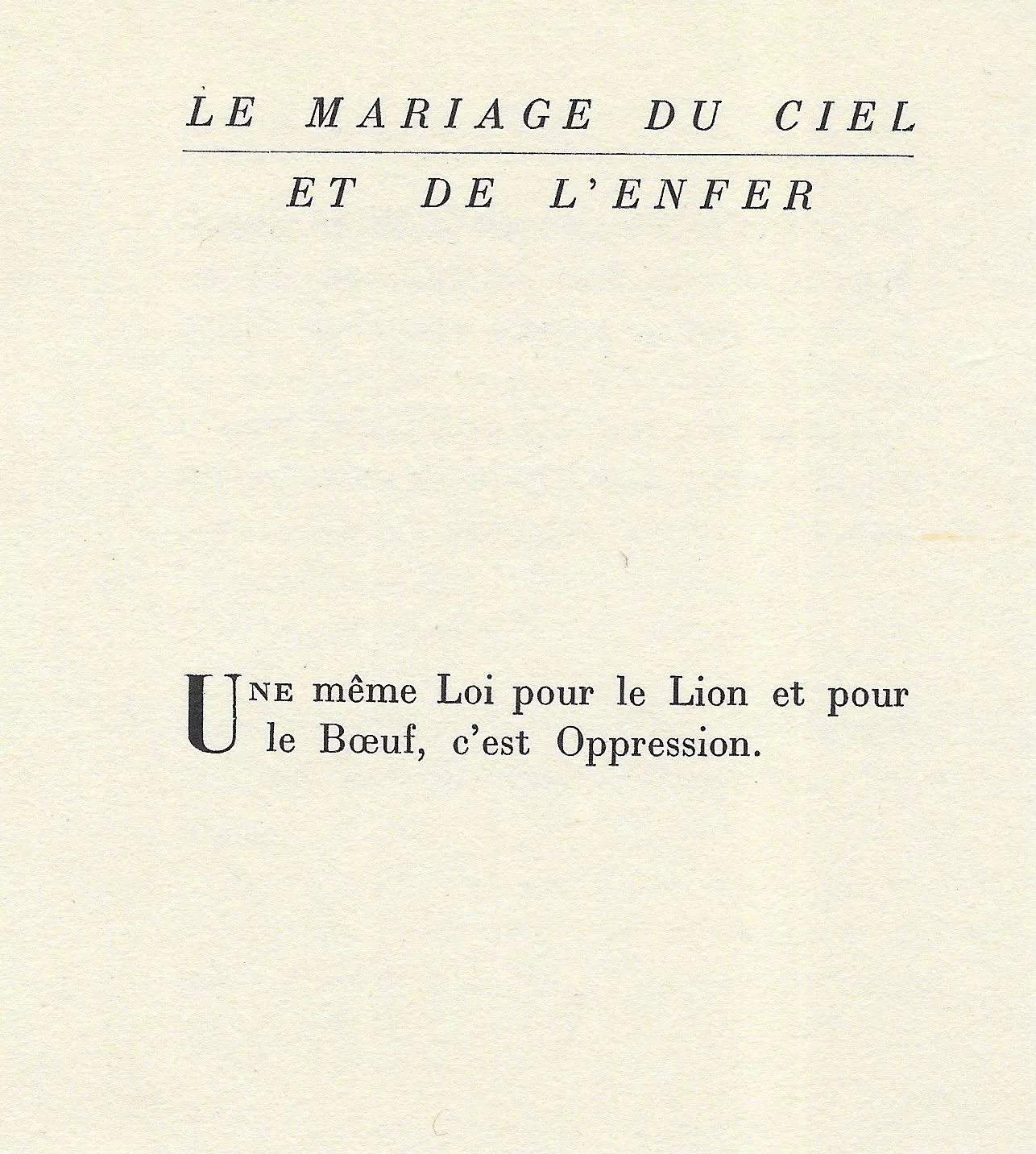
The text itself was far from innocuous during the Occupation. The final leaf, which closes the text — “One Law for the Lion & Ox is Oppression” — recalls the particular moment of early 1942, when the Nazi grip on the country was tightening.
Gide had translated this text in 1922, during an intense period of writing and translation: after Conrad’s Typhon in 1918, he would also translate Shakespeare, Tagore and Pushkin between 1921 and 1924. He had a declared preference for William Blake, whom he had first approached in 1914 “with astonishment,” placing the English poet alongside Nietzsche, Browning and Dostoevsky among the four stars of his intellectual firmament. In this text Blake proclaims “human unity,” a kind of Manichaeism not without blasphemy, but one that founded an entire aesthetic admired by Gide, who saw in “the star Blake the spark in that distant region of the sky where the star Lautréamont also shines. Radiant Lucifer, his rays clothe the wretched and glorious bodies of man and woman in an unusual brilliance.”