

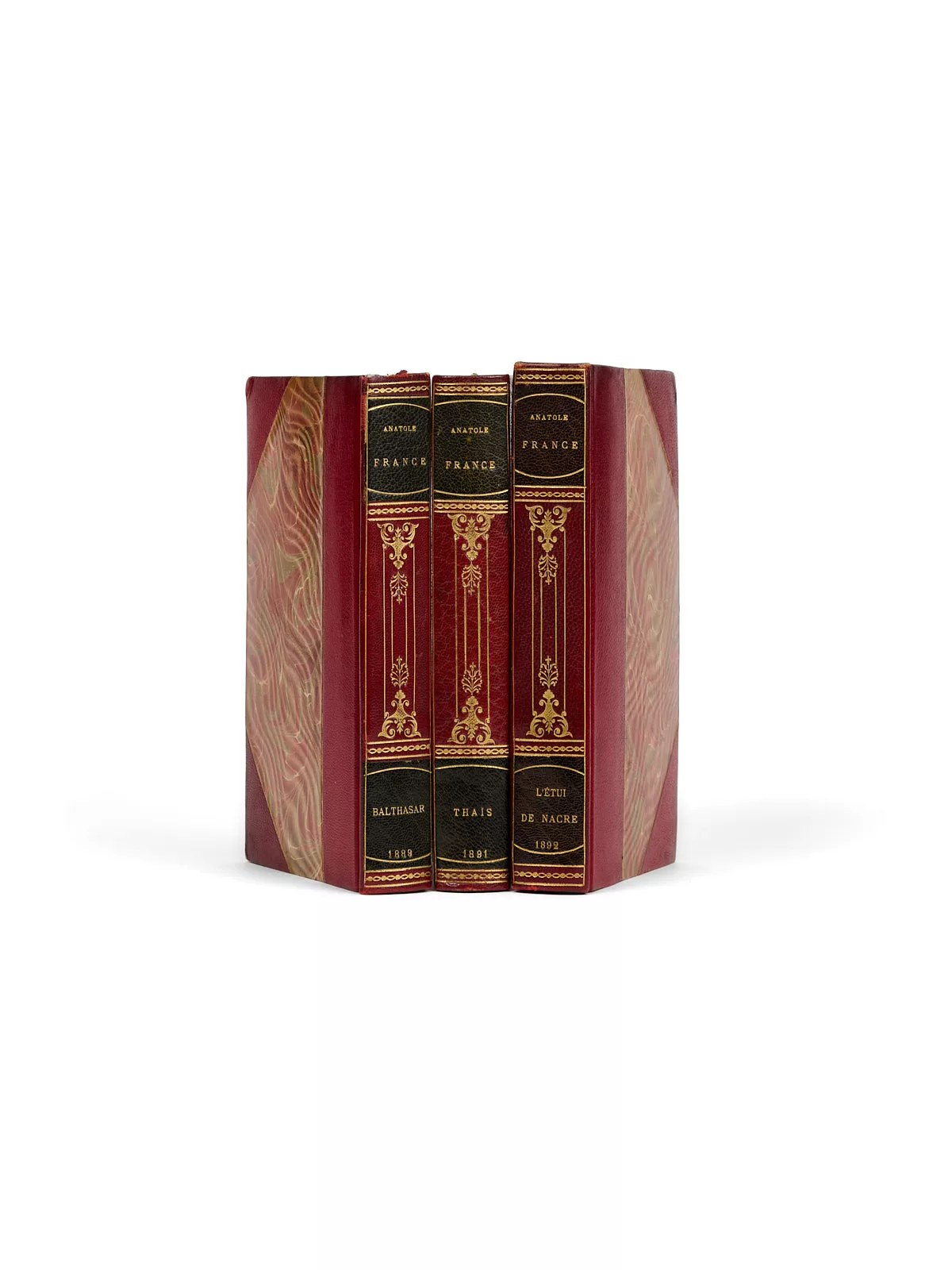
Balthasar – Thaïs – L’Étui de nacre
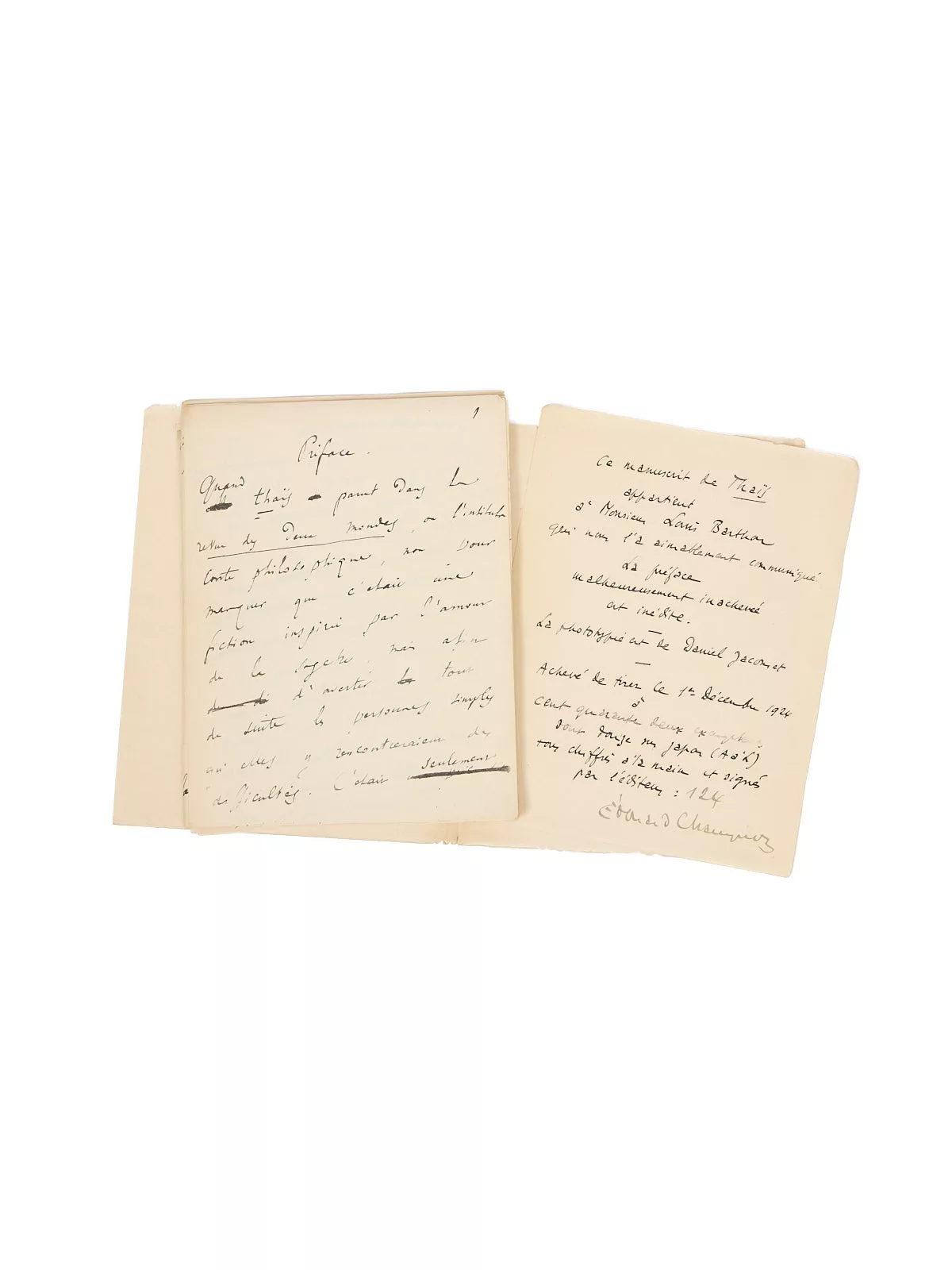
Accompanied by the facsimile edition based on the Louis Barthou manuscript of Thaïs, limited to 142 copies, numbered and signed by the publisher (no. 124); together with a copy of the second edition of L'Étui de nacre, Calmann-Lévy, 1922.
“How much better the tale and the short story are than the novel! What a refined way to please people of wit! […] Is not the writer’s first courtesy to be brief? The short story suffices for everything.” (Anatole France, La Vie littéraire, vol. IV). France never abandoned this taste for short narratives, and it was with them that he began his career, after a few collections of poems. He saw in the short form an effective means of conveying his ideas and his philosophy of life.
The manuscript of one of France’s most famous titles, Thaïs, was written on the letterhead of the Senate, where Anatole France then held a position. Its serial publication in the Revue des Deux Mondes was arranged by Léontine de Caillavet (1 and 15 August 1889) under its definitive title, Thaïs. “The success was resounding and grew even greater when it appeared in book form in October 1890. Suddenly Anatole France’s name spread among the general public: he became a celebrated author, placed on the same footing as the leading figures who had preceded him on the road to fame — Zola, Maupassant, Daudet, Loti, Bourget […].”
Thaïs would later receive two illustrated editions, one by P.-Albert Laurens in 1900 for Éditions Romagnol, the other by Rochegrosse in 1909 for Ferroud.
Charming uniform bindings by Visinand for Anatole France’s first two collections of short stories and his celebrated Thaïs.