

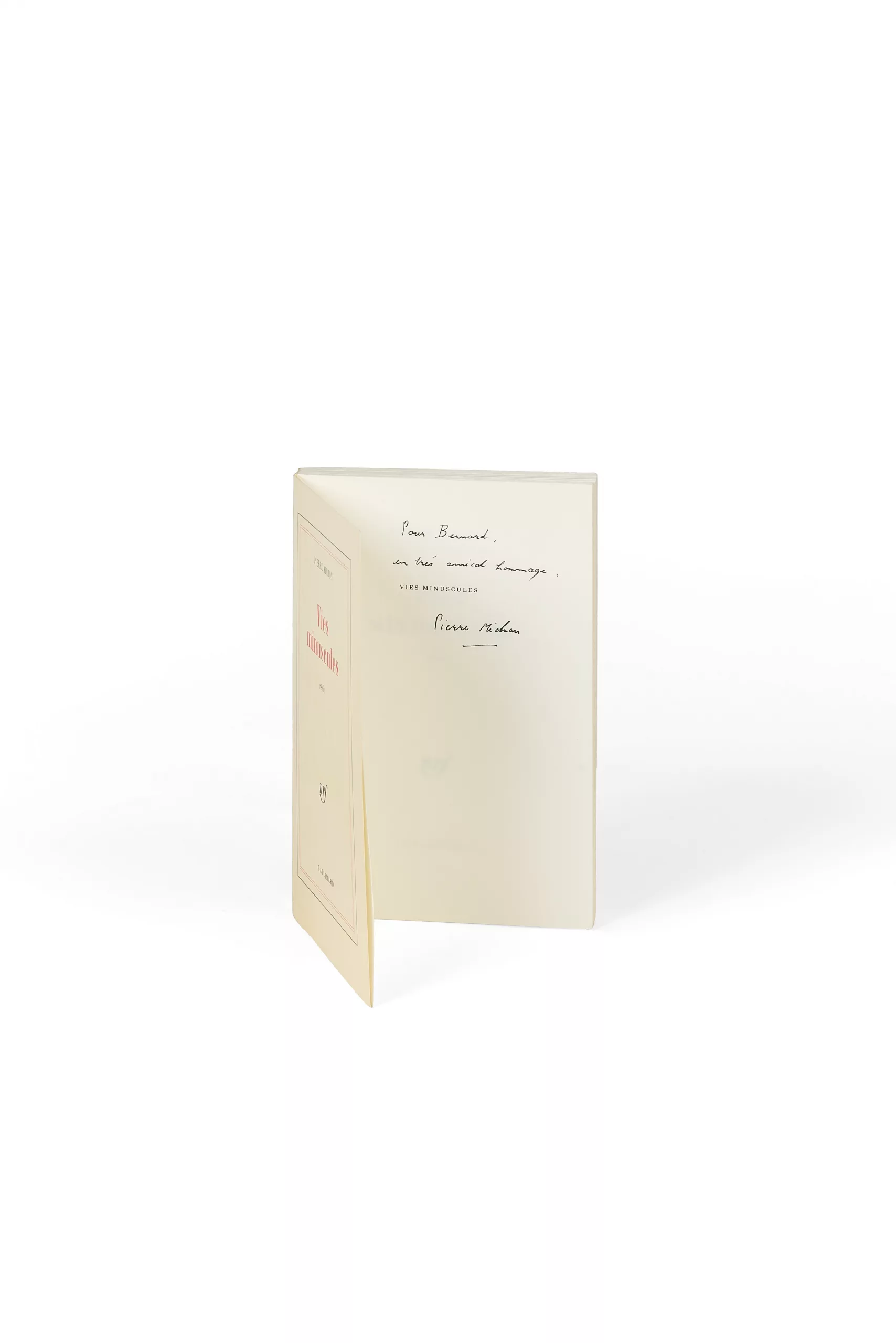
Vies minuscules
Inscribed and signed: “Pour Bernard, en très amical hommage. Pierre Michon.”
Any characterization of Pierre Michon’s work would naturally mention his gift for evoking “imaginary lives” — echoing Marcel Schwob’s title — whether “minuscule” or magisterial: lives of painters or writers, lives of the humble and fate-forsaken, sketched in a few striking strokes now inseparable from the figures they portray. One would also mention his singular style, which he himself describes as roaring in the forge of writing, and which he comments on and criticizes at the close of Vies minuscules: “this tendency toward archaism, these sentimental liberties when style falters, this taste for old-fashioned euphony — this is not how the dead speak when they have wings, when they return in pure language and light.” Style, then, and the evocation of real people who, through that evocation, become characters, in what the writer calls his “fictive summers.” There is little point in adding further commentary; one need only recommend reading the works themselves, particularly Vies minuscules and Rimbaud le fils.
“This is a book that set the bar extremely high, and I wonder if that was a good thing (…) I should have saved the essential for later (…) Part of me says: it would have been fitting if I had written this book and died the following year. The James Dean effect. Or rather the Rimbaud effect. I don’t think I ever again found that same necessity I felt in writing this book (…) For the people I write about, I felt both pity and a kind of projection of myself into them. They were people bound to that extremely closed rural world, unable to leave it, and I was in the same position myself — someone who absolutely wanted to leave, leave, leave that place. The room, the fire, the old people. And I wrote Vies minuscules because suddenly a wave of forgiveness, of goodwill toward all these people, swept over me” (in 21 cm, interview with Augustin Trapenard).