

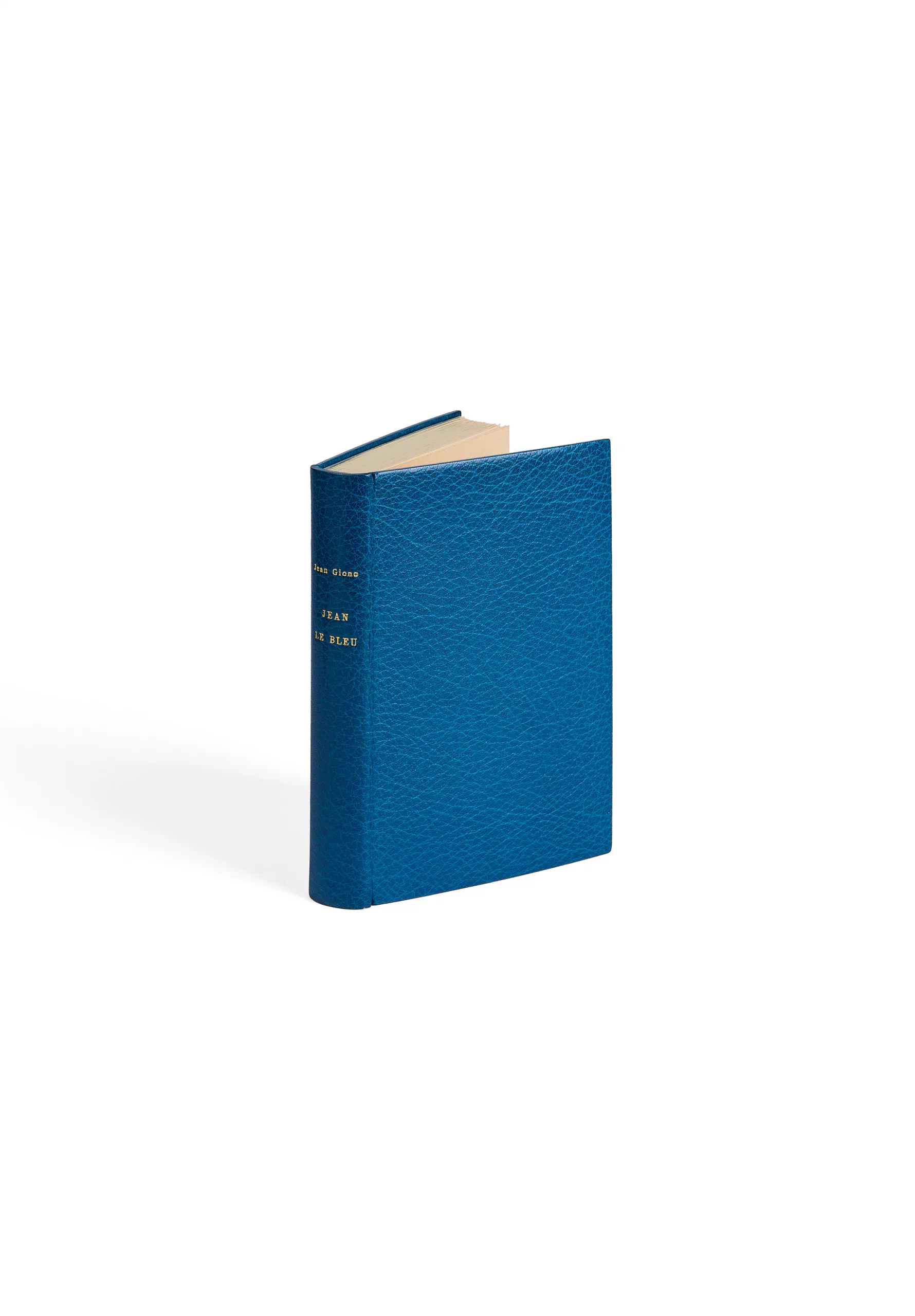
Jean le Bleu
One of 12 first copies on Imperial Japan paper (no. 1).
A precious deluxe copy, superbly bound and enriched with a fine autograph letter, dated 2 August [1932], acknowledging receipt of the proofs of Jean le Bleu: “Je vais me mettre à la correction,” Giono writes, indicating to his correspondent — perhaps Bernard Grasset himself — that he has available “a series of photographs”: Giono as a child, at six, at eighteen, with his mother, evoking this youth and his mother, elements that form the very fabric of the book.
An original photograph by Walter Kardas — the German photographer and friend of Giono with whom he would sign Les Vraies Richesses four years later, illustrated with 112 photographs — is mounted at the front: a view of Manosque, taken from the path leading to the writer’s house. A woman is seen from behind, walking down the path: she is very likely Elise Giono, to whom the writer would dedicate Que ma joie demeure in 1935: “À Elise dont la pureté m’aide à vivre.” Jean Giono and Elise Maurin married in 1920; she survived him by thirty-five years, dying in 1998 at the age of 101, having devoted her life to preserving Giono’s memory, both the man and the work.
Jean le Bleu evokes Giono’s Provençal youth: sunlit, musical, saturated with scents and portraits, between an ironing mother and a shoemaker father. Ordinary people become heroes, animals mingle with angels, and nature is steeped in myth, all rendered in magnificent prose. An autobiographical narrative, a poetic autofiction: a double awakening, of sensuality and of imagination. “I invented that book as much as the others; invention there is nonetheless grounded more than elsewhere in the real […],” Giono admitted in 1956, at the time of its reissue by the Livre-club des libraires. “For my youth, I did exactly the same thing. It is beside the truth, but it is within the truth that I, as a young man, knew. […] It is my inner life that I wanted to describe in Jean le Bleu” — a life that was essentially magical (Jean Giono, Entretiens avec Jean Amrouche et Taos Amrouche [1952], Gallimard, 1990, p. 77).
A choice copy.