

« Les Visiteurs du soir »
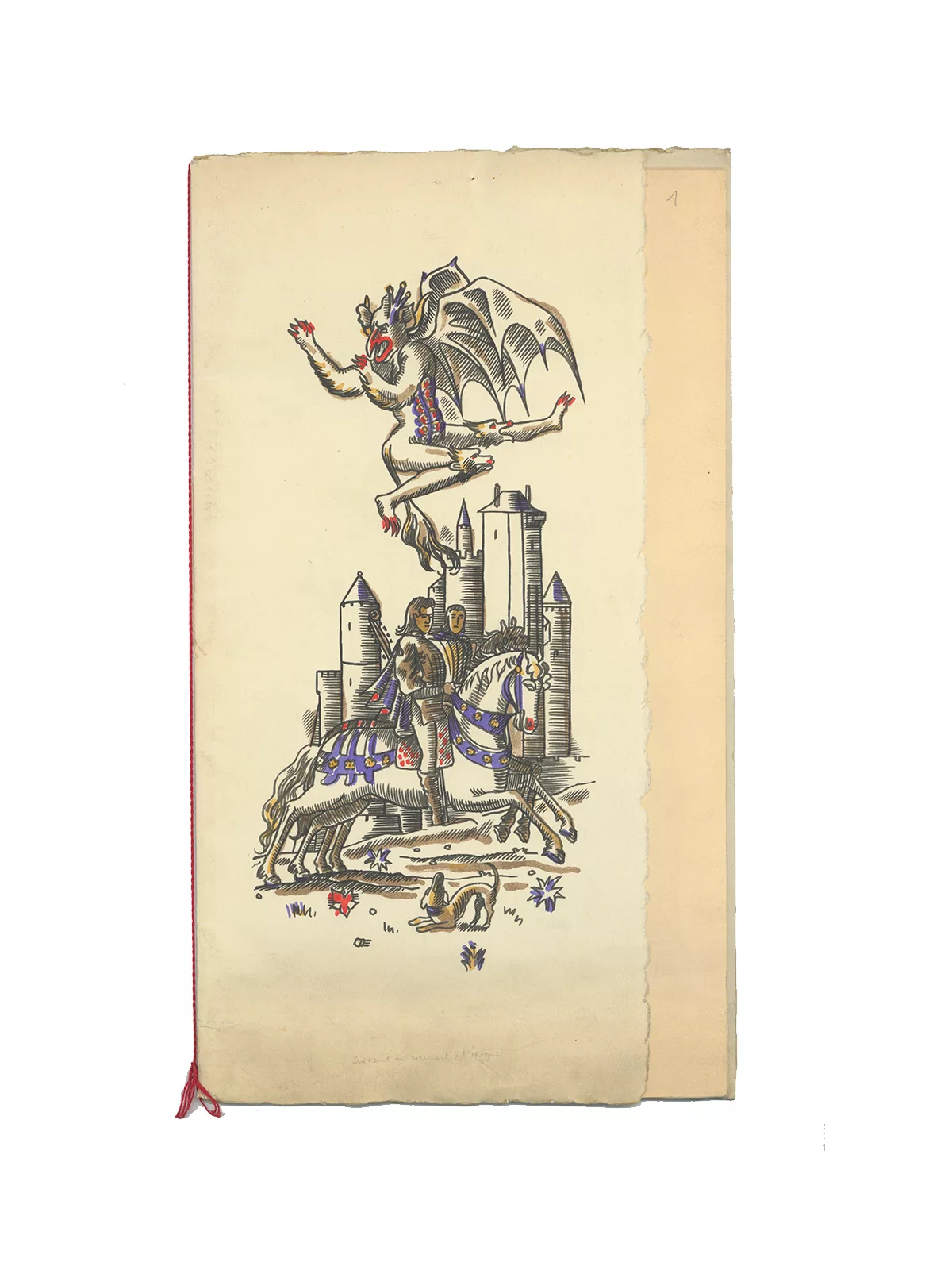
Beneath the cover illustration, this caption: “Suivant un document de l'époque.”
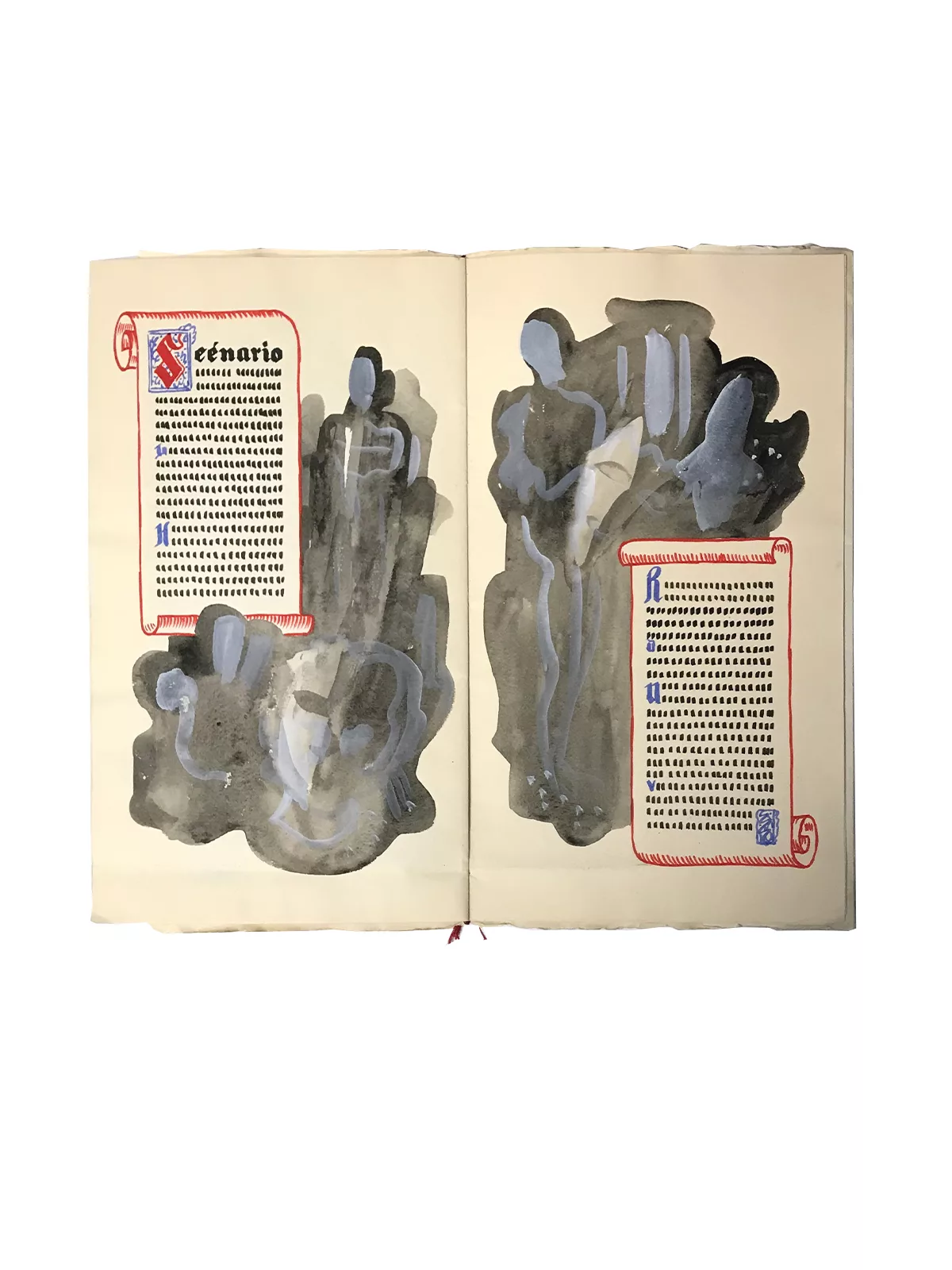
For the release of Les Visiteurs du soir, immense painted frescoes were mounted on the façade of the Cinéma de la Madeleine starting on December 5, 1942. A preview screening, however, had been held the previous evening at the Lord Byron: a private screening on December 4, 1942 (at 122 avenue des Champs-Élysées, on the site of what is now the Bistro Romain), for which a booklet was published and sold in aid of the cinema’s Œuvres sociales. It presented an illustrated scenario, supervised by Jean Mounier, head of publicity for Discina (André Paulvé’s production company).
Presented here is a design project (maquette) for that published booklet. Jacquelin offers a classical and marvelous interpretation of the scenario, with vignettes surrounding the film’s synopsis, in the form it would take for the evening of December 4.
Carné’s marvelous film owes its success as much to Trauner’s sets as to Prévert’s dialogue and the performances of Arletty, Jean-Louis Barrault and Alain Cuny. It opened in Parisian theaters on December 5, 1942, at two prestigious cinemas: the Madeleine and the Lord Byron, on the Champs-Élysées. The film ran for nineteen weeks at the Madeleine, the same cinema where, three years later, Les Enfants du paradis would have its exclusive premiere.
It was an immense success with both audiences and critics: “Les Visiteurs du soir emerged in the dreary output of 1941–1942 like a revolutionary event. It was immediately understood that it would mark a turning point, the beginning of an influence, the origin of a style. The cinematographer created images perfectly attuned to the drama — spare, black and white, stripped bare and luminous like the southern landscape that forms its backdrop. This poem in the language of Oc needs no ambiguity of shadow to work its spells. The mystery lies entirely within the souls of beings and things, which offer their sun-scorched appearance without disguise” (André Bazin, Jeux et poésie, 1943). “In the company of his faithful screenwriter, Jacques Prévert, Marcel Carné has so thoroughly escaped his murky dramas that we find him in the very midst of the land of legend, in those medieval times when the marvelous was so familiar to men. One cannot praise too highly the delicacy and assurance with which Carné has blended symbol and allusion, the prodigious taste evident in the composition of his smallest images, and those refined plays of light that form, from beginning to end of the film, the most expressive accompaniment to a poem of great love…” (François Vinneuil, Le Petit Parisien, December 12, 1942).
The screenplay by Jacques Prévert and Pierre Laroche was published in 1947 by La Nouvelle Édition, with a preface by Pierre Mac Orlan.