

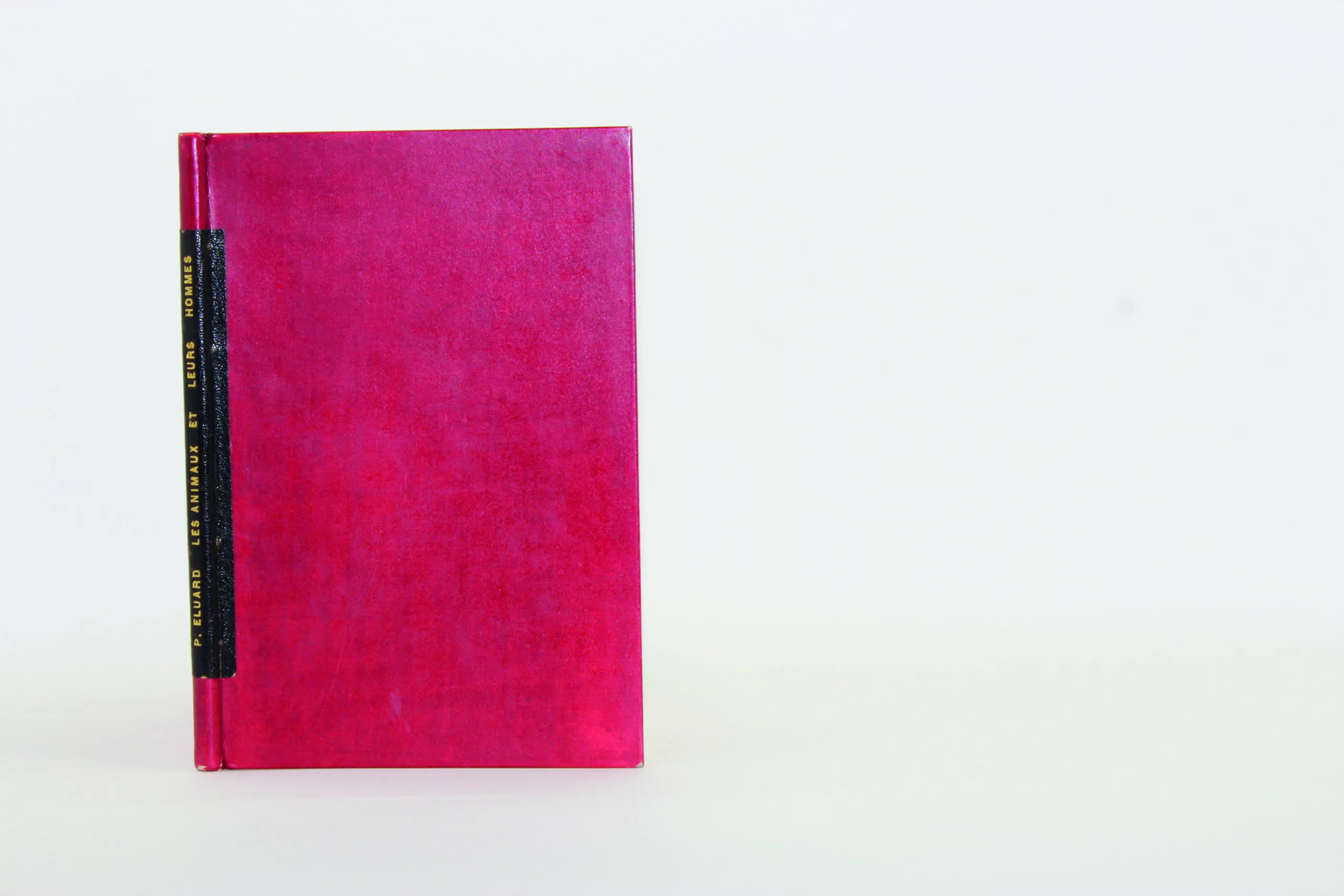
Les Animaux et leurs hommes. Les hommes et leurs animaux
One of 555 copies on vélin d'Alfa (no. 0309).
Signed presentation inscription: “à André Breton, ce livre qui n'est pas fait pour lui déplaire, Paul Éluard.”
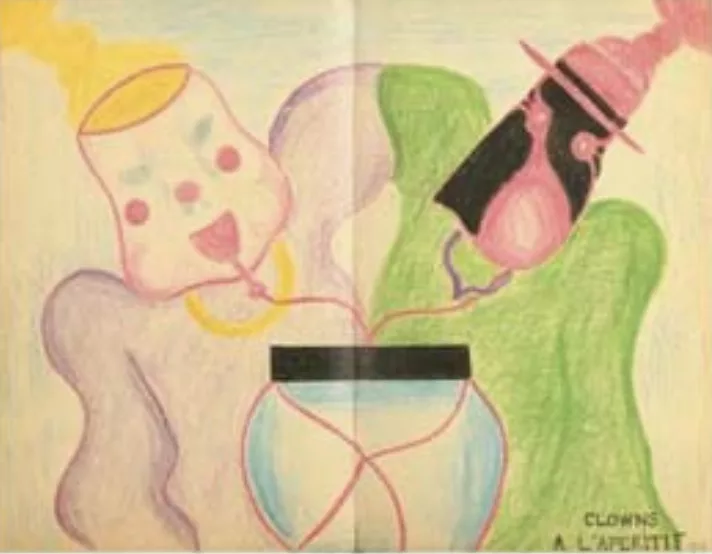
Mounted on a guard: a large original drawing by Paul Éluard (250 x 197 mm) in charcoal and colored pencils on a folded bifolium of thin Alfa paper watermarked ‘Croxley’. Dated and titled in the lower left corner “Clowns à l’apéritif 1917.”
A photograph is known of Éluard and Gala surrounded by friends, made up as clowns (reproduced in Éluard. Livre d’identité, pp. 70–71), and this colorful, joyful drawing may well echo the poet’s marriage to Gala in February of that same year, 1917. In a letter to his mother written from the front, Éluard details the final preparations: “Il faut faire homologuer l’acte de naissance de Gala […] acheter la robe blanche de Gala […] Le principal aussi serait de nous chercher une chambre calme, avec un excellent lit. […] Je voudrais un vaste et haut et moelleux lit de campagne, massif, solide et doux, où nous vivrons et où nous mourrons.” (Lettres de jeunesse, 13 January 1917). Everything suggests that this drawing was inserted into the copy by André Breton himself, when he had it bound by Pierre Legrain.
By 1920, when he sent him Les Animaux et leurs hommes, Éluard had already entered Breton’s circle. In March 1919, introduced by Jean Paulhan, whom he had met through Poèmes pour la paix, Éluard came into contact with Breton. In May 1919, issue no. 3 of Littérature published one of the poems from the forthcoming collection, entitled Vache. On 26 March 1920, Gala and Éluard performed in a play by André Breton and Philippe Soupault at the Maison de l’Œuvre.
This precious copy appeared in the catalogue of the bookseller Jean Hugues, Poésie contemporaine. Picasso et l’art d’aujourd’hui, no. 133, which listed the first three of Éluard’s poetry collections sent to Breton. On Le Devoir et l’inquiétude, Éluard had inscribed his first presentation to Breton: “à André Breton pour les rares poèmes que je connais de lui”; then on Poèmes pour la paix: “à André Breton bien sympathiquement, 26-2-19”; and finally this inscription on Les Animaux et leurs hommes, already revealing a deep literary and personal connivance: “à André Breton, ce livre qui n’est pas fait pour lui déplaire, Paul Éluard.”
The assemblage created in this copy through Éluard’s drawing is indeed the work of Breton himself, who decided early on to have it bound. As with Le Devoir or Les Malheurs des immortels, it bears the handwritten and signed note of J. Anthoine-Legrain, who identifies the binding as her father’s work, specifying that these are among Legrain’s earliest bindings, known as ‘reliures simples.’ Contemporary with the book, this binding was executed by Stroobants, like the three others commissioned by the poet from the binder.
At this time, Legrain was at the very start of his brief and dazzling career as a binder, which began in 1917 when the collaborator of the decorator Iribe, discharged for a heart condition, sought work from the great patron Jacques Doucet. “Why not make bindings for me?” the patron proposed to him. “I have gotten rid of everything old I had. […] For modern books, I want modern bindings. So far I have found no one to make them for me.” Although in 1919 he left Doucet’s service to set up on his own, the two men remained very close, and Legrain continued to look after the books in the patron’s library — a collection of which André Breton was to become the official librarian from 1920 onward.
Provenance: André Breton (bookplate designed and engraved by Salvador Dalí);