

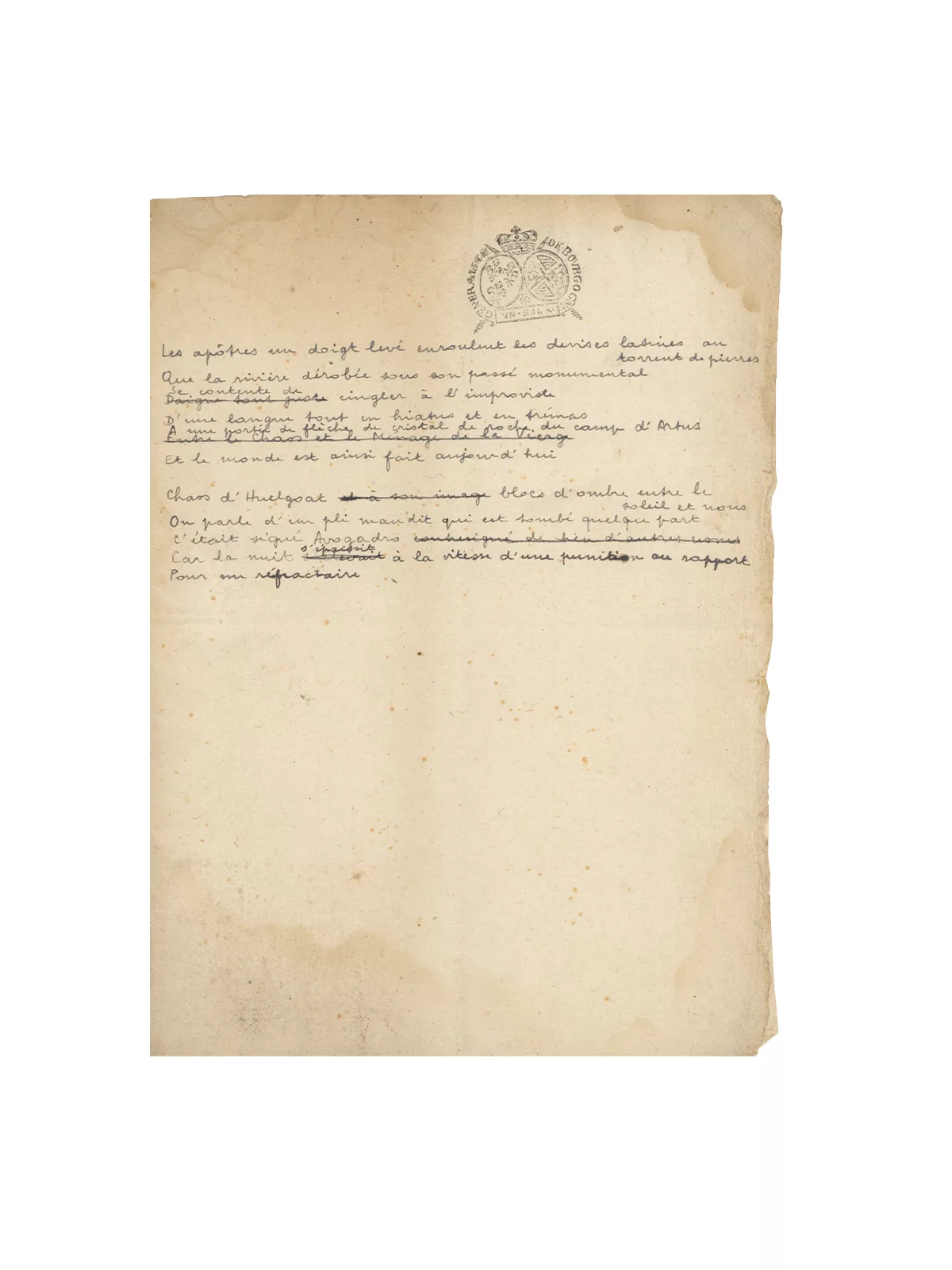
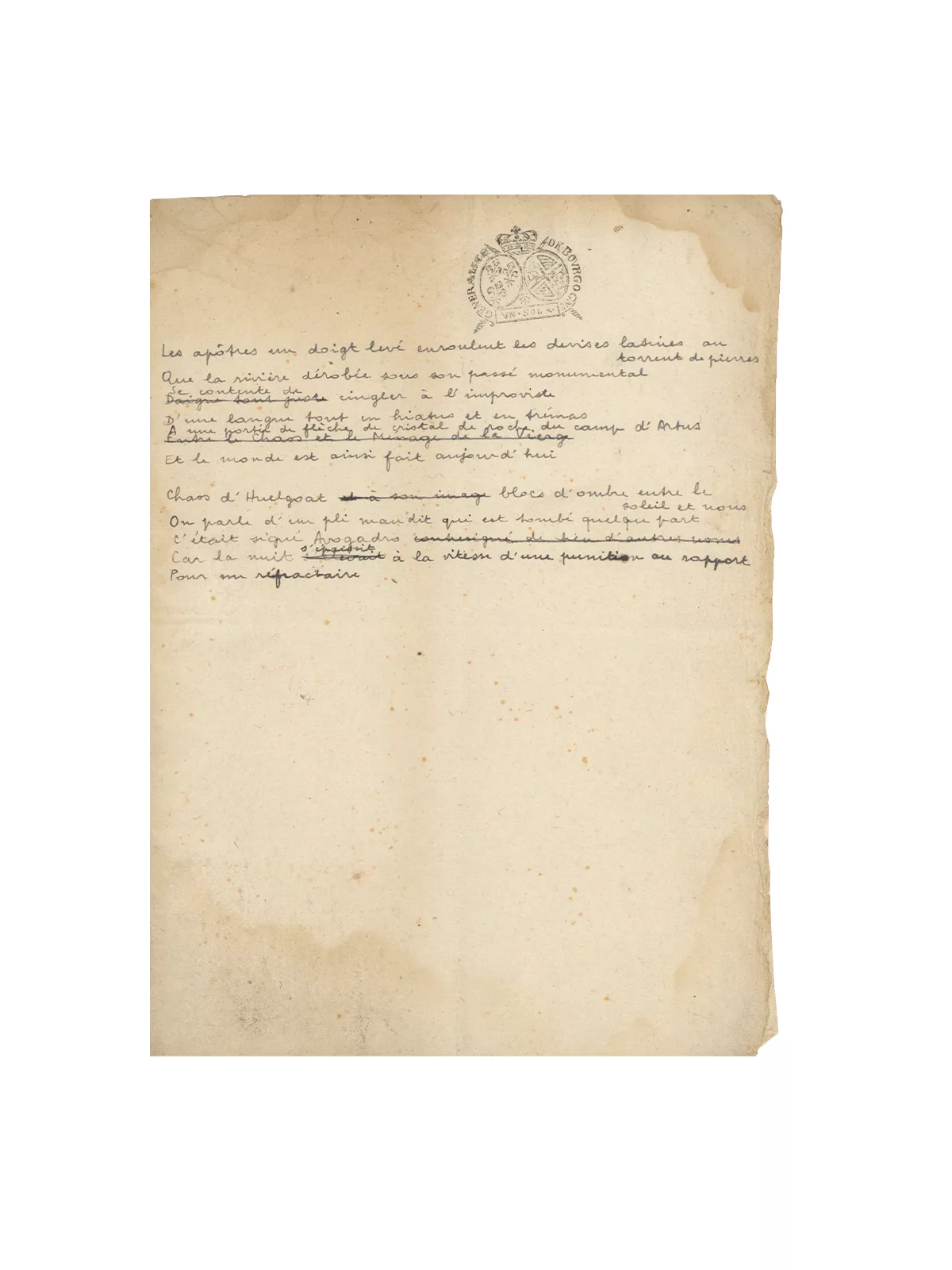
« Les Apôtres »
Étienne-Alain Hubert, in the Œuvres complètes, dates this text to 1946. It is written on reused antique paper, strictly identical to that used by Breton to reply to an article by René Huyghe published in Les Cahiers du Sud in March 1952. It is a classic stamped paper bearing the combined arms of France and Burgundy, the royal crown and two swords, with the legend “Généralités de Bourgogne” and, in the cartouche, the tariff value, here twenty sols. This paper was used for administrative documents.
The poem evokes the Chaos du Moulin, an enchanting site at the foot of the lake in the village of Huelgoat, in the Monts d’Arrée, bordering the river Fao, nicknamed “the Silver River.” It winds among countless moss-covered chaotic rock formations of strange shape, a “torrent of stones,” as Breton calls it, said to be the work of Gargantua: the irascible giant supposedly hurled boulders there to avenge himself on the inhabitants of Huelgoat for their poor welcome.
The “camp d’Artus,” also mentioned in the poem, was the largest Gallic camp in Gaul, covering thirty hectares. Its main rampart is described by Julius Caesar in De bello gallico, VII, 23. It lies a few leagues from the Chaos.
Huelgoat may have drawn André Breton for its literary associations: Victor Segalen died there on 21 May 1919, holding his Shakespeare in hand, on a promontory overlooking the gorge; Paul Sérusier painted several works there; and it is also the ancestral land of Jack Kerouac, whose forebear François-Joachim Le Bihan, sieur de Kervoac, was born in Huelgoat. It was probably through Yves Tanguy that Breton visited the area: the most Breton of the Surrealists grew up a few kilometers away, in Plestin-les-Grèves, and owned a house nearby, which inspired Breton’s poem “La Maison d’Yves Tanguy.”
Provenance: André Breton sale, 2003.