

Memoirs
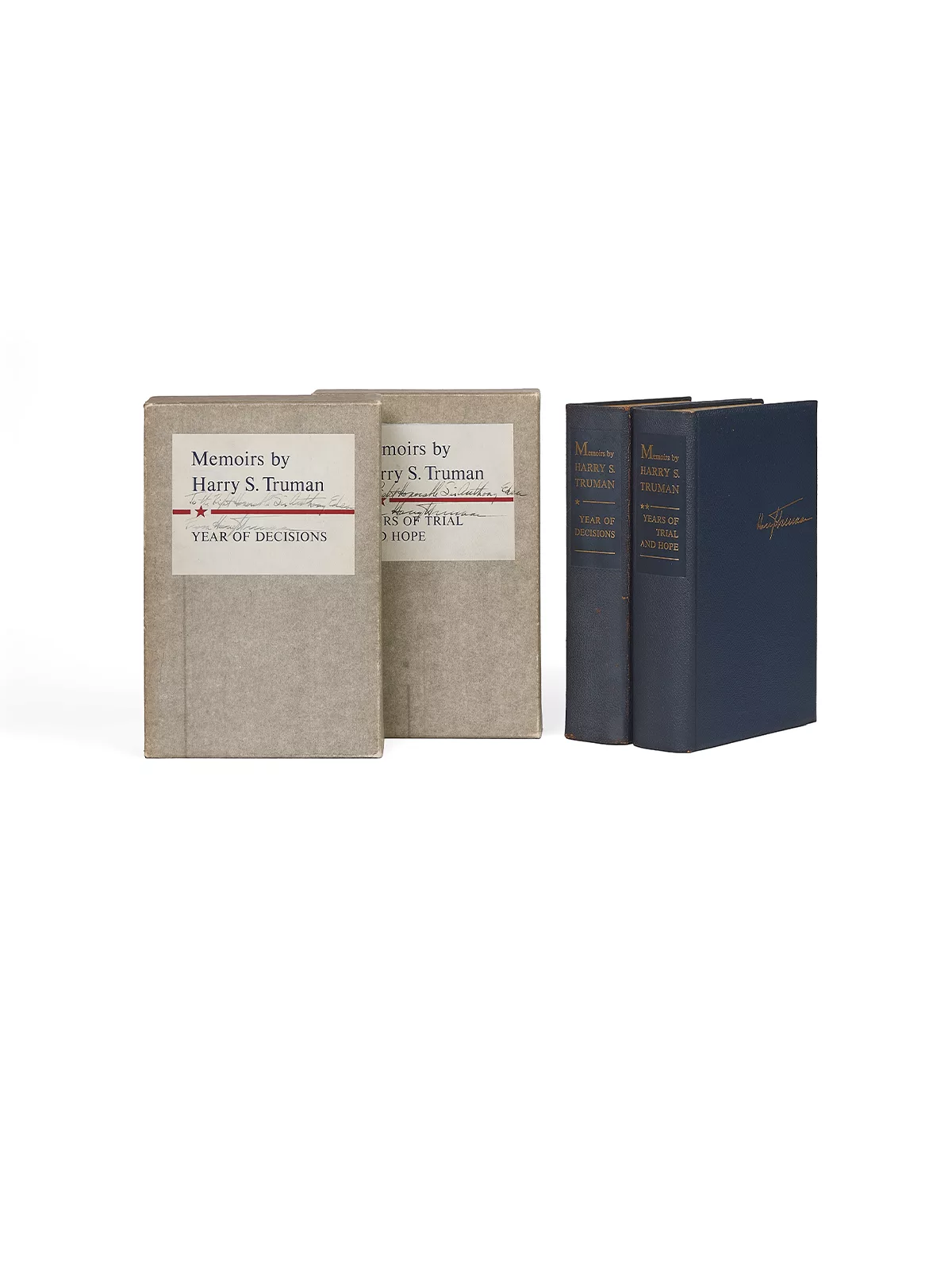
Deluxe printing, reserved for and financed by President Truman: one of 101 copies bound in morocco, for the account of the American president.
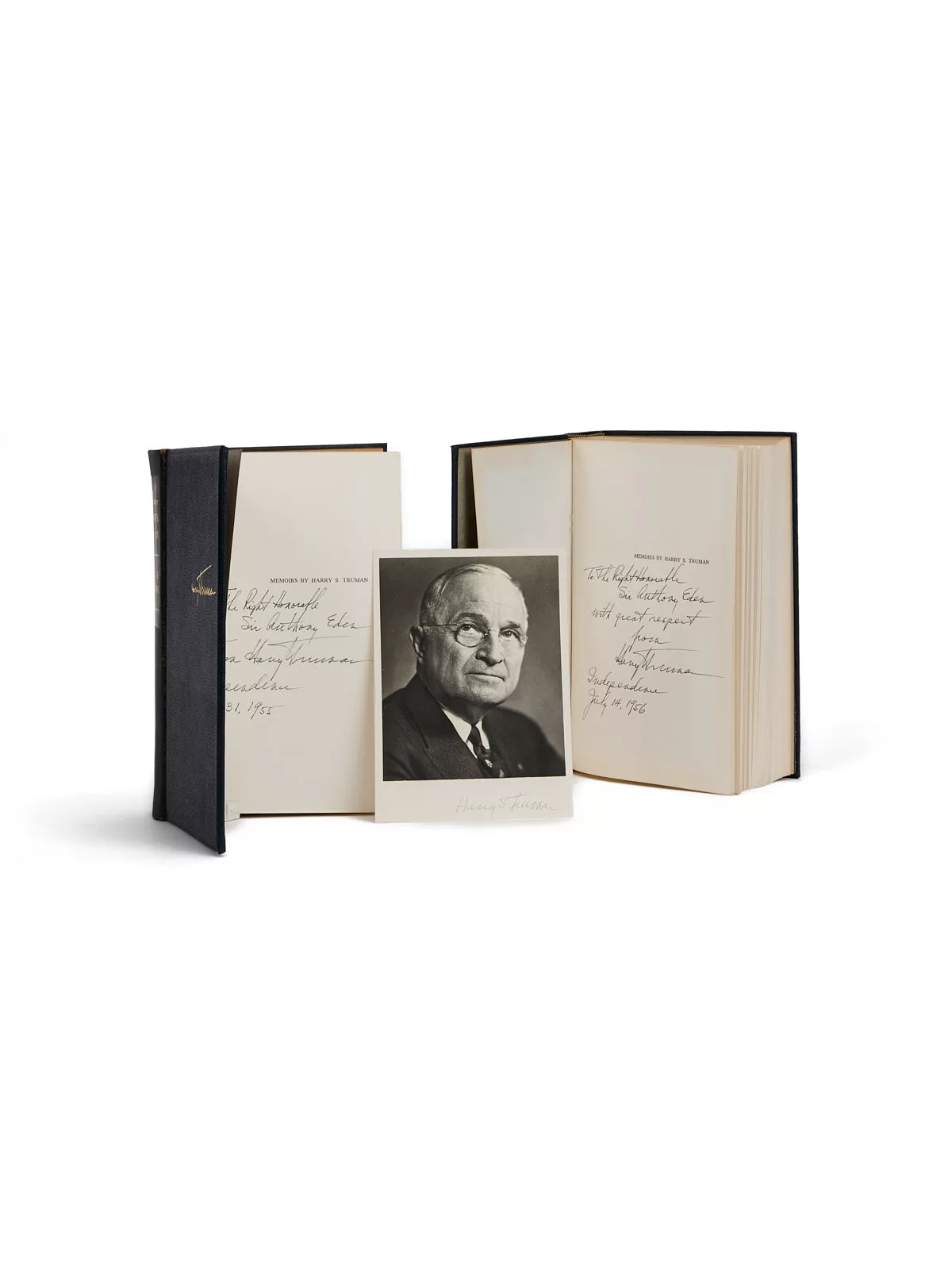
Signed presentation inscriptions:
“To the Right Honorable Sir Anthony Eden from Harry S. Truman Independence Dec. 31, 1955” in volume 1;
“To the Right Honorable Sir Anthony Eden with great respect from Harry S. Truman Independence July 14, 1956” in volume 2.
A precious copy presented to the sitting British Prime Minister, Anthony Eden.
Anthony Eden served as Churchill’s Foreign Secretary from December 1940 to July 1945. He therefore plays an important role in Truman’s Memoirs and is involved in all the diplomatic disputes among the great powers during those years, which Truman recounts at length.
Truman became president upon Roosevelt’s sudden death on April 12, 1945. It was Anthony Eden who represented Britain at Roosevelt’s funeral — Churchill had decided that he could not “lose interest in events in Europe” at that time — and Eden met Truman for the first time on that occasion. Eden “quickly formed a positive opinion of the new president, describing him as ‘honest and friendly’ and appreciating his integrity and humility in his new position. In this assessment of one of the most remarkable modern American presidents, Eden was ahead of his time, cabling Churchill that same evening: ‘was struck by the president’s air of quiet self-confidence’…” He was also pleased that Truman had so quickly become “a warm friend and admirer of Britain and its Prime Minister, and was certainly no isolationist” (Rhode James, p. 294).
After their surprise defeat in the July 1945 general election, Eden served under Churchill as Deputy Leader of the Conservative Party, then returned as Foreign Secretary in Churchill’s second government before succeeding him as Prime Minister and party leader in April 1955. Both volumes therefore appeared, and were presented, during Eden’s premiership (April 1955 to January 1957). Truman, for his part, had just completed the second of his terms as President of the United States (April 12, 1945, then November 2, 1948 to January 20, 1953).
In the months following the inscription of the second volume, Anthony Eden oversaw the invasion of Egypt during the Suez Crisis, a debacle that led to his resignation, due in part to opposition from the United States under Eisenhower, Truman’s Republican successor from January 1953. This crisis is often regarded as marking the effective end of Britain’s empire and superpower status, a status in which both Churchill and Eden had deeply believed.
Eden’s reflections on Truman’s Memoirs are unknown to us, but one passage evidently affected him, since he placed an exclamation mark in pencil in the margin of vol. II (p. 64), beside the statement that both Truman and the American ambassador to China, Patrick J. Hurley, believed “that America should be the champion of anti-imperialism in Asia,” and he also annotated the comment that Hurley’s peace agreement in China “never bore fruit” (p. 65).
The standard edition of the first edition of Truman’s Memoirs appeared in the usual publisher’s boards and dust jacket from Doubleday & Co., while a signed deluxe edition was also planned, to be sold at $35. Truman objected to this, feeling that he could not “engage in a program which would give the impression that I am selling autographs instead of a book” (letter to the editor-in-chief of Doubleday, July 1, 1955, quoted in Ferrell, p. 319), a position he considered unworthy of a former President of the United States. However, Truman remained drawn to the idea of a deluxe format and asked the publishers to supply him with 500 copies (ibid.) for his own account, which he would give away hors commerce, at his own discretion. Two series were accordingly produced: one in full blue leather binding (as in this copy), the other in full cloth, both housed in slipcases.
The archives of the Truman Library indicate that the statesman was indeed billed for 101 copies bound in morocco and 401 copies bound in cloth, at $10 and $2.80 apiece respectively, for a total (a considerable sum at the time) of $5,533.24. These invoices describe them as a “personal edition” of Truman’s own: he presented numerous copies to dignitaries and close associates over the years, reserving the leather-bound copies for the most important and closest among them.
The copy inscribed to F. D. Roosevelt’s widow, Eleanor, sold for $41,125 at Sotheby’s on February 15, 2001.
Until his death in 1972, Truman still owned and inscribed copies, and a significant number of them were subsequently given back to the White House presidential library and to the Truman Library.
Robert H. Ferrell (ed.), Off the Record: The Private Papers of Harry S. Truman, 1997; Robert Rhodes James, Anthony Eden, 1986.