

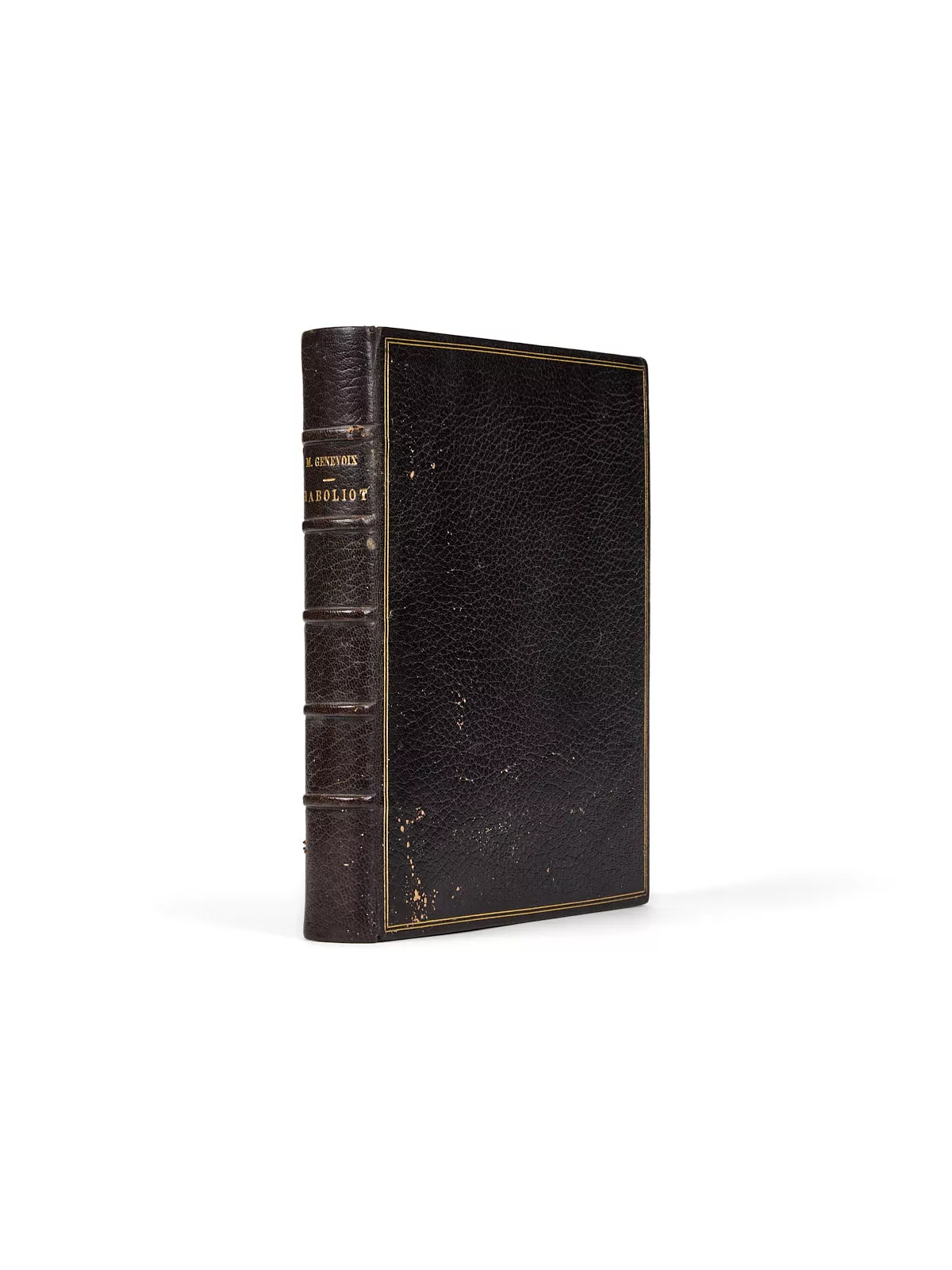
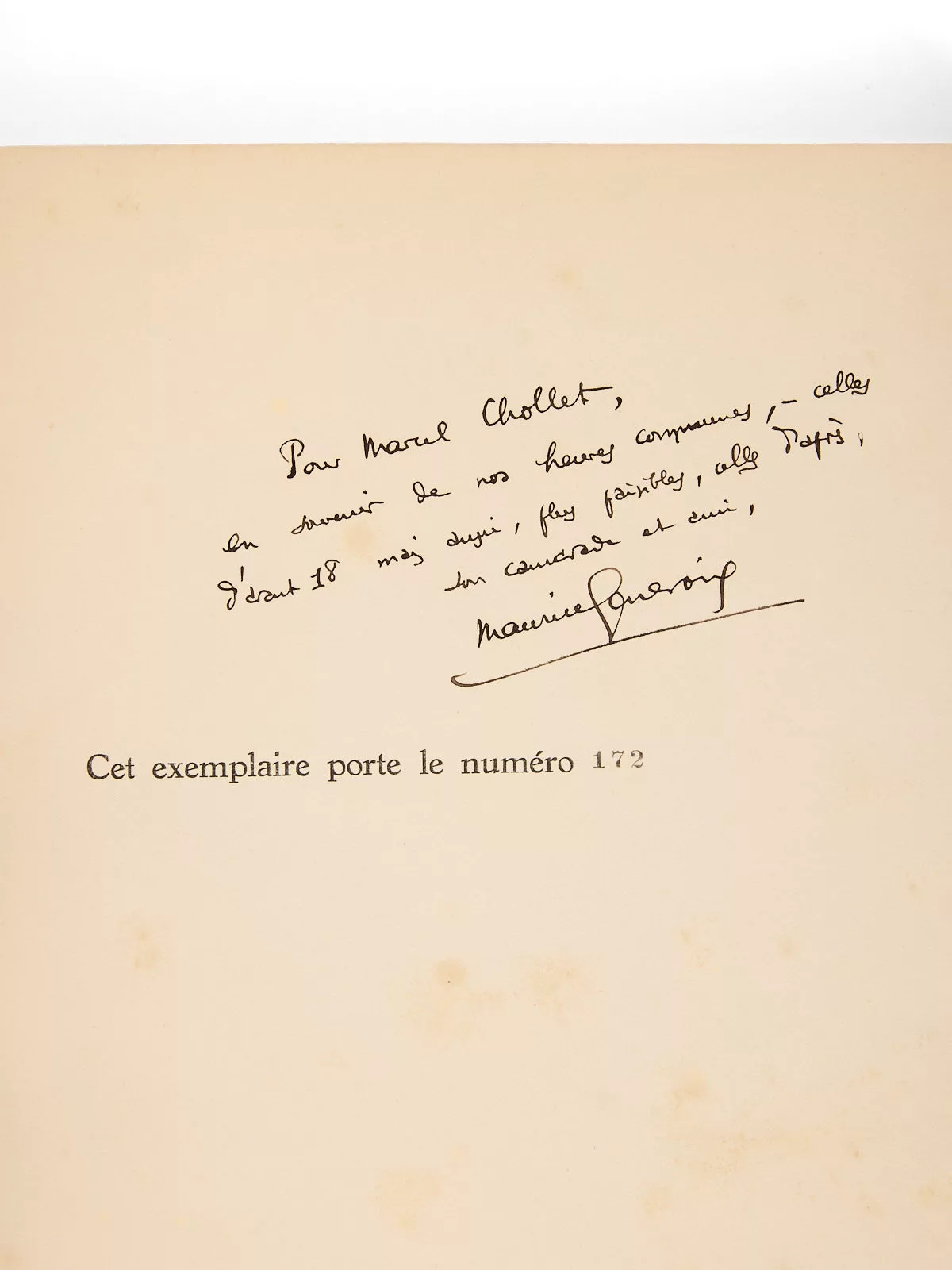

Presentation copy inscribed by Genevoix to Marcel Chollet: “Pour Marcel Chollet, en souvenir de nos heures communes, - celles d'avant 18 mais aussi, plus paisibles, celles d'après, son camarade et ami, Maurice Genevoix.”
One of 950 copies on tinted vélin pur fil (no. 172).
A highly symbolic provenance: Marcel Chollet ran the village hardware store in Brinon-sur-Sauldre, at number 26 Grande Rue.
It was at Brinon that Genevoix’s uncle had acquired a hunting ground after the war, and it was there that Genevoix himself, perhaps yielding to the same call of nature, decided to settle in the summer of 1924: “One evening I shouldered my bicycle, took the local train that would carry me to Brinon. I arrived at dusk, jumped into the saddle, and after six kilometers dismounted in front of the gamekeeper Trémeau’s house” (in Trente mille jours, p. 200). It was on this land, facing the étang des Clouzioux — which becomes the étang de la Sauvagère in the novel — that his ideas took shape: “Sologne is eminently rich in game. The hero of my future novel, a true son of this hunting country, could only be a hunter […] but a hunter by instinct, a free man, indifferent to social constraints, answerable only to his own kind and to the calls that summon and bind him — in other words, a poacher.”
Brinon was the native village of Alphonse Depardieu, known as “Carré,” the “most famous, cunning, skilled and sensational poacher of the region,” with whom Genevoix secured an “audience” in the autumn, as the novel and its cast of characters took shape. A meeting was arranged in Brinon, but it never took place: the suspicious poacher failed to appear.
Genevoix made repeated visits to Brinon-sur-Sauldre, an ideal center for his work: the commune, spanning 11,600 hectares and crossed by some 340 km of rural paths, is simply the largest commune by area in the whole département. Only 132 communes in France cover more than 100 km2.
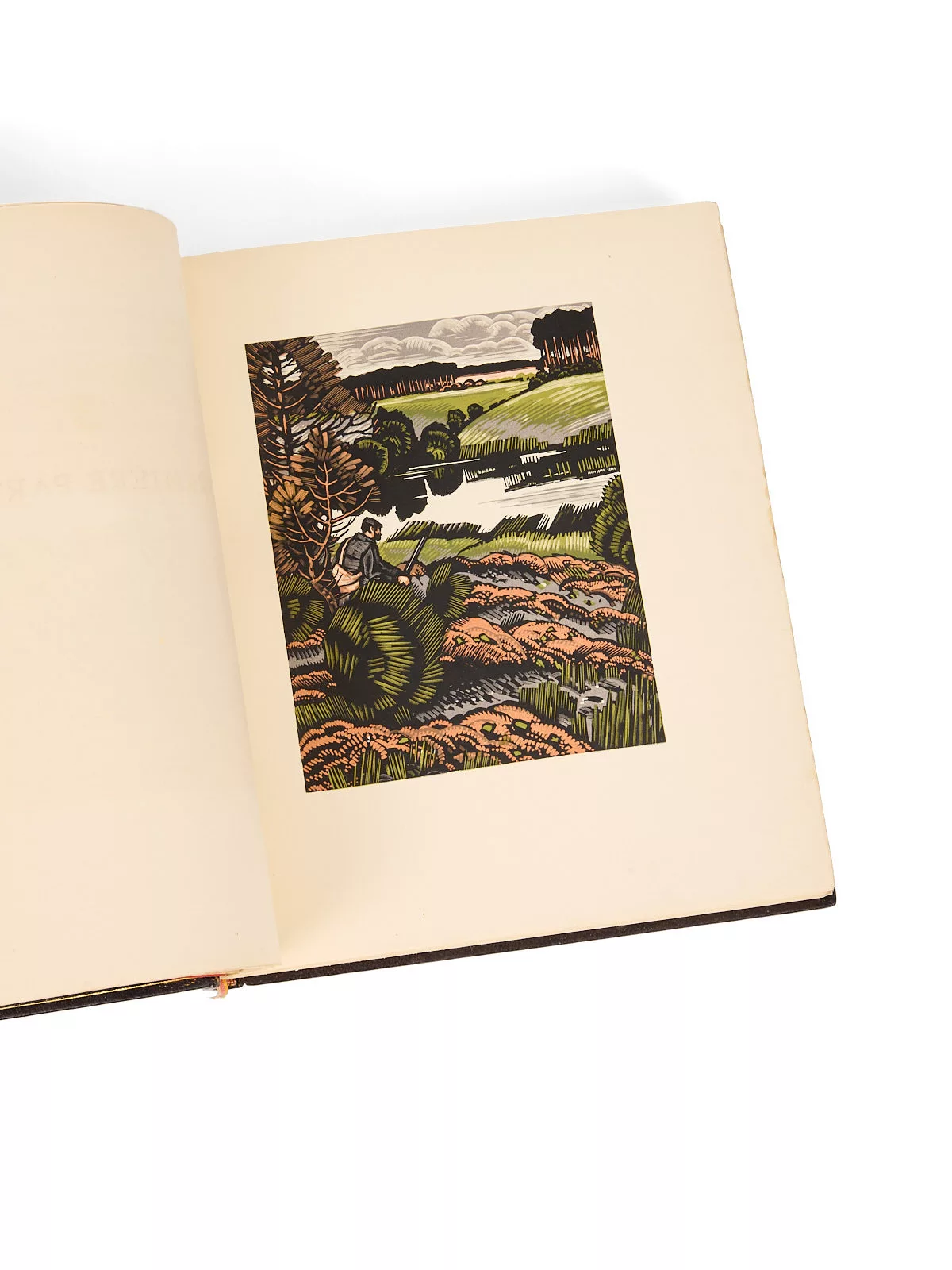
Trained at the École Estienne (graduating in 1922), a pupil of Robert Bonfils, Mathurin Méheut and Léon Jouenne, Joseph Soulas learned wood engraving, then etching under André Jacquemin, and finally burin engraving. Grasset, wishing to publish an illustrated edition of Raboliot, brought about the meeting between Genevoix and Soulas, who stayed several times in Sologne in 1928 alongside the writer to absorb his world. This closeness shows through in the expressive intensity of his engravings.
Soulas later became director of the École régionale des beaux-arts d’Orléans, then deputy curator of the prints department at the Musée des beaux-arts. There he taught wood and copper engraving, as well as sketching and drawing. Genevoix awarded him the Légion d’honneur on 22 October 1950. On 26 March 1954, while hurrying to catch the train back to Orléans, he collapsed from a heart attack at the Gare d’Austerlitz, leaving behind some thirty illustrated books and nearly five hundred engraved plates.
A fine copy, with excellent Sologne provenance.