

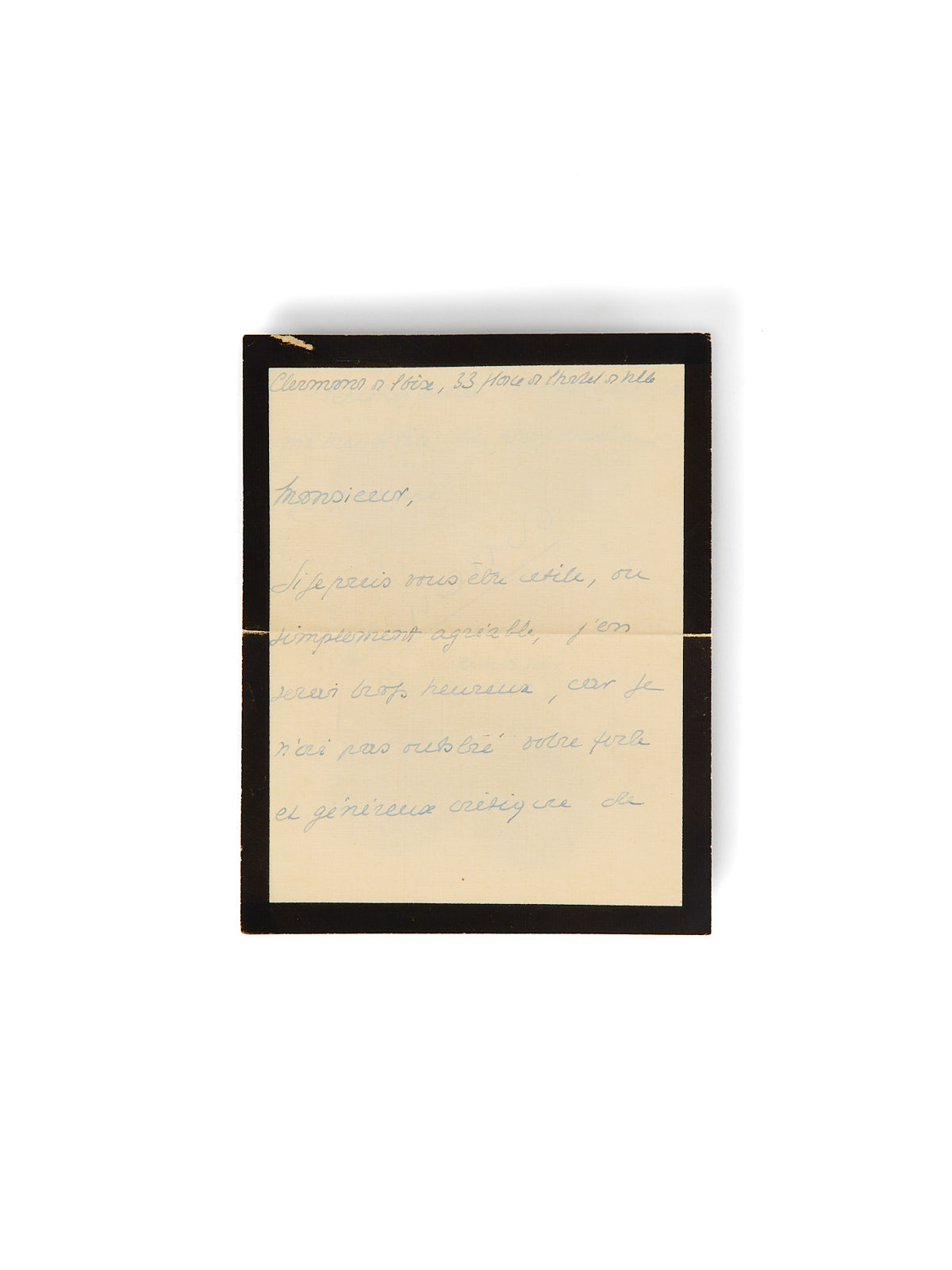
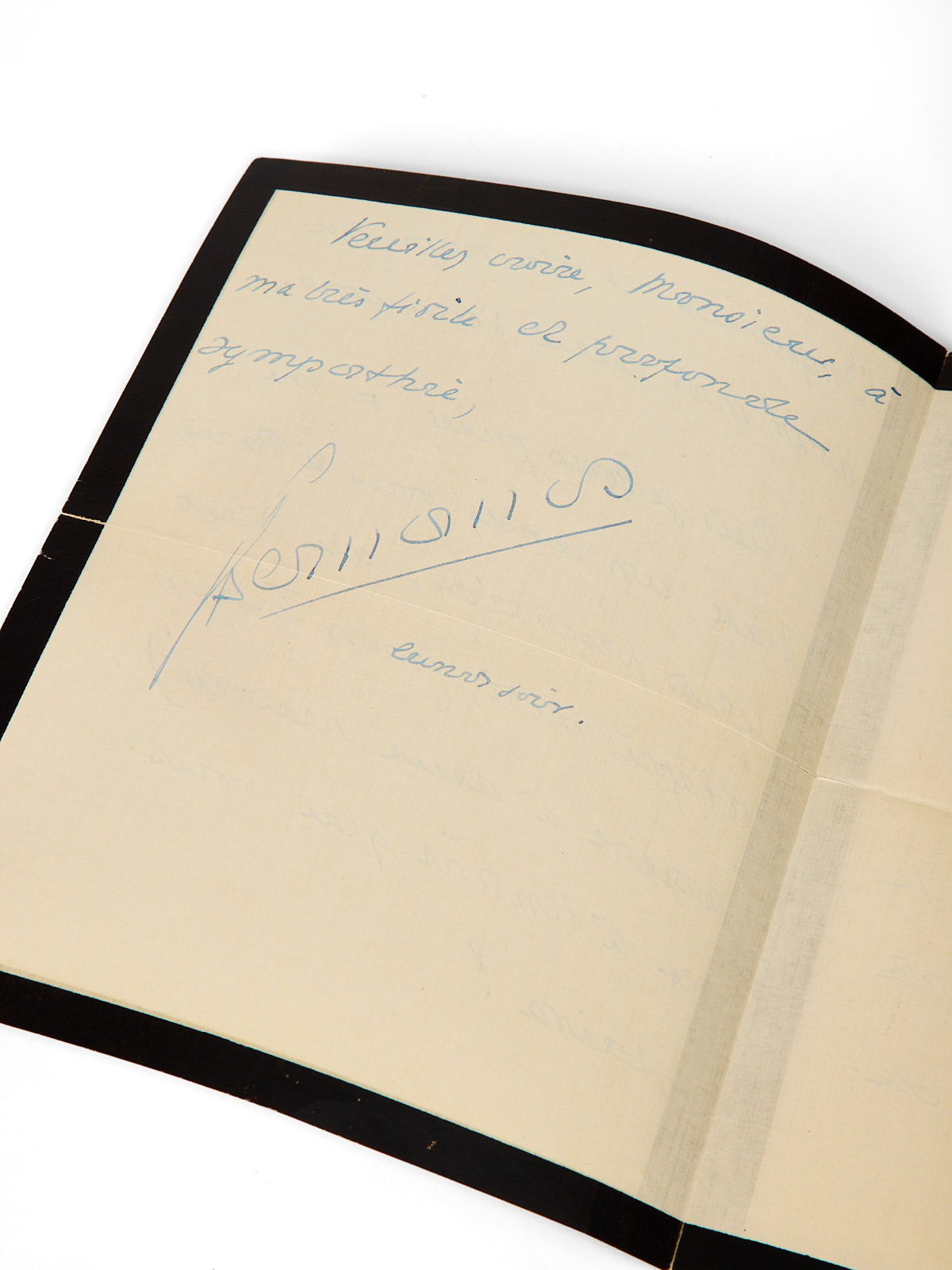
Lettre à André Malraux
“Monsieur, Si je puis vous être utile ou simplement agréable, j'en serai trop heureux, car je n'ai pas oublié votre fidèle et généreuse critique de L'Imposture, et votre nom est pour moi celui d'un ami. Puis-je vous prier de me fixer un rendez-vous à Paris, jeudi prochain, au début de l'après-midi, (mon train arrive à deux heures), et à l'endroit qui vous plaira ? Veuillez croire, Monsieur, à ma très fidèle et profonde sympathie, G. Bernanos. Lundi soir.”
This letter follows Malraux’s article in the N.R.F. (no. 242, March 1, 1928, p. 745), reviewing L’Imposture upon its publication. It represents the first documented trace of a “meeting” between the two writers, “at the moment when Malraux made known his reaction to Bernanos’s second novel […]. Malraux was among the first to perceive the novelty of Bernanos’s fiction, seeing in the dramatic structure of L’Imposture an unmistakable sign that the modern novel had taken over from tragedy” (Joseph Jurt, Malraux et Bernanos face à la guerre civile d’Espagne, Présence d’André Malraux, no. 16, 2018, pp. 73–87).
Malraux, the agnostic, was permanently marked by his reading of Bernanos — so much so that in 1974 (at the request of Jean-Loup Bernanos, the writer’s younger son) he agreed to write a preface for a forthcoming reissue of his father’s complete works at Éditions Plon.
That ambitious project never came to fruition, and the preface was instead used for the paperback edition of Journal d’un curé de campagne, though it first appeared in Le Figaro littéraire (no. 1480, September 28, 1974, pp. 11–12), under the title “Bernanos, le dernier témoin de la pitié sacrée.” A remarkable text, one of the most penetrating pieces ever written on Bernanos. Malraux closed it with these words: “Reviewing L’Imposture upon its publication in March 1928, I wrote in La N.R.F. that in this book it is not the characters who create the conflicts, but the conflicts that give rise to the characters… I would not be surprised if the ‘crises’ appeared to Bernanos even before the characters had taken shape in his imagination. L’Imposture was less accomplished than Journal d’un curé de campagne. But how strange it is to speak of ‘accomplishment’ in connection with a book by Bernanos!”
Georges Bernanos died on July 7, 1948, at the American Hospital in Neuilly. A few days earlier, he had summoned André Malraux to his bedside; Malraux emerged shaken from a four-hour conversation, the content of which was never disclosed. Malraux attended the funeral, though only in a private capacity, and was the sole representative of the literary and political world present — Bernanos, a man who had persistently declined honors, having presumably felt no obligation toward such circles: he refused the Légion d’honneur three times (1927, 1938 and 1946), as well as a seat at the Académie française and offers of ministerial and ambassadorial posts.