

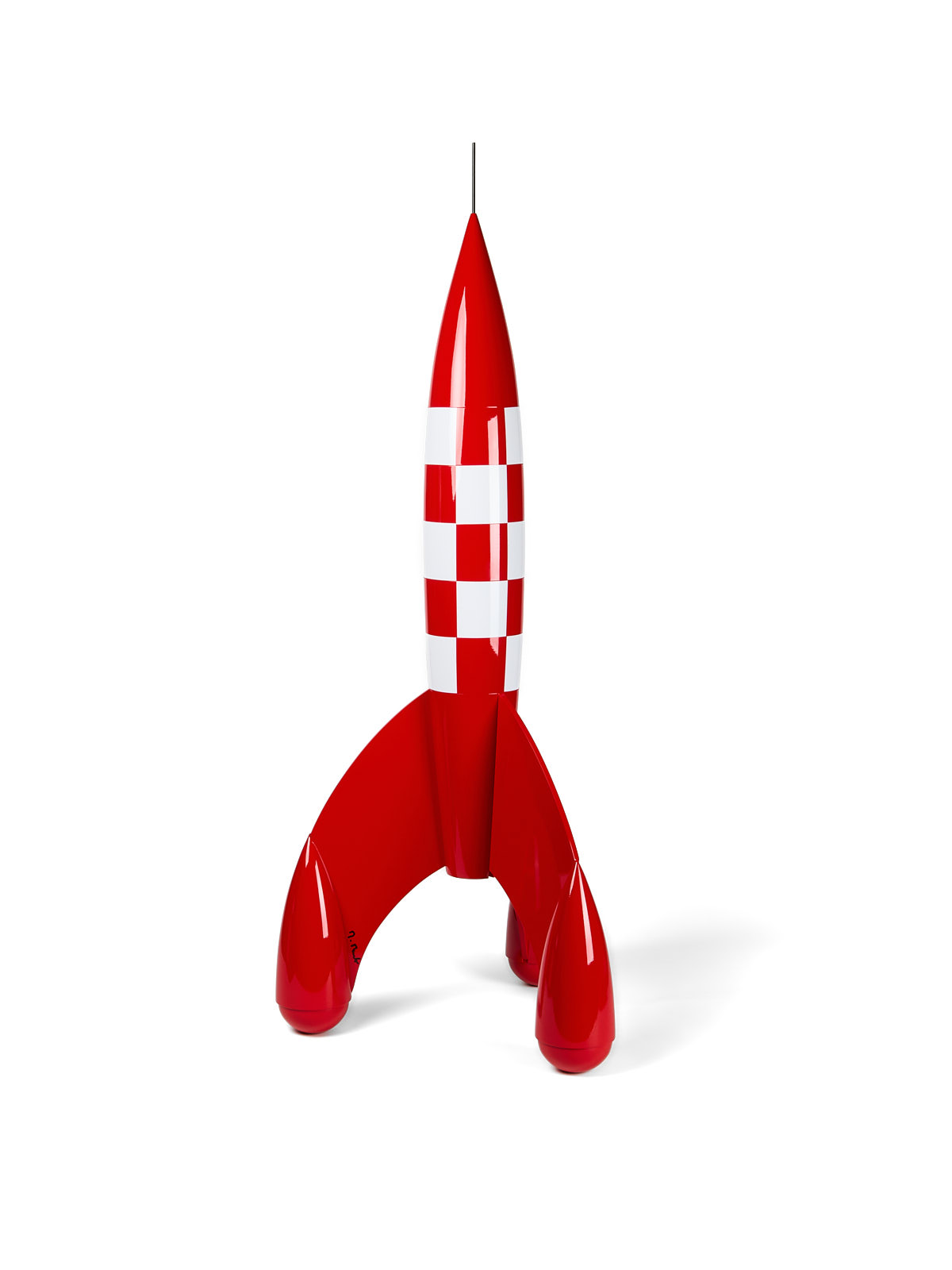
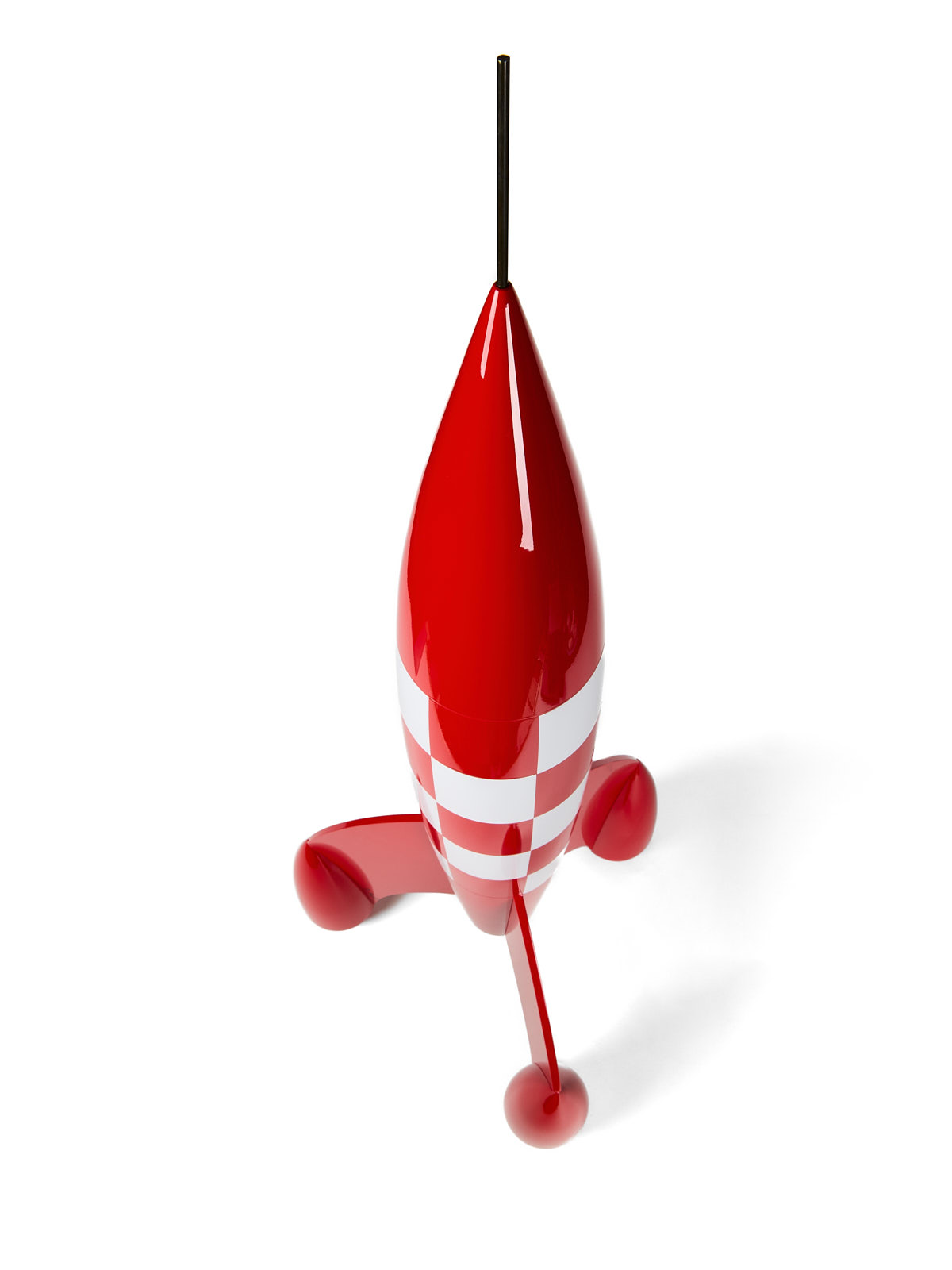
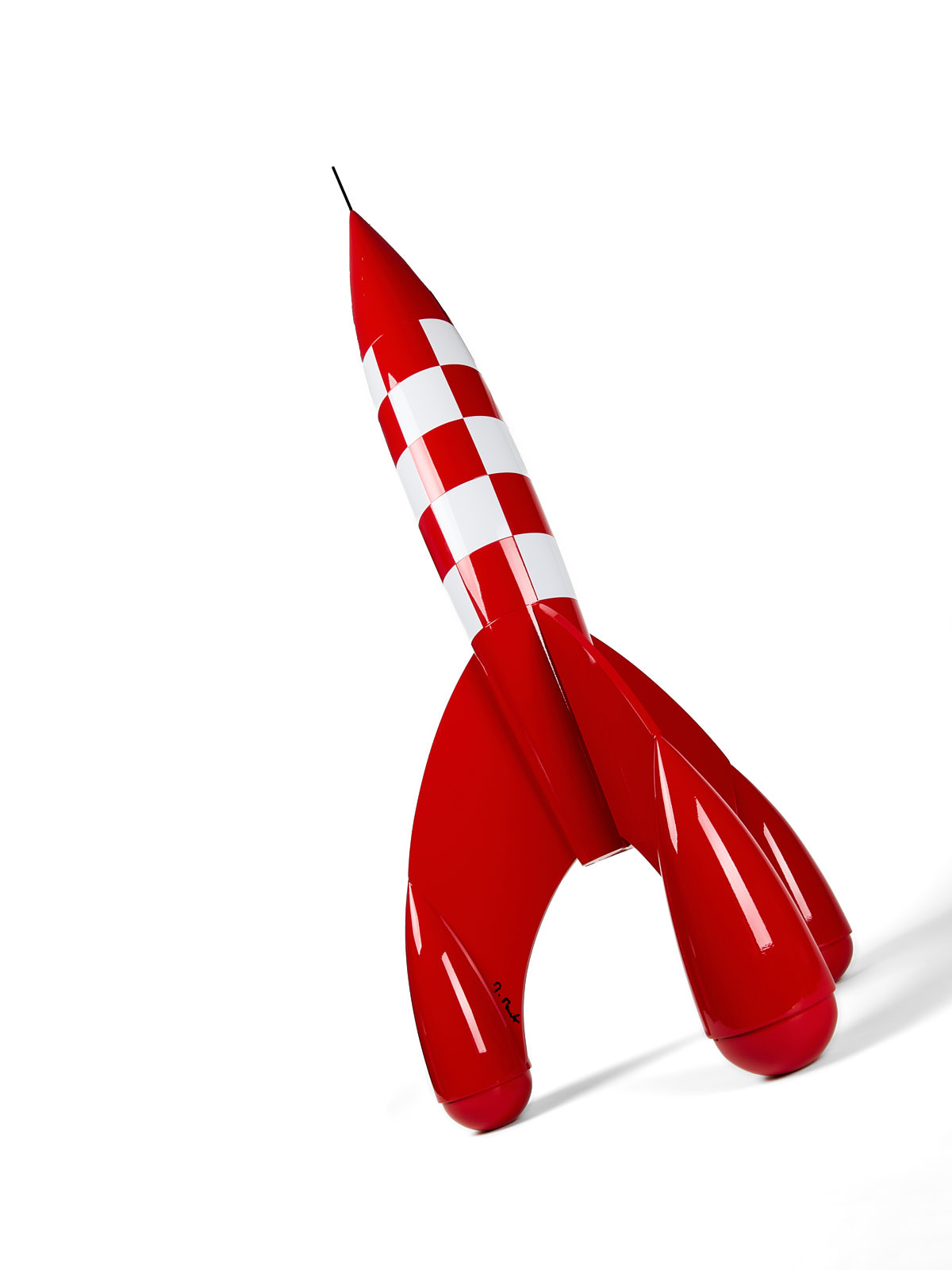
Fusée lunaire de Tintin
The Studios Hergé were founded in April 1950, allowing Hergé to surround himself with assistants. One of the first was Bob De Moor, who assisted him on a freelance basis from March 1950 before being hired full-time in 1954 as chief assistant. He devoted himself first to the diptych Objectif Lune (Destination Moon) and On a marché sur la Lune (Explorers on the Moon), where he was responsible in particular for the sumptuous depictions of the launch base, the lunar surface and the vehicles. His first assignment was the full-page illustration revealing the moon rocket on its launch pad: it took him no less than a month to master its treacherous perspective and vanishing lines.
Hergé, fascinated by science, infused his work with a hyperrealism made possible by his formidable capacity for research, so as to ground each album as firmly as possible in reality. For this story he sought inspiration and advice from two specialists in space travel, Bernard Heuvelmans and Alexandre Ananoff. In March 1950, seven years before the launch of the first Sputnik, Éditions Fayard published Ananoff’s L’Astronautique, which became a recognized classic within the scientific community; it was Albert Weinberg, the creator of Dan Cooper, who recommended Ananoff’s book to Hergé. Hergé was captivated by it, and Ananoff agreed to guide Tintin’s creator through the character’s first steps on the moon. Hergé drew on the book for a wealth of precise details that he reproduced almost exactly, such as the ergonomic couches on which the heroes lie down to withstand the pressure of takeoff, or the wide circular cockpit bristling with instruments, about which he wrote to Ananoff, wishing “that my characters should travel aboard a spacecraft ‘as realistic as possible’… I have read your book… with the keenest interest… and on pages 264 and 265 I found a drawing… showing a number of devices whose purpose I confess I do not know. I have therefore taken the liberty of tracing the drawing and sending it to you, so that you might kindly indicate, next to each number, the name and function of these onboard instruments…” (letter to Ananoff, 18 April 1950).
To thank him and pay him tribute, Hergé prominently drew Ananoff’s book on the corner of the table in the scene where Professor Calculus tests the strength of his new plexiglass helmet with a hammer; this illustration appeared on the cover of the journal Tintin of 11 May 1950.
Hergé used prototypes to draw the rocket’s equipment and drew on established knowledge of outer space and the moon; he commissioned Arthur Vannoeyen to build a composite-material model to serve as a reference, giving Bob De Moor a model so that the rocket, and particularly its internal structure, would appear consistently in every panel. “I wanted Bob De Moor, when drawing it, to know exactly where in the spacecraft the characters were located. It was essential that every detail be in its proper place, that everything be perfectly worked out,” he explained. Galvanized by the scale of the project, he involved himself in every aspect: he visited the Acec Atomic Research Center in Charleroi and corresponded with its director, Max Hoyaux, guided throughout by a principle he never abandoned: the rejection of fantasy or science fiction. “I could have depicted monstrous animals, incredible beings, two-headed creatures, and made a fool of myself… So I took a thousand precautions: no Selenites, no monsters, no fabulous surprises!” he explained to Numa Sadoul in the celebrated Entretiens avec Hergé (Casterman).
His lunar adventure anticipated the Apollo 11 mission by nearly fifteen years before Neil Armstrong set foot on the moon. What generations of readers of these two albums remember above all, of course, is the red-and-white checkered rocket, the true heroine of On a marché sur la Lune and a symbol not only of Hergé’s work but of comic strip art in general.
Michel Aroutcheff took up the iconic rocket in 1986, producing lacquered wooden replicas. The first series came in five sizes: 11.5 cm, 23 cm, 37 cm, 67 cm and finally 114 cm, the largest version. A new version, designed in the 1990s, culminated in a final large size with the creation of a 160 cm rocket, made in about thirty copies. “The plans are in the album, and I used them as the basis for creating a replica, which I then produced in different sizes,” he recounts. Before doing so, Michel Aroutcheff had the courtesy to seek authorization from Hergé’s widow. “I was the first to obtain a license!” Since then, relations with the Moulinsart company, which manages all rights relating to the artist’s work, have grown considerably more strained, with two lawsuits, both won by Aroutcheff. “The court recognized that this was a creation, not a copy or a counterfeit,” he explains. “Essentially, I own the volume and proportions of this rocket, and they own the drawing. So no replica can be made without my authorization” — nor, henceforth, without theirs.
Absolutely mint condition, without a single scratch.
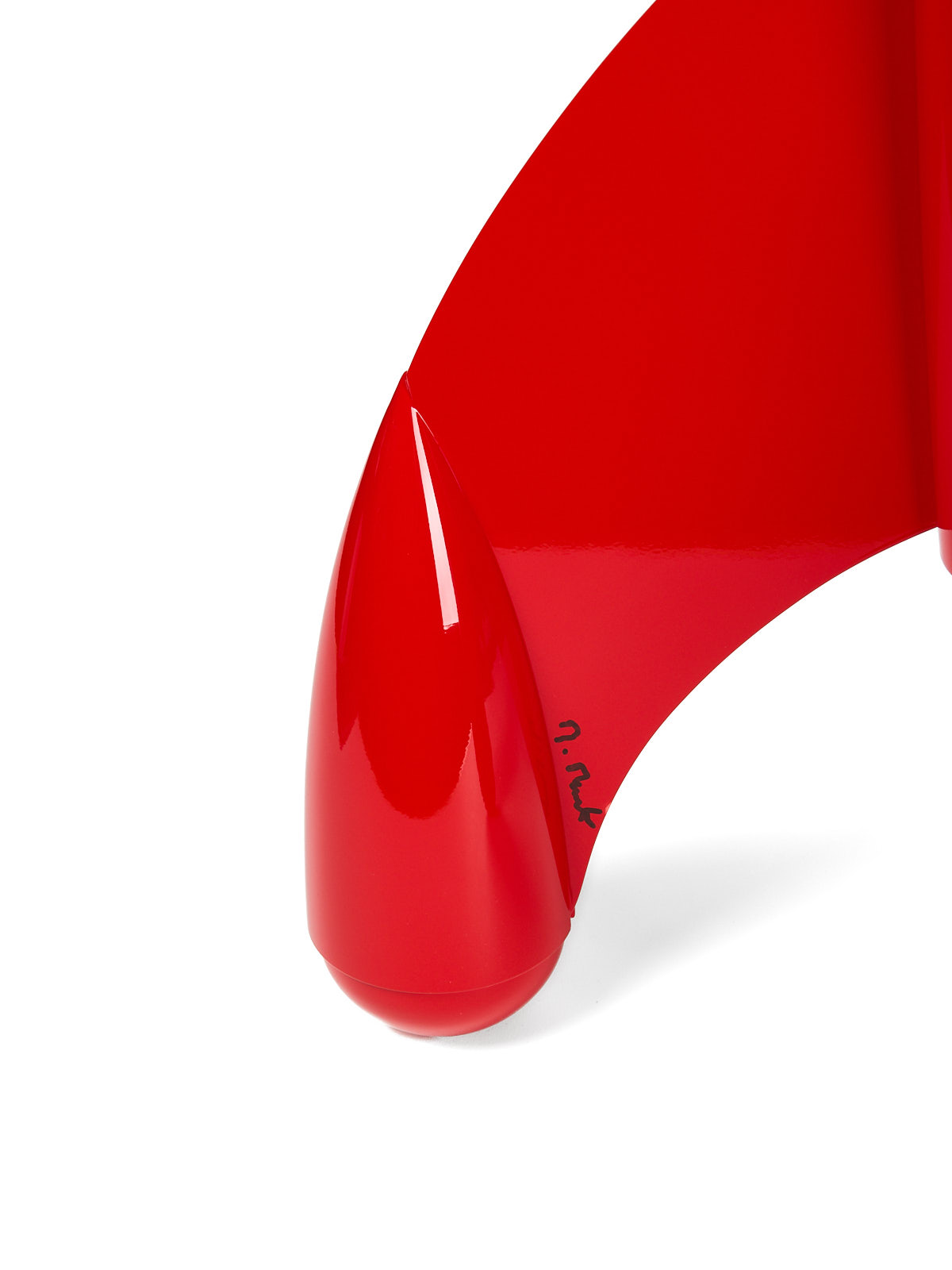
Exceptional condition, moreover signed by Aroutcheff.