

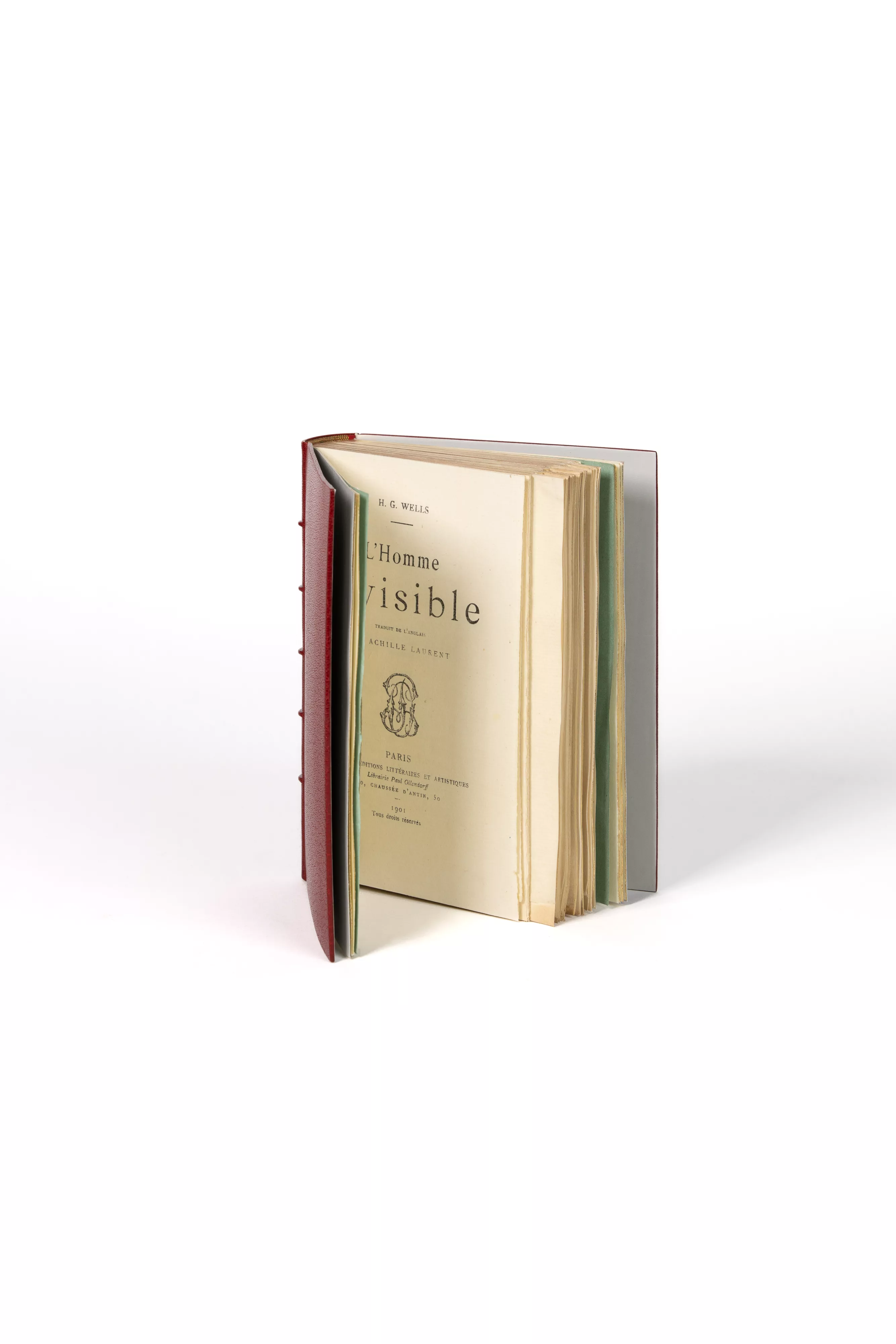
L’Homme invisible
One of the first 5 copies on Hollande paper (no. 5).
Although he did not invent it, H. G. Wells gave lasting shape to the myth of the invisible man with this novel, which exploits every resource of scientific romance and establishes its author, alongside Jules Verne, as a great pioneer of science fiction and speculative fiction. In three years, Wells produced four masterpieces of the genre: The Time Machine (1895), The Island of Doctor Moreau (1896), The Invisible Man (1897) and The War of the Worlds (1898). Through the power of his extraordinary imagination, he introduced a powerful literary method — science fiction — to interrogate the future of humanity, the boundary between the natural and the monstrous, the benefits and dangers of science, and, more broadly, our place in the universe and the vulnerability of the human species.
The Invisible Man is by far the most psychological of Wells’s early scientific romances, and certainly the most human-centered. At once satire, farce and tragedy, this “grotesque romance,” as its original subtitle describes it, tells the “strange and terrible career” of Griffin, the scientist who discovers “the subtle secret of invisibility.” Centuries earlier, Plato’s Republic told the story of the ring of Gyges, by means of which a shepherd could vanish at will. Wells transposes this figure into a scientist ruined after some fifteen years of fruitless research, who at last discovers the formula for invisibility: he tests it on himself, notably to escape his creditors, but can no longer return to visible human form, trapped in a body that neither emits nor absorbs light.
Like the shepherd with the ring of Gyges, Griffin exploits his new power with complete lack of morality. Like Plato’s character, who seduces the queen, murders the king and takes his place, Griffin does not hesitate to cheat and to use his invisibility to free himself from responsibility for his actions: spying on people, robbing them, terrorizing them and committing murder.
The text was first serialized in Pearson’s Weekly in 1897, before being immediately published in book form. Its French translation, given by Achille Laurent in La Revue de Paris from November 1900 to February 1901 and then in book form in March, met with great success, definitively establishing Wells’s reputation.
A copy with all margins, unopened, in its plain temporary wrappers, the five deluxe copies on Hollande paper being, as is customary, without the publisher’s printed wrappers.