


Choix de poèmes
Copy B among the 12 deluxe copies on China paper (the only deluxe paper).
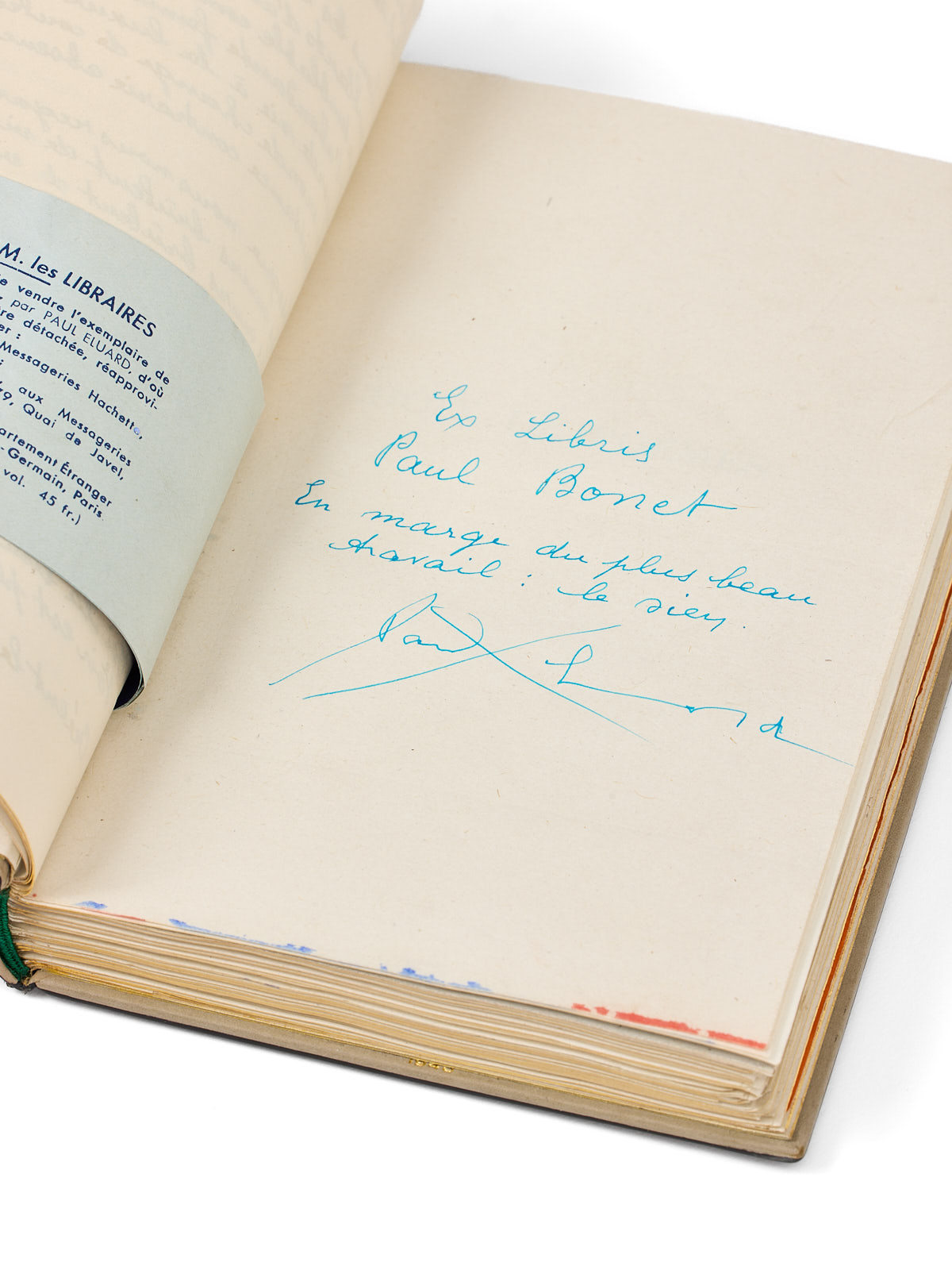
Signed presentation inscription: “Ex libris Paul Bonet En marge du plus beau travail : le sien Paul Eluard.”
Bound in at front:
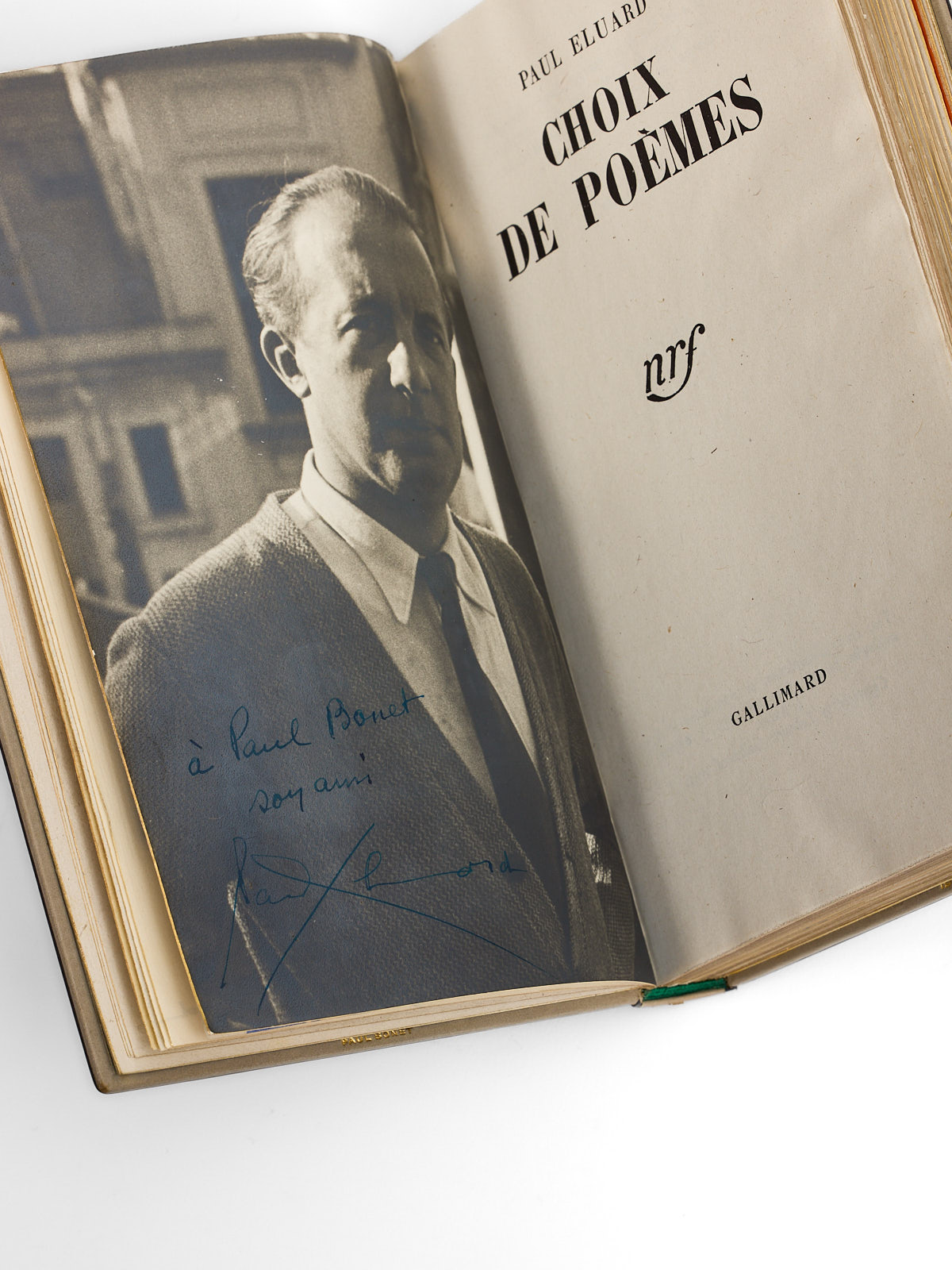
– an original photographic portrait (182 x 114 mm) of Paul Éluard, placed as frontispiece and inscribed to the binder: “à Paul Bonet / son ami / Paul Éluard,” a silver print on “Agfa Brovira” paper;
– an autograph manuscript signed by Paul Éluard of the poem “Sous l’angle d’or” (44 lines on 2 p., in-12, in black ink on fine vellum paper). This poem was first published in L’Arbalète (no. 5), in Lyon, in spring 1942; it was subsequently collected in Le Livre ouvert II (Paris, N.R.F., 1942), close to the poem “Tant de livres” dedicated to Paul Bonet;
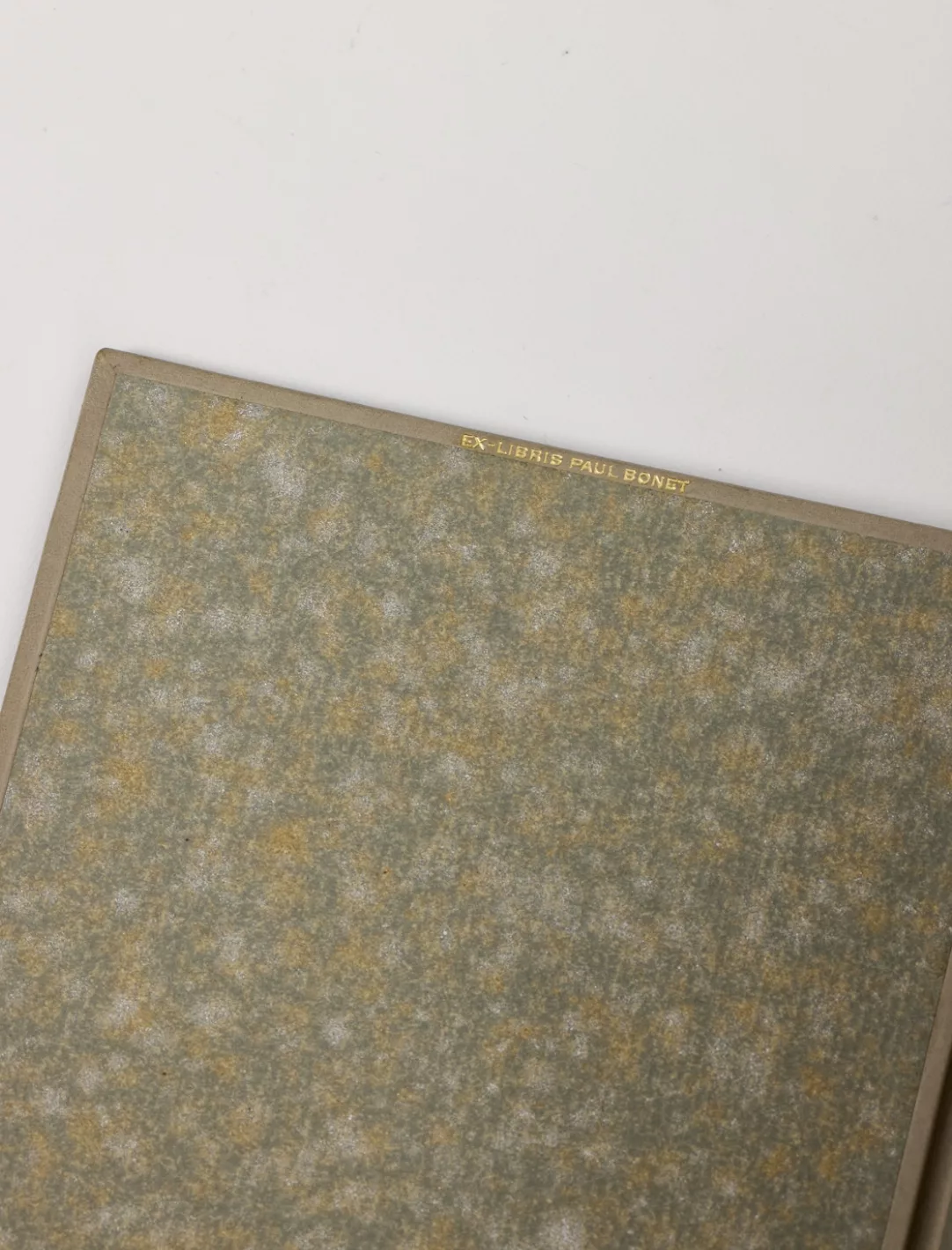
– an original cover from the “cartonnage Bonet,” blocked on simili-parchment, signed in gilt by the binder, from the special printing of 250 copies in this specific issue;
– the original publisher’s wraparound band and the publisher’s insert.
This collection is the poet’s first composite volume, in which he sought, for the first time, to gather what he regarded as the best of his poetry, from his first collection, Poèmes (1914), to Le Livre ouvert (1941), passing through all his major books: Le devoir et l’Inquiétude (1917); Pour vivre ici (1918); Poèmes pour la paix (1918); Les Animaux et leurs Hommes (1920); Les nécessités de la vie et les conséquences des rêves (1921); Répétitions (1922); Mourir de ne pas mourir (1924); Capitale de la douleur (1926); Les Dessous d’une vie ou la Pyramide humaine (1926); Défense de savoir (1928); L’Amour la Poésie (1929); À toute épreuve (1930); La vie immédiate (1932); La Rose publique (1934); Facile (1935); Les Mains libres (1937); Cours naturel (1938); Donner à voir (1939); Chanson complète (1939) and finally Médieuses (1939).
After this publication, Paul Éluard went into hiding, definitively from September 1942 with the appearance of Poésie et Vérité 1942. After the war he published only a few minor collections, partly because of the tragedy of losing his wife Nusch, who died in 1947; he survived her by five years. Choix de poèmes thus remains the most complete and richest of Éluard’s poetic anthologies, containing the essential body of his most celebrated and important poems.
The collection mattered to Éluard from the moment of its publication. Issued by Gallimard at the end of 1941, it marked a further step in the recognition of the poet, and of the future Resistance figure: on 12 January 1942, Paris-Soir praised the appearance of “Choix de poèmes, by Paul Éluard (N.R.F.), [which] gives the true measure of this poet’s talent, a genuine poet, a spontaneous poet, by turns sober and tormented, a poet ardently poetic.” Two months later the book reached Max-Pol Fouchet, who enthused in L’Écho d’Alger of 25 March: “Choix de poèmes, just published, overflows with extraordinary beauties, beauties that demand of the reader collaboration, active participation if he wishes to penetrate them. Simple, beautiful love, the intoxication of passion, that warmth which turns the adolescent into a poet and the man into an adolescent, gently expansive and talkative sentimentality — this is not what one should seek in Éluard. He pursues, in the manner of a Poe or a Mallarmé, unique, unalterable, perfect love.” Éluard had certainly won public esteem: “I was surprised yesterday to learn that Choix de poèmes, printed in 3,000 copies, is sold out,” he wrote with satisfaction on 26 June — a record, in under six months.
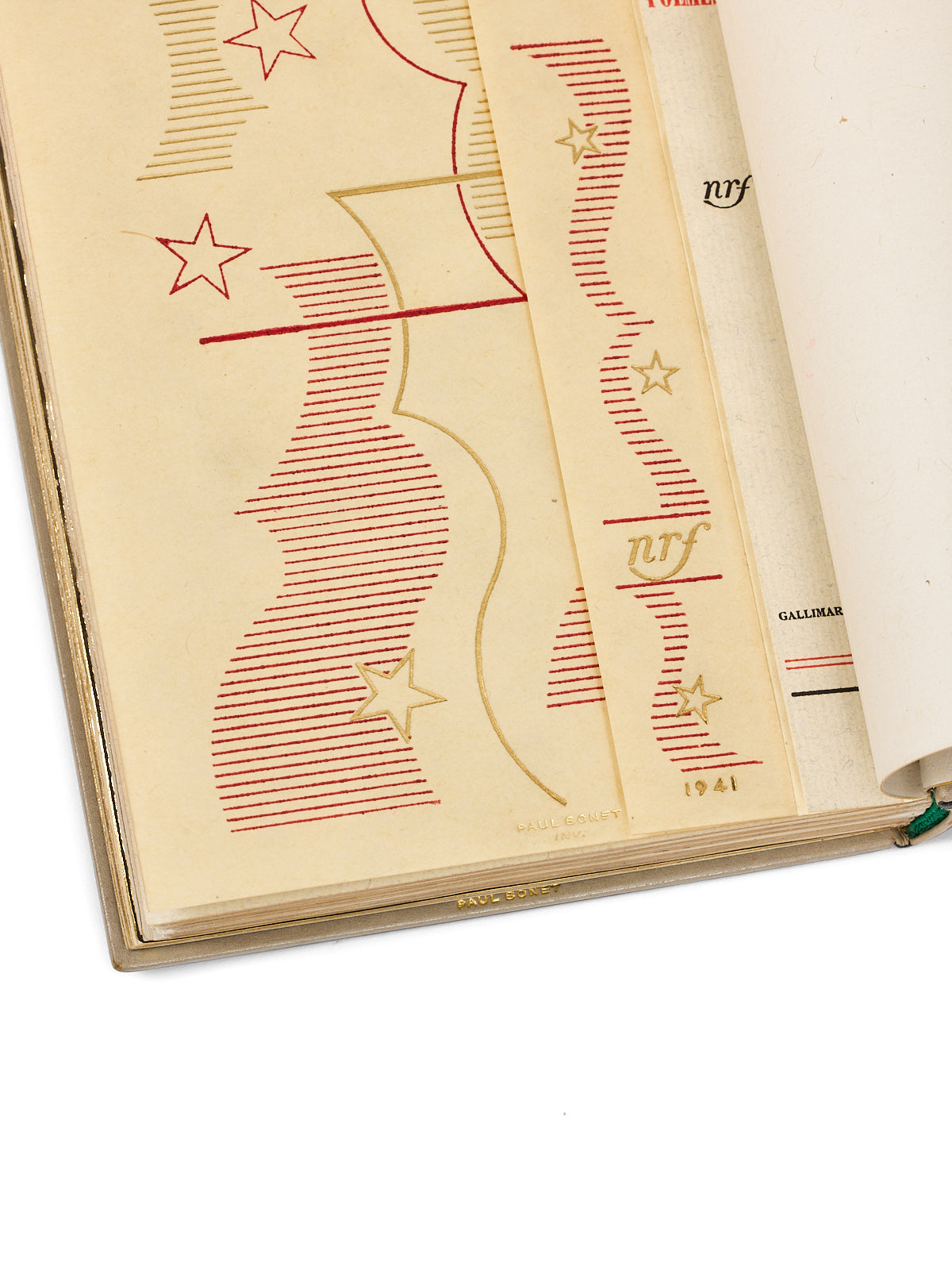
At this date, Paul Bonet was in Paris, busy with his bindings: by October 1942 he already had in hand four copies on China paper of the book: A, B, I, and the hors commerce copy I — Paul Éluard’s own. He began the bindings immediately, working on them in succession or even simultaneously between October and November, finishing them during 1943. He kept the fourth binding, copy B, for himself: Paul Éluard — then in hiding at Lucien Scheler’s home on the rue de Tournon — had entrusted him with a manuscript of a poem, as well as a fine photograph inscribed to him (the only one of the four copies to have it), which is bound in at the front. The binder added his own design for the covering of the cartonnage he had created for Éditions Gallimard — the famous “cartonnages Bonet.” His binding, executed by Lagadec and gilt by André Jeanne, was finished in November 1943, recorded in his Carnets under no. 636, with the note: “décor très léger et aérien.” Bonet produced a fifth and final binding on this title in 1959.
The first four bindings of Choix de poèmes are all accompanied by a variant of Bonet’s design for the N.R.F. cartonnage cover.
It should be noted that the published cartonnage is unsigned: this copy proves that Paul Bonet was indeed its creator. Of the five bound copies, this is the only one that is inscribed. After Paul Bonet, who kept it until his death, it passed into the collection of Daniel Filipacchi (Christie’s, 2004, no. 96), then into another important French collection.
An exceptional copy, and probably one of the most precious copies of this title.
Éluard’s own copy contained no manuscript.