

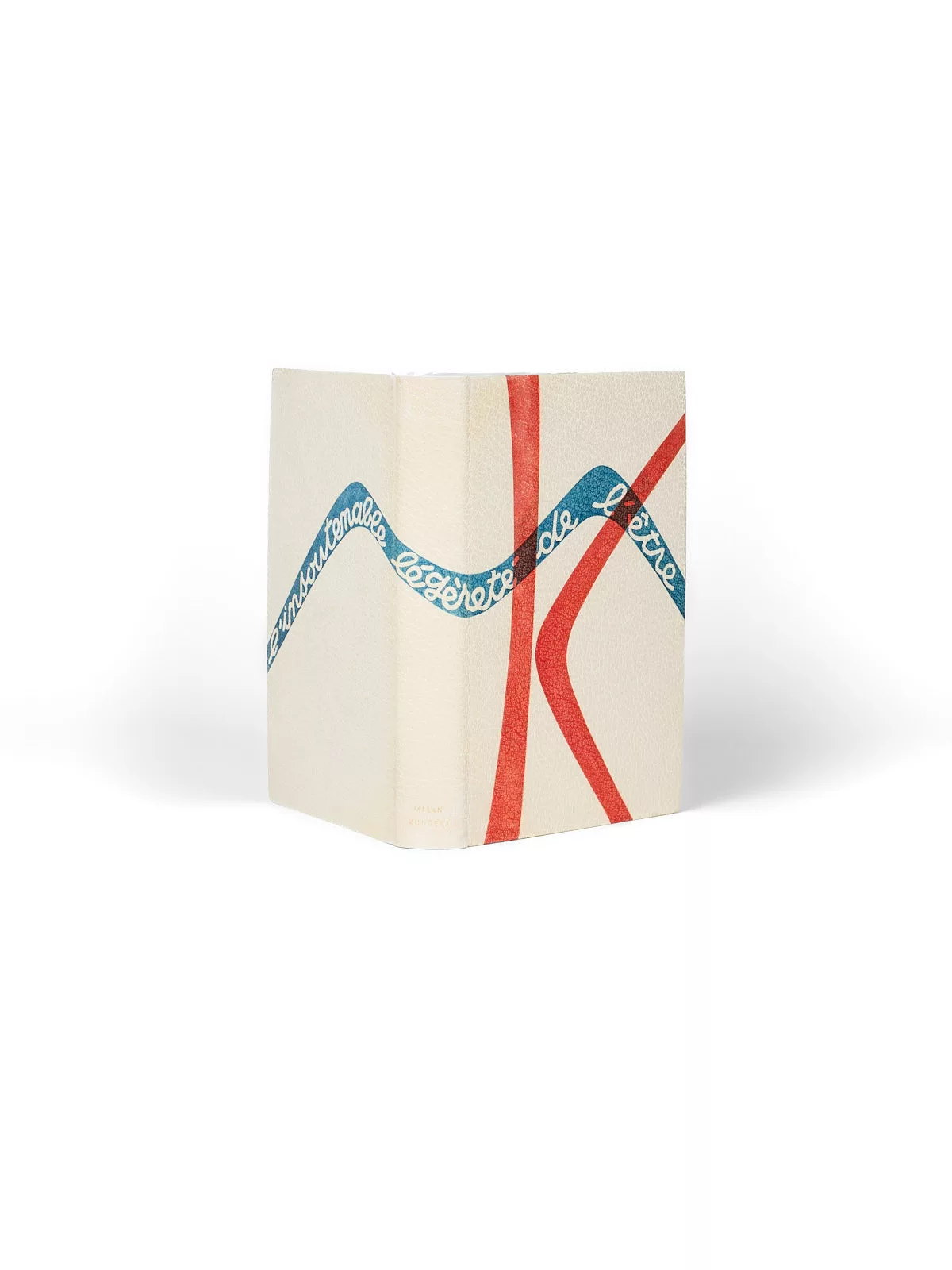

L’Insoutenable légèreté de l’être
One of 23 copies from the deluxe issue on Arches vellum (no. 1).
Presentation copy inscribed by the author to Claude and Colette Gallimard: “À Colette et Claude, en signe de ma vieille et fidèle amitié. Milan. Paris, 1984.”
Accompanied by a postcard sent from Capri: “cher Claude, imagine que je suis obligé de descendre et monter chaque jour le chemin que tu vois sur la carte...”
Probably the most valuable copy of this title in existence — and the only one known combining the deluxe issue with an inscription.
On the novel’s publication, the shrewd and visionary critic Bertrand Poirot-Delpech wrote: “A Czech living in Paris since the Russian invasion of 1968, Milan Kundera is becoming one of the finest living examples of the fruitfulness of hybridization in literature. His latest novel perfects the synthesis, begun with La Plaisanterie, Risibles Amours and La Valse aux adieux, between two European traditions of the philosophical tale: the Eastern one, running from Goethe to Kafka, Musil and Gombrowicz, and the eighteenth-century French tradition, largely lost along the way, which our guest revives, enriched by his forced, then chosen, exile […] In the great reckoning that late-twentieth-century Europe is inflicting on its beliefs in man and history, one will henceforth have to reckon with Kundera’s sumptuous skepticism, which excludes neither gaiety nor tenderness” (Le Monde, 27 January 1984).
To date, only fourteen authors have seen and touched their own works printed on Bible paper in the celebrated Pléiade collection, after first passing through the equally famous — though today increasingly crowded and less finely printed — collections, the “Collection blanche” for French authors and “Du monde entier” for foreign ones. Kundera was granted both collections, as well as the prestigious third.
A valuable provenance: Claude Gallimard had met Milan Kundera in Prague and had smuggled the manuscript of La vie est ailleurs back in his luggage. The novel won Kundera the Prix Médicis étranger in 1973. This marked the beginning of a long collaboration between publisher and author, who recalled: “In 1967, La Plaisanterie was published in Prague; without telling me, my publisher passed it on to the house of Gallimard, where, as the rules required, it was given to a reader to assess — a Czech woman living in Paris; she thought it was worthless. As the proverb says, what begins badly can end well. Antonin Liehm, a brilliant Prague intellectual, brought the book to Louis Aragon, who, unable to read it himself, recommended it to Claude Gallimard, promising to write the preface himself. And the conspiracy of chance continued: Aragon received the translation in August 1968, just as Russian tanks were invading Czechoslovakia. Ah, the tanks — what publicity! That settled everything. Under the Russian occupation, foreign writers occasionally visited their closely watched Czech colleagues. But no major publisher did — except Claude Gallimard. He came several times. And I stress: not as a businessman in search of a bestseller, but as a great European figure trying to support a culture being put to death. (A telling detail: each time, he stayed with Adolf Hoffmeister, a Czech painter, a Surrealist of Breton’s generation, author of an unforgettable series of caricatures of the great modern artists…) Encouraged by Claude, I finished two more novels, the manuscripts of which he carried back to Paris with him, one after the other. Claude Gallimard understood, and, in his subtle, almost shy way, he encouraged my wife and me to emigrate […].” The rest is well known.
A magnificent copy.