

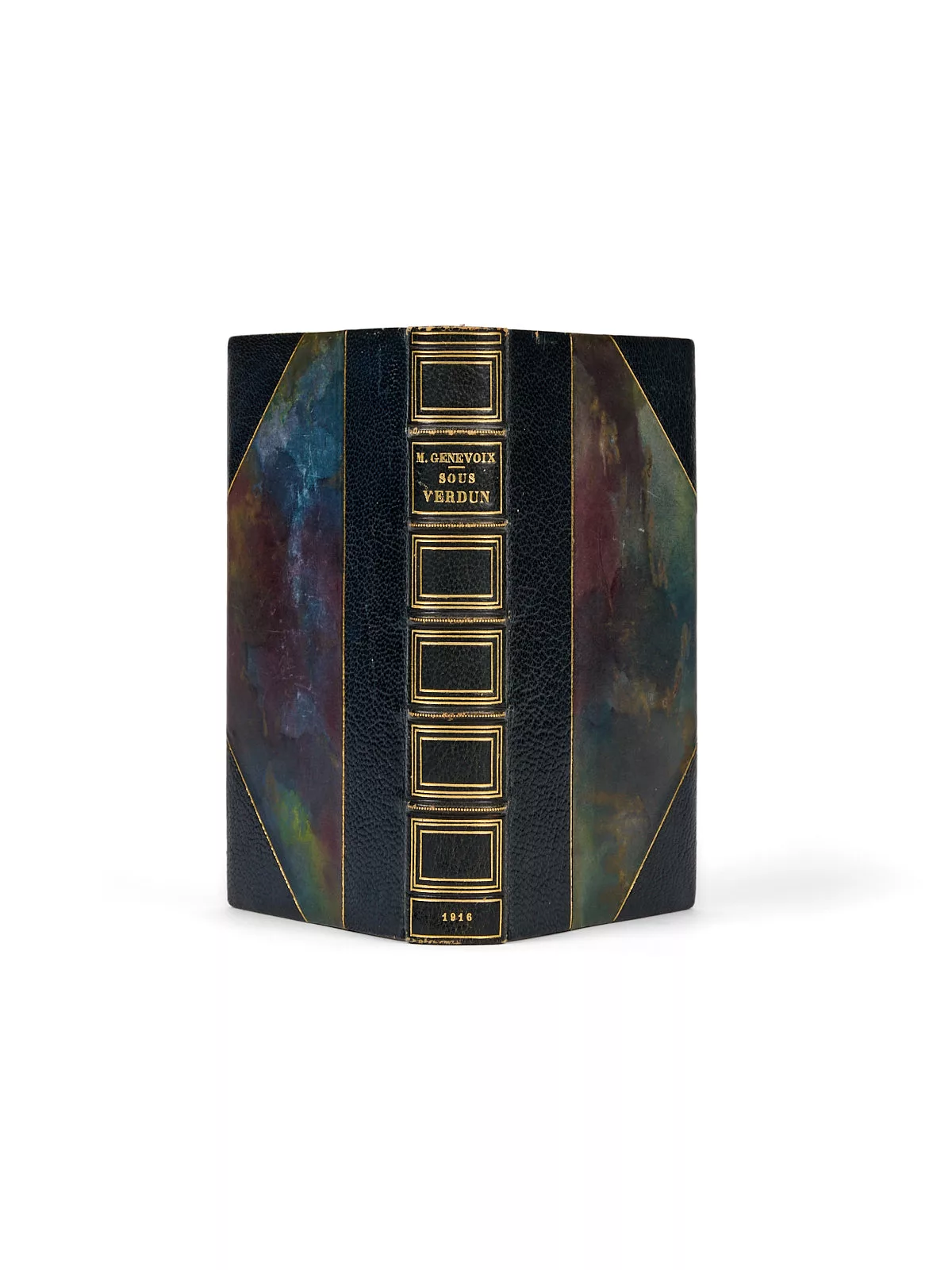
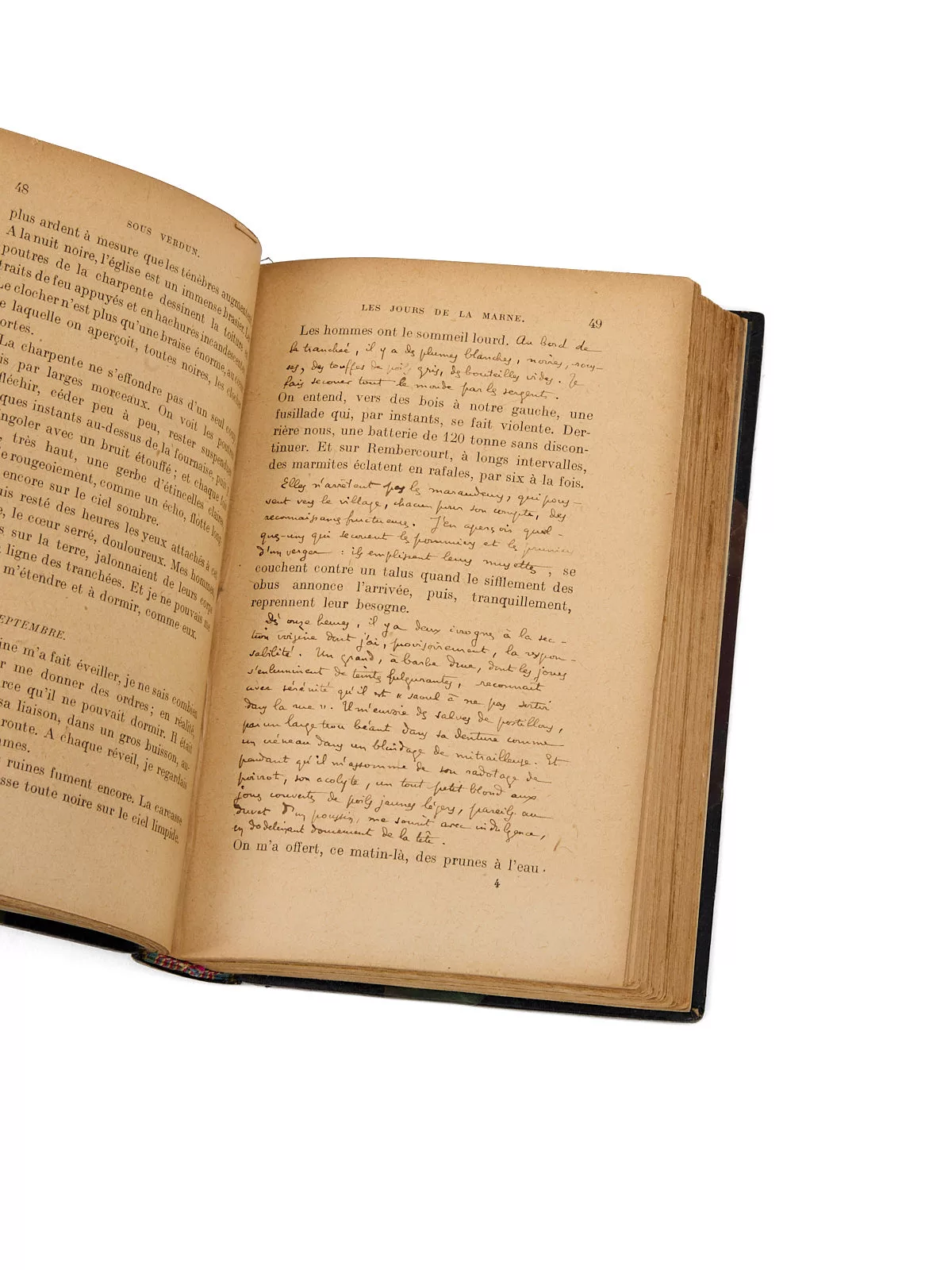
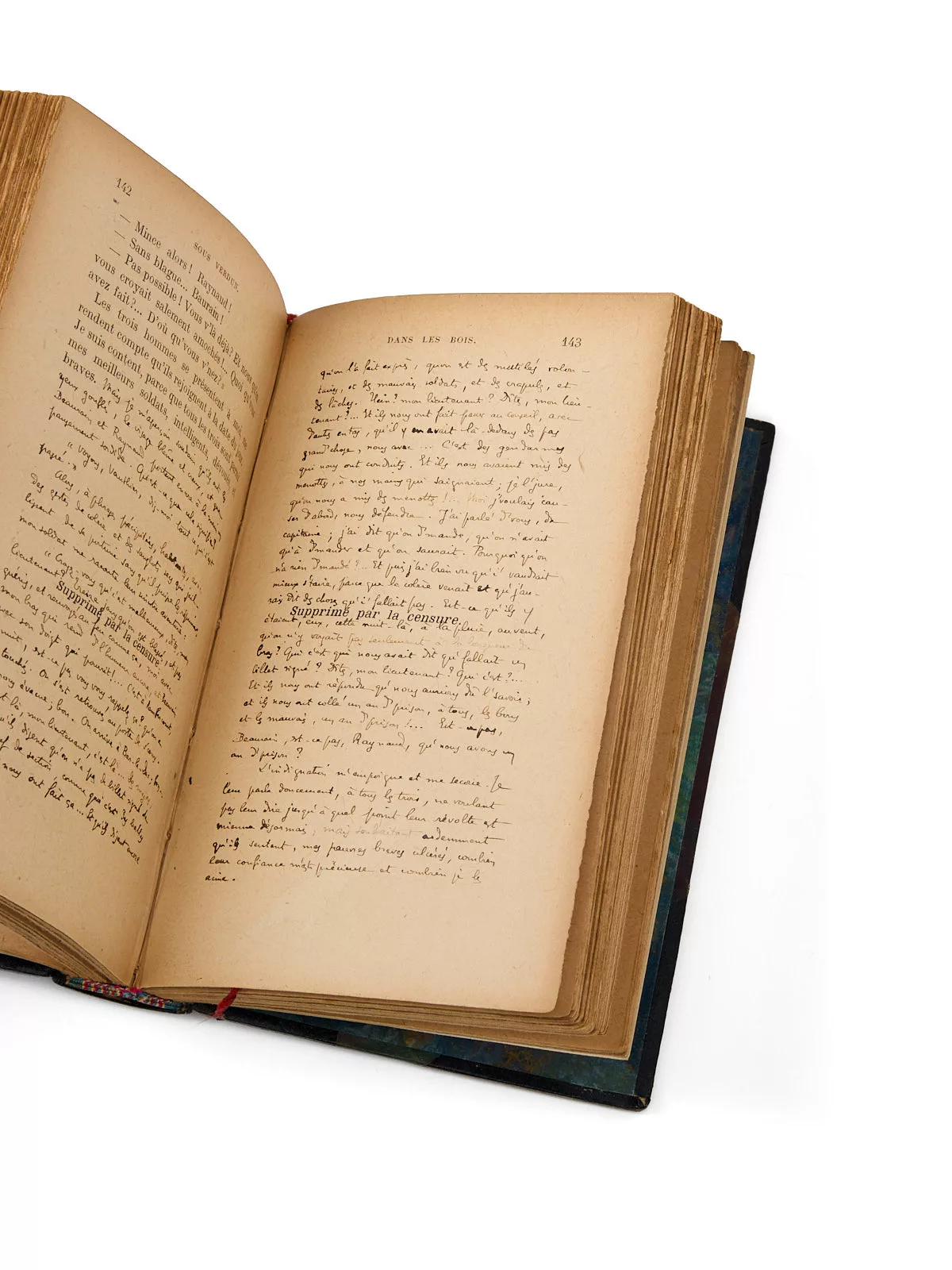
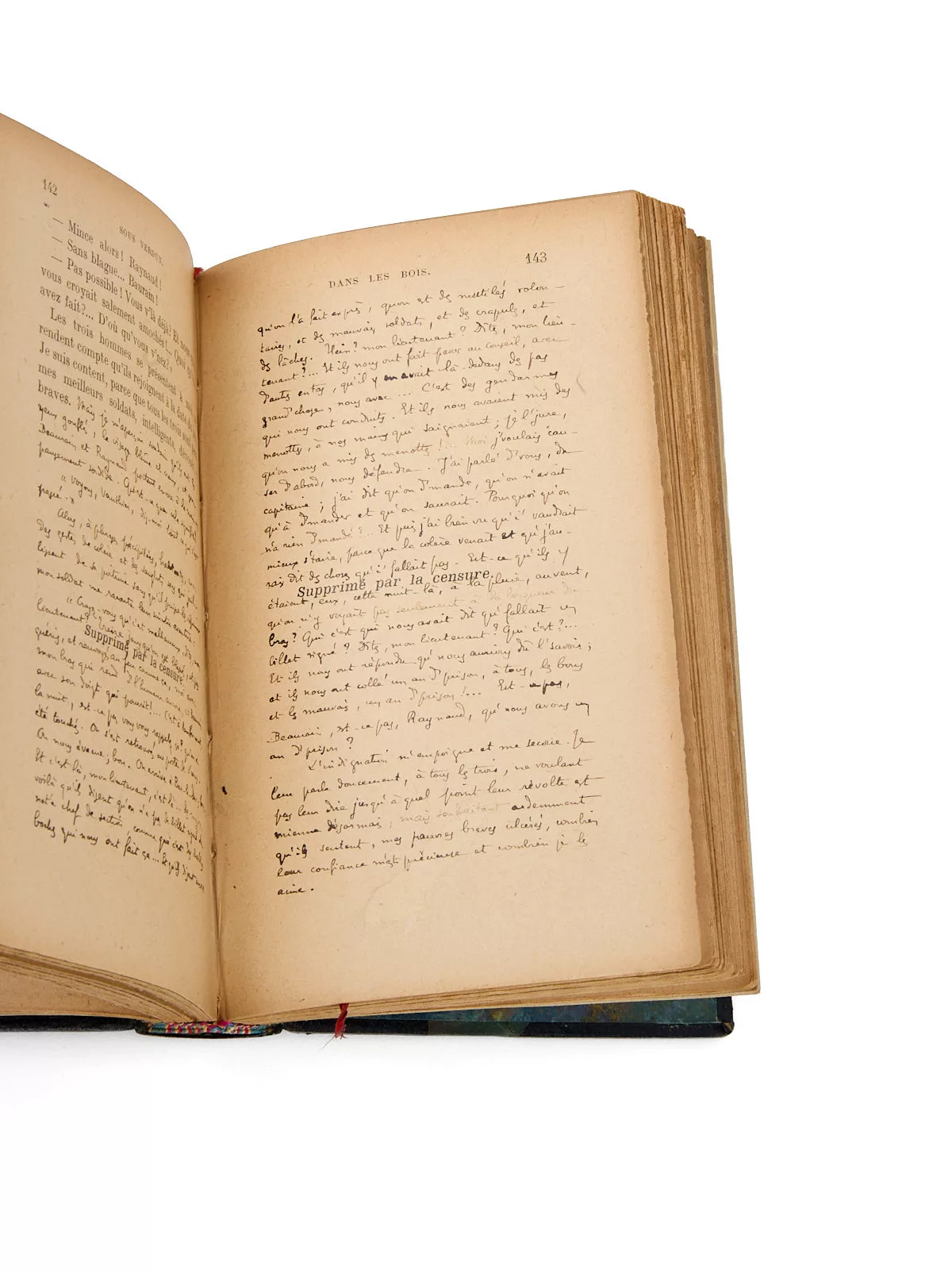
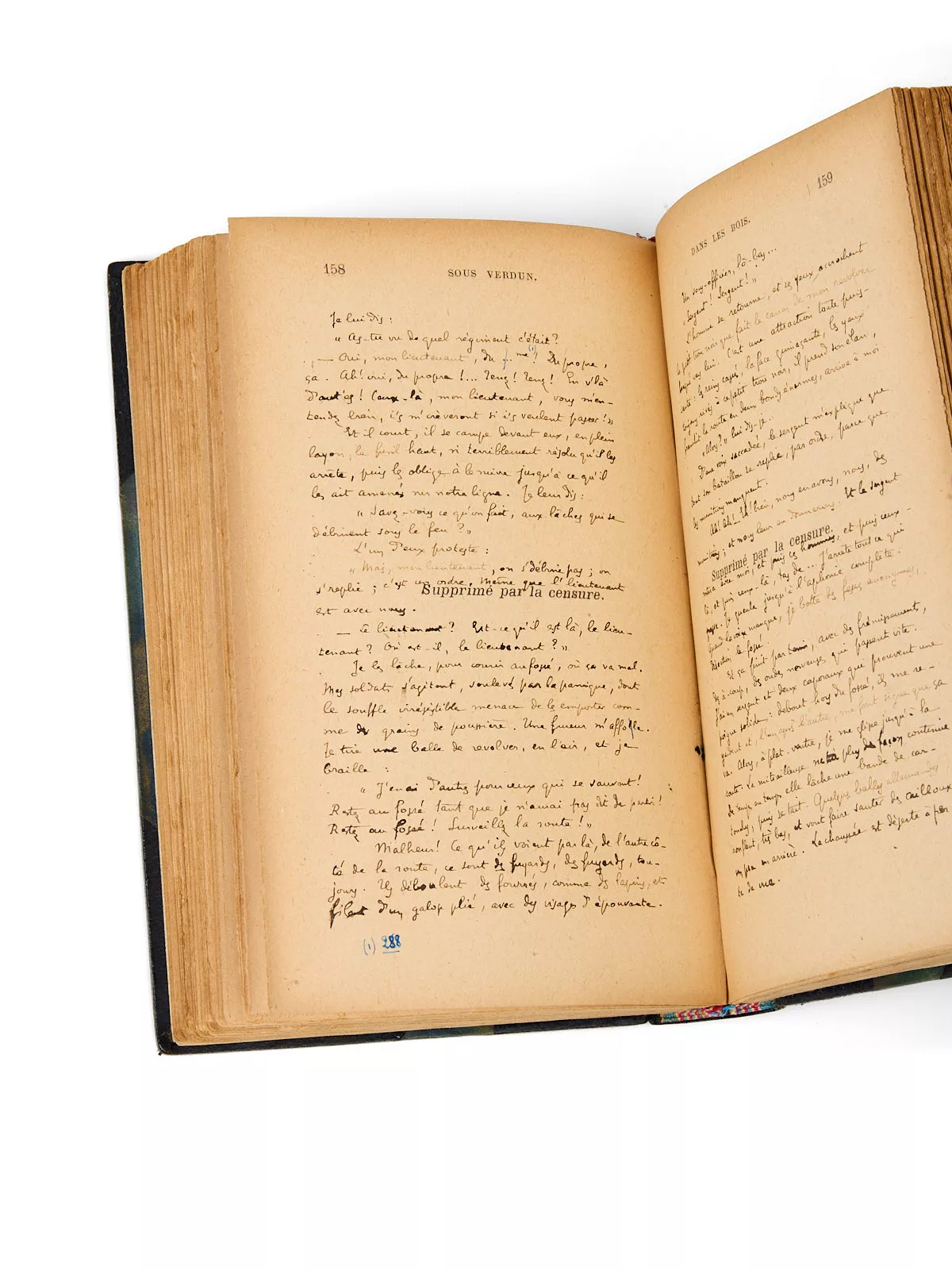
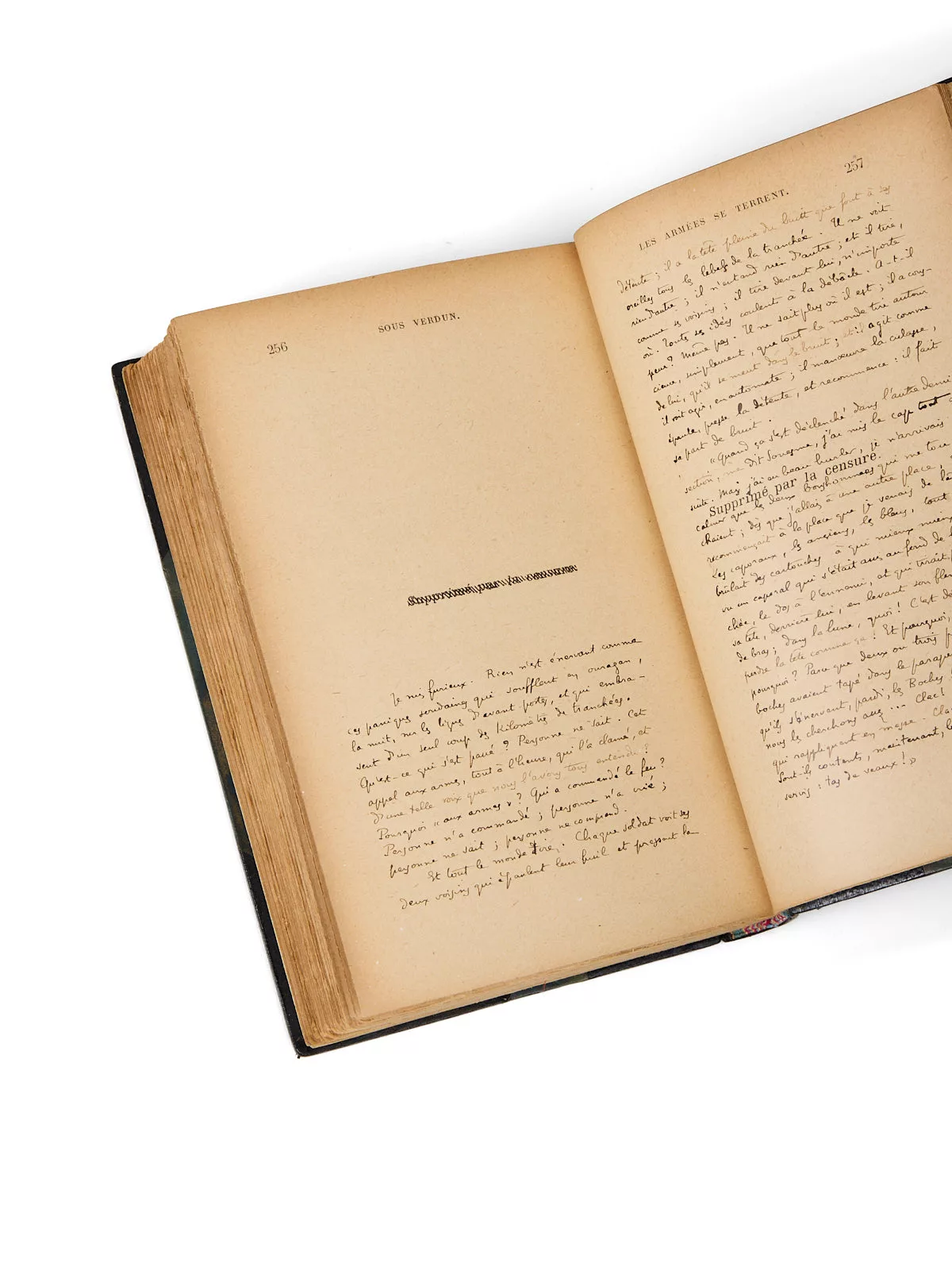
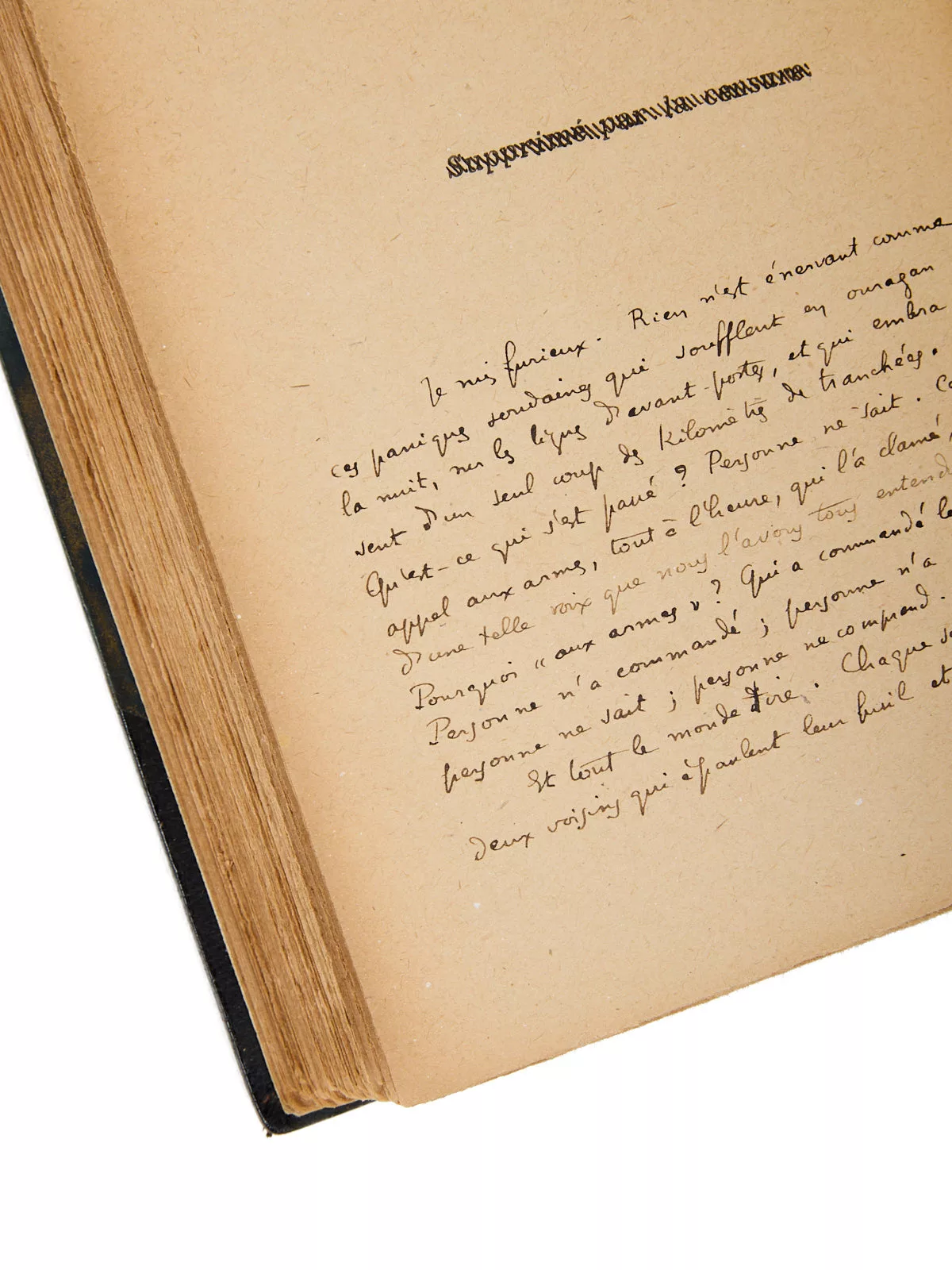
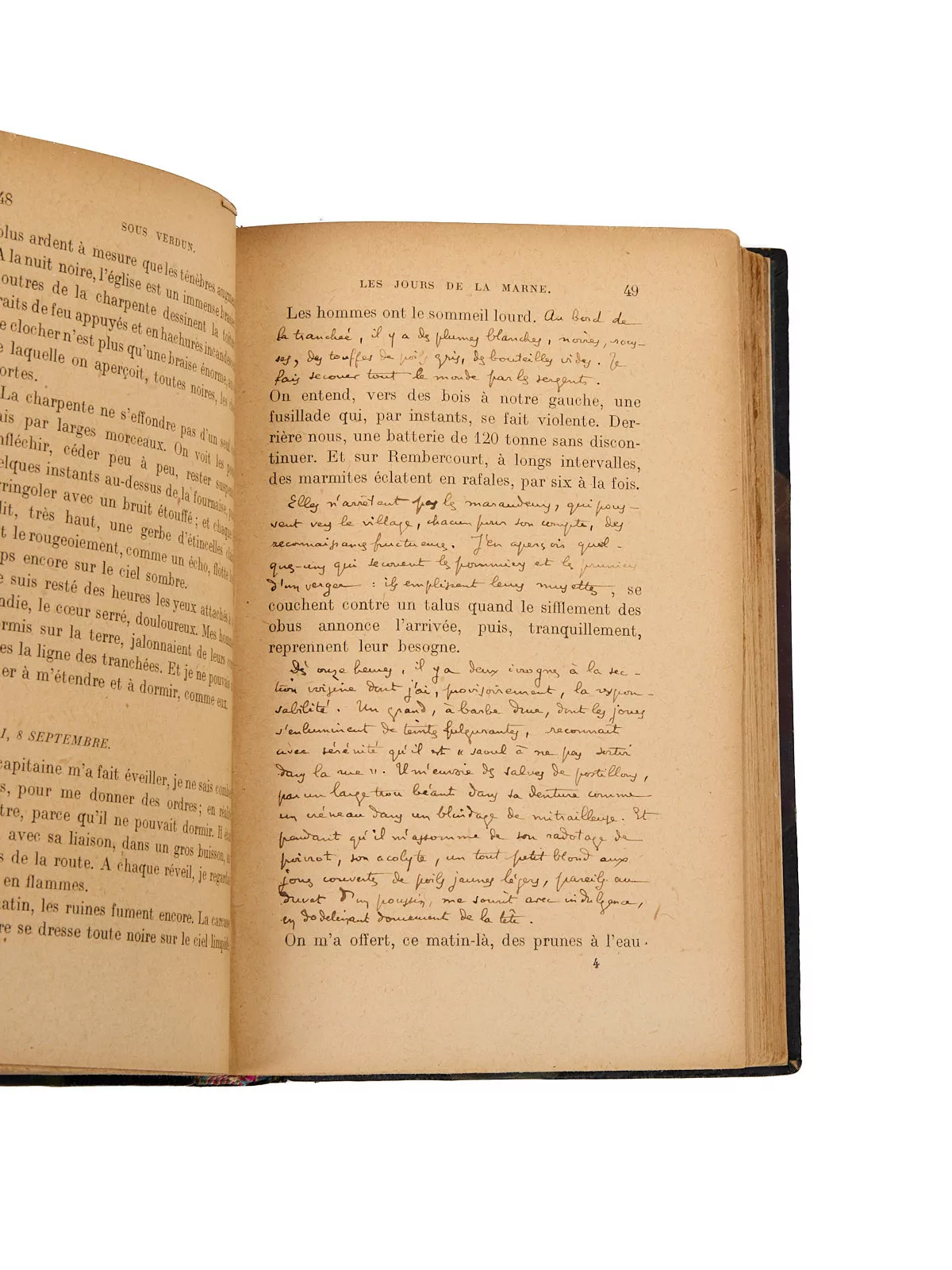
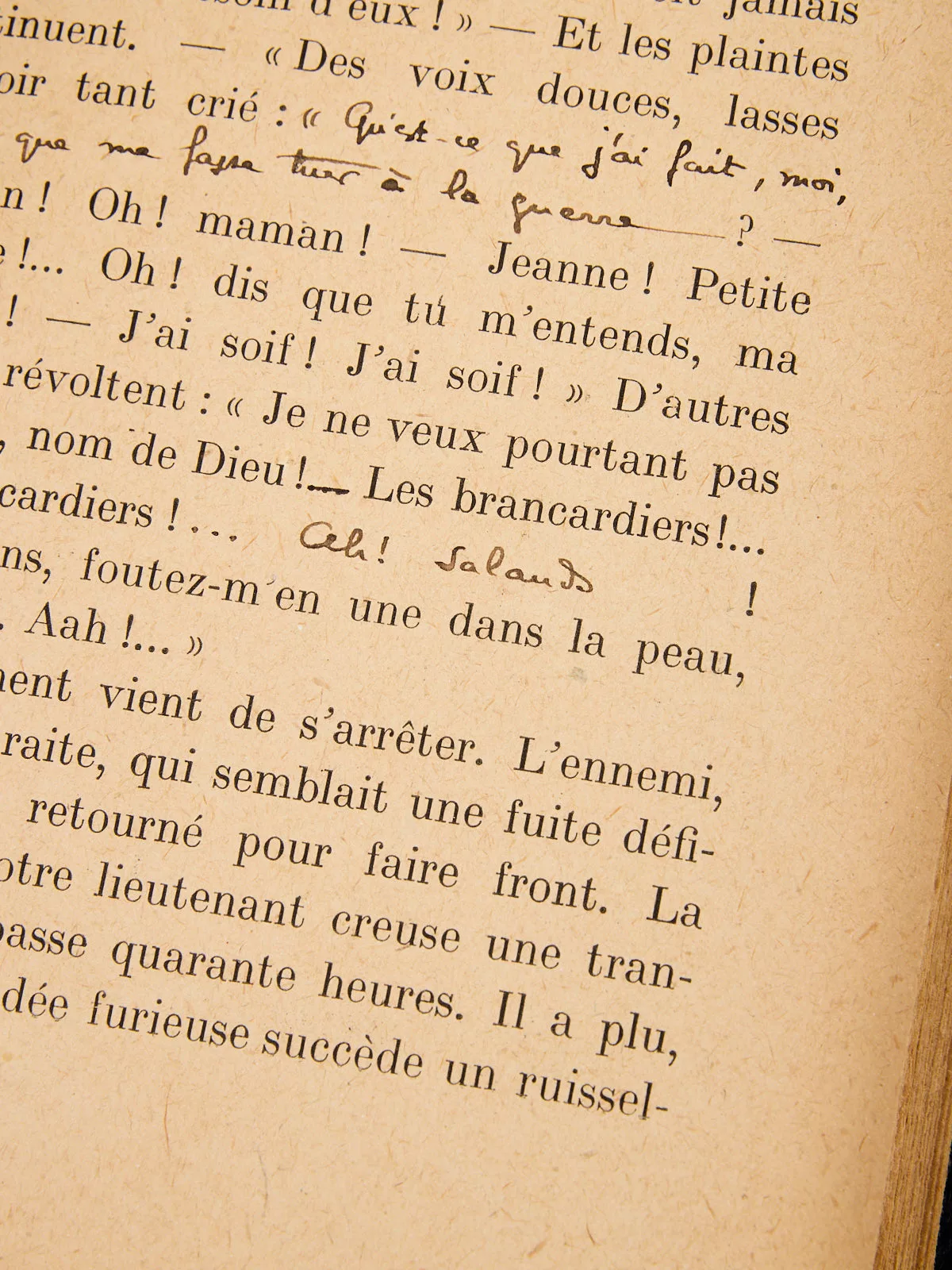
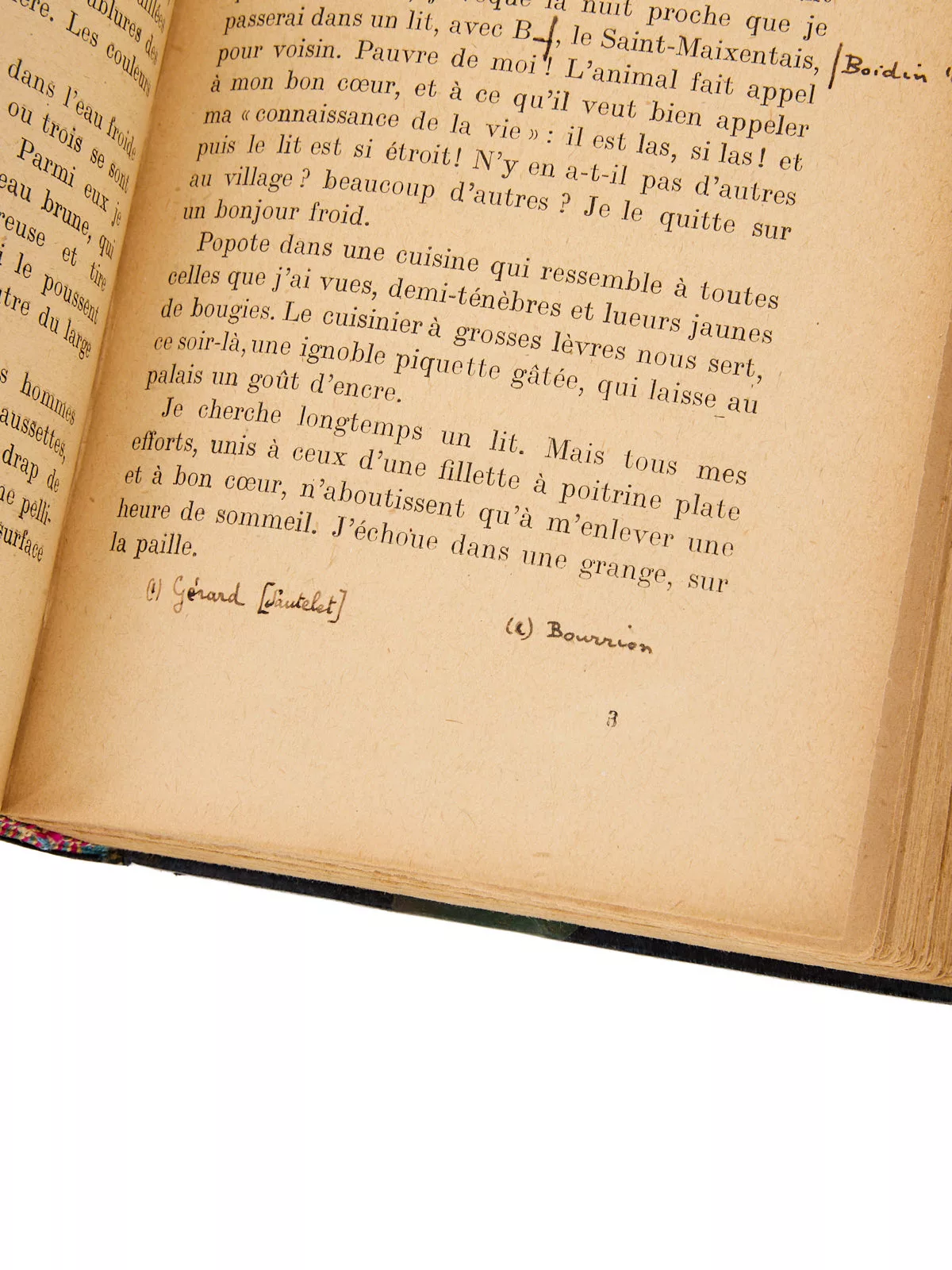
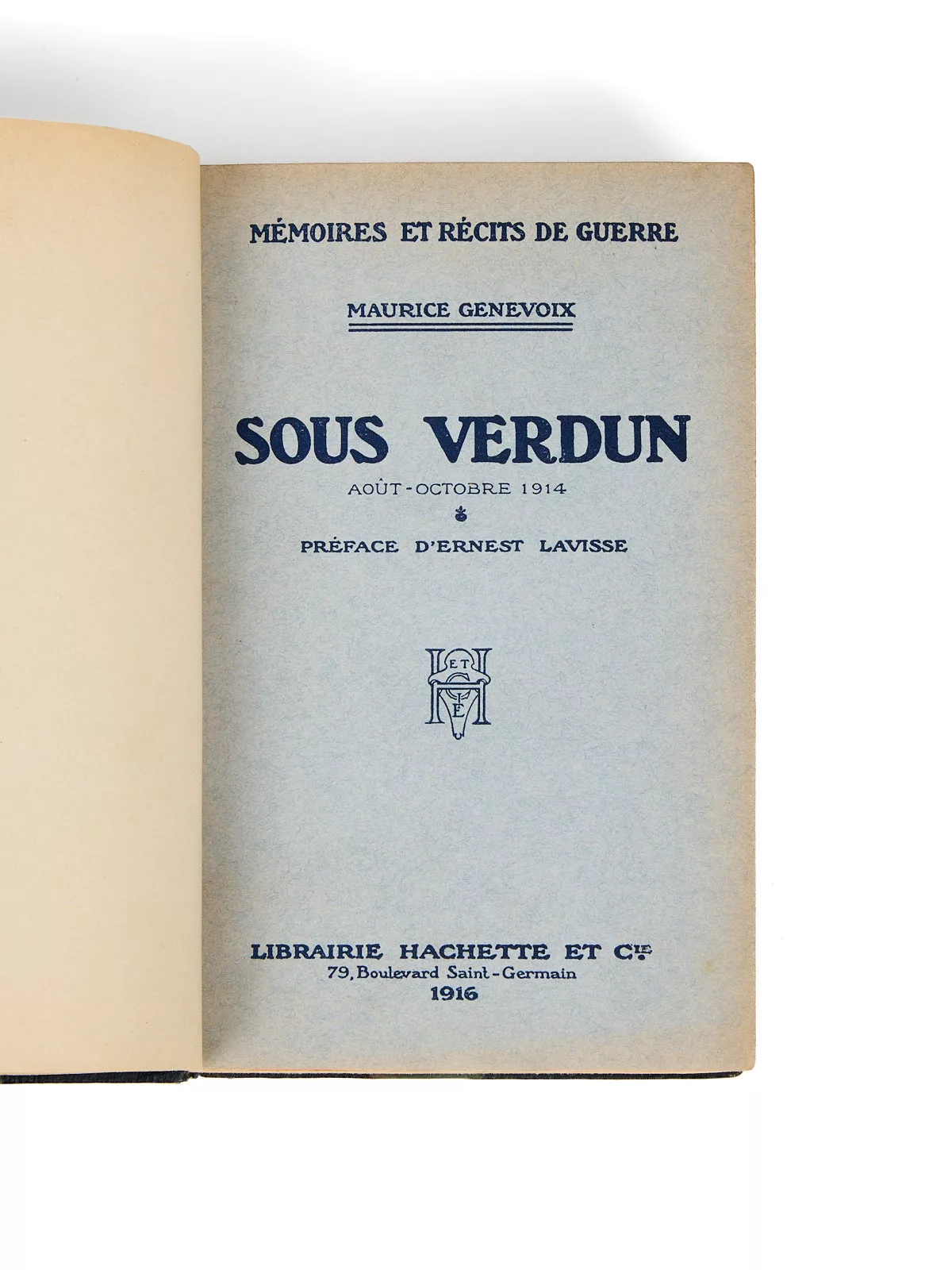
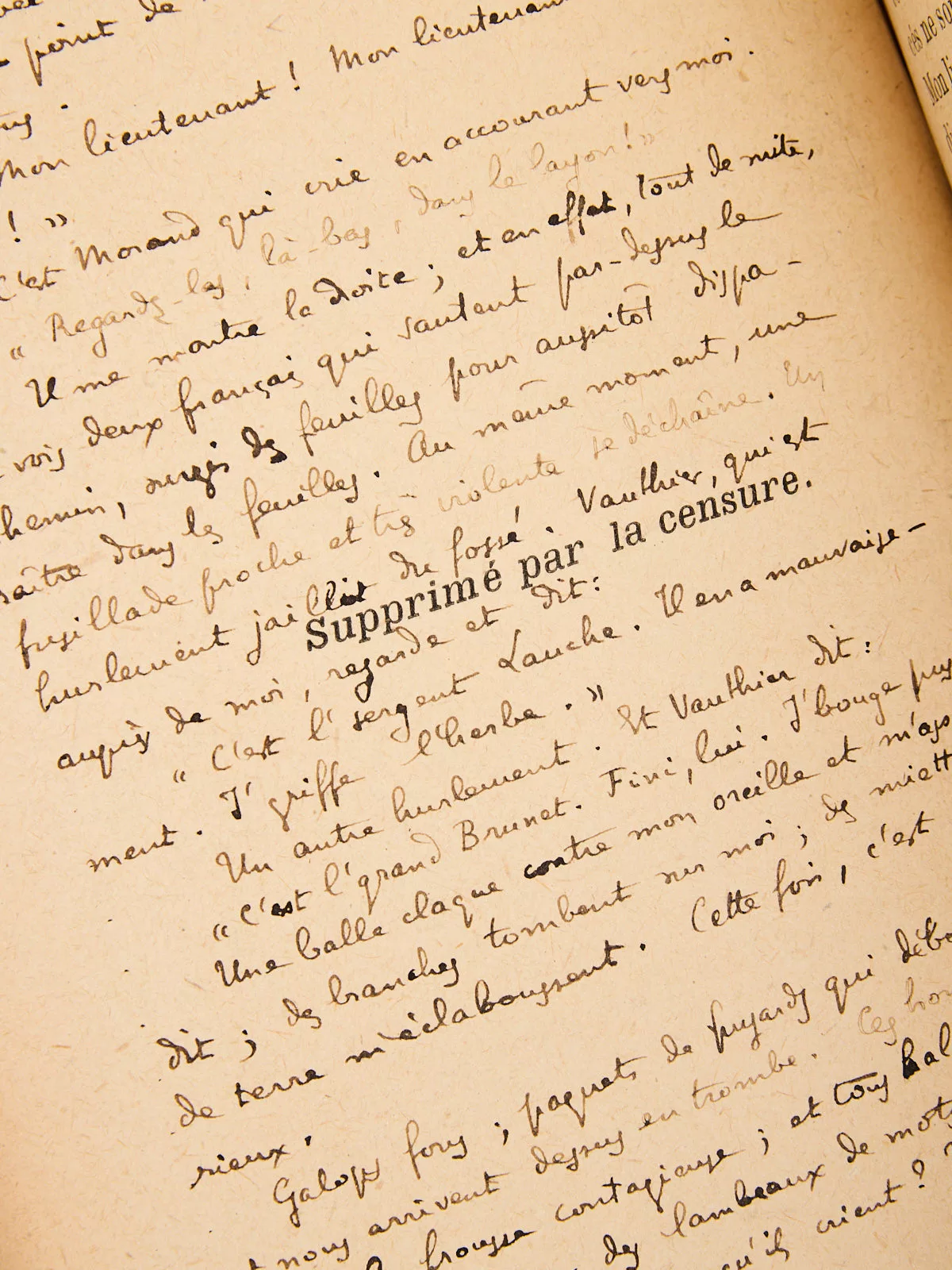
An exceptional copy, in which Maurice Genevoix restored by hand all the passages censored at the time of publication. The manuscript passages appear in the margins or copied directly into the blanks left in the text, marked with “…” and, in the printed sections, “Supprimé par la censure,” on pages 7, 14, 21, 27, 31, 47, 49, 54, 56, 62, 78, 83, 84, 94, 134, 140–143, 150, 154, 156–159, 167, 179–181 and 256–257. Genevoix also identifies the real names of the soldiers and officers mentioned in the text, initially masked or abbreviated.
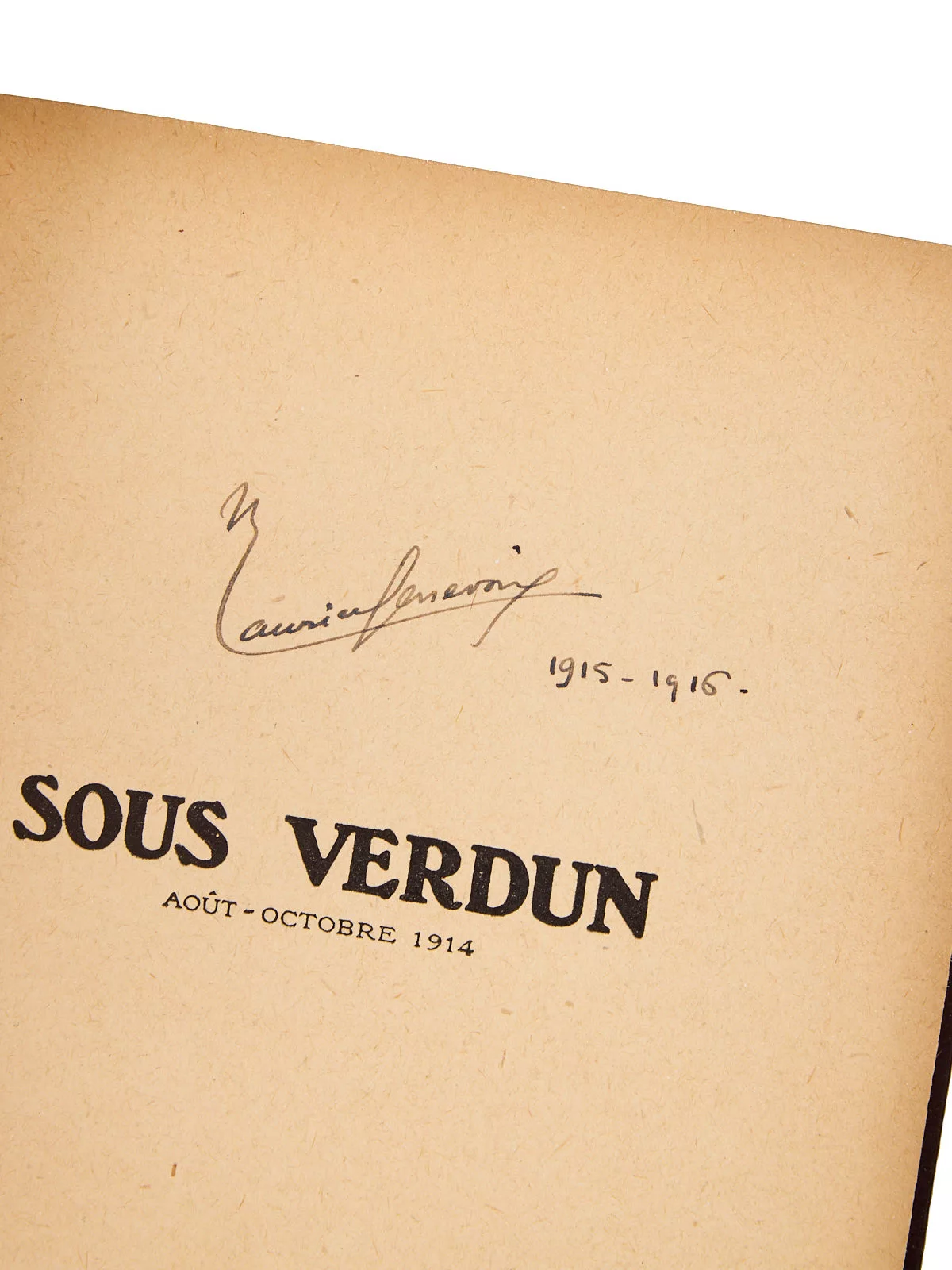
Copy with the author's manuscript ownership inscription dated “1915–1916.”
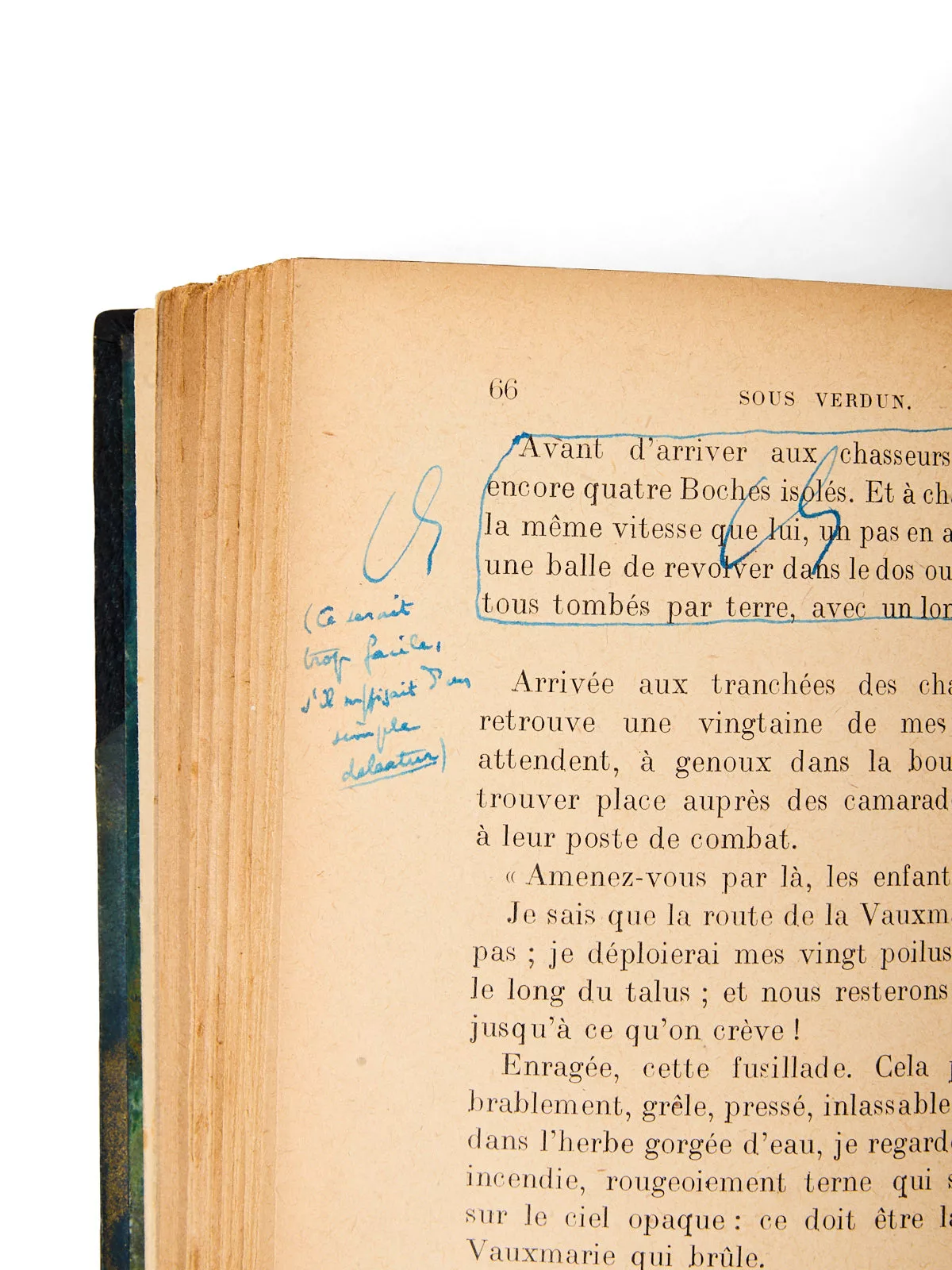
In addition to these corrections, the copy bears a striking manuscript note in the margin of a passage that would later be deliberately removed — this time by the author himself — in the following edition.
Sous Verdun is the first of the five accounts that Maurice Genevoix would later gather in 1949 under the title Ceux de 14. It was followed by Nuits de guerre (May 1917), Au seuil des guitounes (September 1918), La Boue (February 1921) and Les Éparges (September 1923).
Genevoix had intended to pursue an academic career after graduating from the École Normale Supérieure on the rue d’Ulm, but the outbreak of war led him to join the 106th Infantry Regiment as a second lieutenant. Known as the “Régiment de Fer” and stationed at Châlons-sur-Marne, the 106th marched to Verdun in September, toward the Butte des Éparges and the Tranchée de Calonne — where Alain-Fournier was killed and where, on the other side of the front line, Ernst Jünger was wounded on 23 April 1915, two days before Genevoix himself fell to German bullets on 25 April 1915, hit twice in the arm and once in the chest.
After seven months in a military hospital, he returned to Paris at the end of the year, to the rue d’Ulm, where, encouraged by Paul Dupuy, secretary of the École normale supérieure, with whom he had corresponded extensively during the fighting, he agreed to write up his testimony. Dupuy and the school’s director, Ernest Lavisse, had asked students who had gone to war to send news from the front, hoping to preserve for national history the war as lived by the country’s intellectual elite. Genevoix’s accounts from the front deeply moved both men. In early 1916 a publishing contract was signed with Hachette for a book that did not yet exist and still had to be written, but for which everything was already at hand: Genevoix’s letters, his prodigious memory, and the still-fresh eight months that had shaken and permanently marked his life.
The book was to appear in the newly launched Hachette series “Mémoires et récits de guerre”; Sous Verdun was to be the second title published, after Gaston Riou’s Journal d’un simple soldat. The series called on “all those who, having taken part in the most significant events, would be capable of recounting them in good language, conveying the impression of lived experience.”
Genevoix later recalled writing his first three war books “in complete submission to lived reality, with the constant will to be truthful and faithful,” noting that in 1916 very few “war books” had yet appeared, the great success of the moment being René Benjamin’s Gaspard, crowned with the Prix Goncourt, a talented but misleading novel that gave a fanciful and false image of the war.
The text is dedicated to the memory of his friend Robert Porchon, cited for his “admirable bravery,” killed at Les Éparges on 20 February 1915. It carries a preface by Ernest Lavisse, at the end of which a publisher’s note explains that blanks in the text correspond to passages suppressed by censorship, marked “Supprimé par la censure” when an entire page or the end of a page was affected. Censorship was severe but necessary to permit publication, since the war was not yet over and the narrative showed too plainly the reality of combat — its harshness, and above all the panic, suffering and confusion of the soldiers. Unlike Barbusse’s Le Feu or Dorgelès’s Les Croix de bois, the book has no lyricism or overt political engagement, but offers a raw sensory memory, an objective account often compared to Ernst Jünger’s In Stahlgewittern (Storm of Steel), published in Germany in 1921. The cuts were consequently numerous: sometimes a word or phrase, more often a sentence, but also whole paragraphs and even entire sections deemed unpublishable — scenes of panic, implicit criticism of the officer corps, insults, undignified suffering, gestures of fear, cries of distress, even glimpses of the enemy’s humanity.
Léon Bloy was outraged by this censorship: “Read Sous Verdun… A living, powerful book, unfortunately mutilated by imbecilic censorship.” Whatever was judged unflattering to the image of the French army and soldier — stories, anecdotes, phrases, words — had been removed. Not every truth was fit to print: French soldiers did not flee, did not lose morale, did not loot, did not get drunk, did not mistreat civilians, did not insult stretcher-bearers even in extreme suffering, and did not find German tinned meat better than their own. This censorship only strengthened Genevoix’s resolve: he later wrote that it remained “a sign and an encouragement,” since neither arbitrariness nor stupidity has any taste for truth.
It was Henri Barbusse’s Le Feu that received the Prix Goncourt that December. As Michel Bernard notes in his 2013 Garnier-Flammarion preface, the jury “made amends in 1925 by crowning Raboliot,” though it was a pity for the prize’s legend that it had not honored the censored Sous Verdun in 1916.
Genevoix took advantage of the fame brought by the prize — and of the passage of time — to have all the words, paragraphs and pages once suppressed by military censorship restored in the 1926 edition. Restored passages include the cries of the wounded, scenes of panic, contradictory orders sowing disorder among his men, and direct criticism of the general staff, where orders forbidding return fire are equated with tactical folly — all evidence of a concern for documentary precision and a clear determination to restore the censored truth.
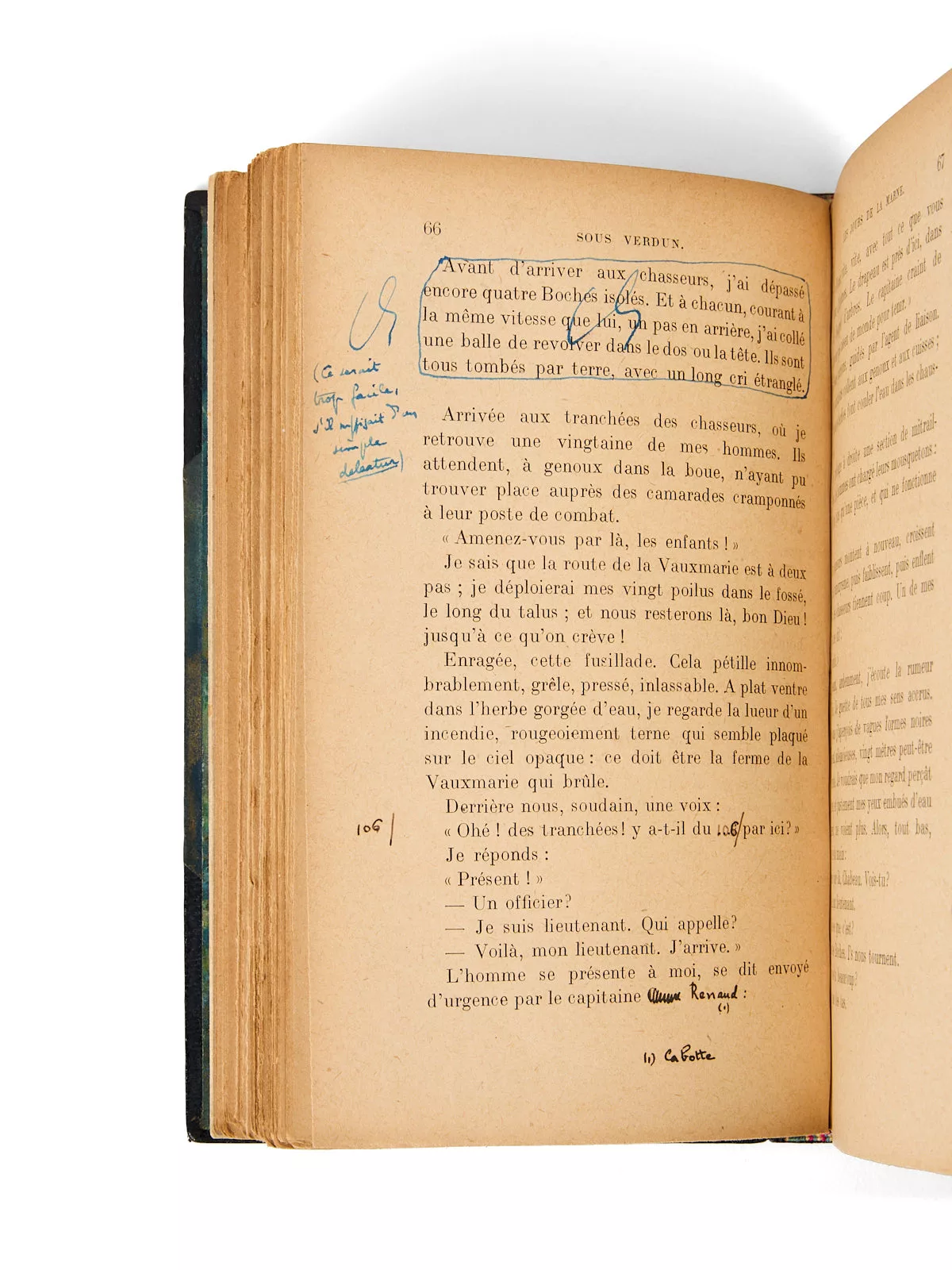
At the same time, without commenting on his decision, he had a single paragraph removed from this new edition: the harrowing passage on page 66 describing how, during the fighting at la Vaux-Marie, he killed four attackers: “Before reaching the chasseurs, I passed four more isolated Boches. And to each one, running at the same speed as him, one step behind, I put a revolver bullet in his back or head. They all fell to the ground with a long, strangled cry.”
A striking manuscript note is inscribed in the margin of this passage, the most controversial in the text yet deliberately spared by the censors, expressing the author’s moral dilemma well before he publicly expressed his remorse: “It would be too easy if it were merely a matter of a simple deletion.”
This annotation in blue ink, later than the other corrections and almost certainly written for the definitive 1926 edition, shows that the removal of this passage was neither casual nor purely formal, and that it was experienced as an insincere gesture — to be read alongside the fresh act of contrition Genevoix would later express in the Ceux de 14 edition, where he restored the passage and this time explained his decision in a footnote: “I restore it today, considering it dishonest to deliberately omit one of the episodes of war that shook me most profoundly and left an indelible mark on my memory.”
The original deleatur thus takes on its full ethical weight: Genevoix explicitly acknowledges that the act of self-censorship he performed at the time was insufficient, and feels compelled to fully own this unbearable memory.
A precious volume, no longer merely a printed and completed book: it is almost an annotated manuscript, an intermediate, confidential and intimate version between the truncated first publication and the restored definitive text. It also bears witness to a man’s evolving relationship with his own past, and to his struggle to remain faithful to reality, however difficult it was to bear.
A copy of the first printing, identifiable by the advertisement leaf facing the title page. Genevoix signed the half-title, adding the date “1915–1916” in ink, corresponding to the dates when the text was written.
The copy is bound to match the other war narratives and early novels that Genevoix kept in his own library.
From the library of Maurice Genevoix, at “Les Vernelles,” with bookplate.