

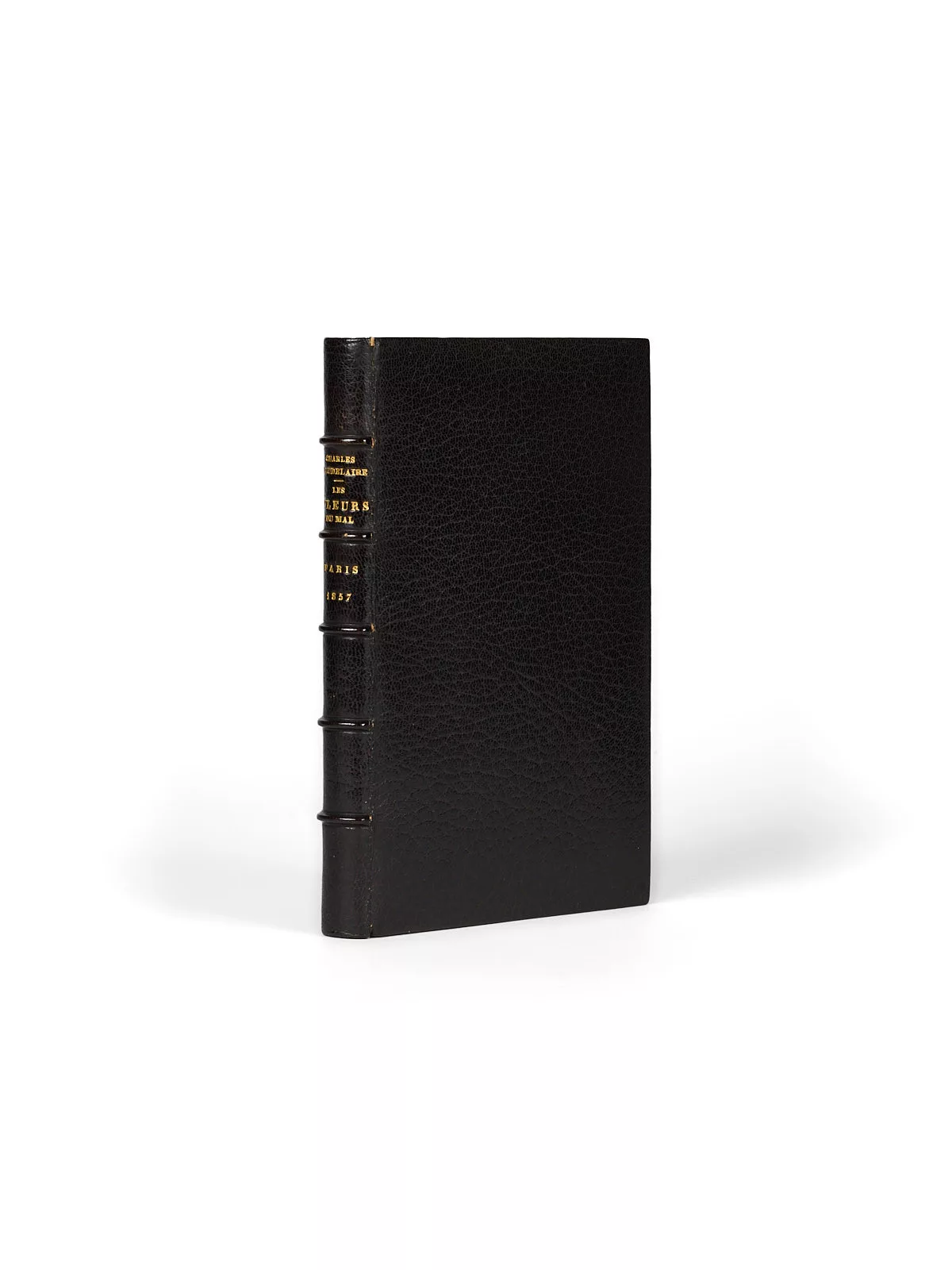
Les Fleurs du mal
Baudelaire signed his first contract for Les Fleurs du mal on 30 December 1856, agreeing to deliver his manuscript on 20 January following. He did not do so until February; there followed a printing of 23 copies on Holland laid paper, distributed by the author, and 1,300 copies on Angoulême vellum, put on sale on 25 June 1857. They were printed, published and distributed by Auguste Poulet-Malassis, since Michel Lévy, the poet’s regular publisher, who had just published the volumes of Histoires extraordinaires by Edgar Poe — translated by Baudelaire — had declined to publish Les Fleurs du mal for fear of prosecution. Prosecution was indeed initiated in July, and the poet was summoned before the examining magistrate.
From the beginning of the summer, Gustave Bourdin had sounded the alarm in Le Figaro: “The odious rubs shoulders with the vile; the repulsive is allied with the foul. Never have breasts been so bitten, even chewed, in so few pages; never has one witnessed such a parade of demons, foetuses, devils, anaemic women, cats and vermin. This book is a hospital open to every madness of the mind, to every putridity of the heart; if only it were to cure them, but they are incurable.”
Jules Habans, in the same newspaper, followed suit a week later, on 12 July: “When one closes the book after reading it entirely, as I have just done, a great sadness and a horrible fatigue remain in the mind. All that is not hideous is incomprehensible, all that one understands is putrid, in the author’s own words.”
The day before, sensing what was coming, the poet wrote to Poulet-Malassis: “Quickly, hide, but hide well the whole edition.” The publisher then concealed part of the print run, before it was bound. A month later, the criminal court, through the deputy imperial prosecutor Ernest Pinard (who a few months earlier had had Flaubert convicted for Madame Bovary), condemned the book “for outrage to public morals and decency” and ordered the suppression of six poems: “Les Bijoux” (pp. [52]–53), “Le Léthé” (pp. [73]–74), “À celle qui est trop gaie” (pp. [91]–93), “Lesbos” (pp. [187]–190), “Femmes damnées” (pp. [196]–197) and “Les Métamorphoses du vampire” (pp. [206]–207).
Poulet-Malassis, drawing on the stock of unbound sheets, had 230 copies mutilated and cancels tipped in: a “ridiculous surgical operation,” as Baudelaire put it, complaining about the execution of these cancels, made without his agreement (letter to Poulet-Malassis, 5 October 1857). The condemned poems were not rehabilitated until 1949, thanks to the Société des gens de lettres and a case brought before the Cour de cassation.
Baudelaire is known to have taken meticulous, almost obsessive care correcting proofs. Poulet-Malassis, often exasperated, wrote to him in the middle of these four months, which felt to him like a century: “My dear Baudelaire, I am beginning to think you are making a fool of me, which I have not deserved in the least!” The poet’s careful attention did not prevent misprints, and a first was spotted by the author as soon as he received his first copies, in the poem “Bénédiction,” on page 12: “s’enhardissent” for “s’enhardissant” — an error, the only one, corrected on the press early in the printing. These copies are the only ones that can properly be called the very first printing. Our copy has this error corrected.
For decades other errors have been claimed as characteristic of a first printing: the most famous being the word “Feurs” for “Fleurs” in the running heads of pages 31 and 108; page 45 mispaginated as 44; or the word “captieux” for “capiteux” in the first line of page 201; to these can be added other misprints that Baudelaire noticed as he gave away copies, in which he corrected in pencil up to eight errors, on the dedication leaf and on pages 29, 43, 110 and 217. About fifteen copies corrected in his hand in this way are known. But these misprints were — and remained — printed throughout: they appear in the entire print run of Les Fleurs du mal and cannot serve as evidence for establishing a chronology.
These “errors,” let us say once and for all, are present in every copy. Repeated descriptions of the type “copy of the first printing, with the errors” are therefore not only excessive but misleading.
Other elements, however, rarely if ever mentioned, do allow a printing chronology to be established: errors in the text of the Avertissement and on the title page, which were indeed corrected during printing.
These corrections are the only ones that can support a chronology:
— in the Avertissement, four elements were successively altered (no doubt because it was easier for the publisher to intervene in a text he had written and which concerned him directly). The first state has the following features: “Les Éditeurs,” with an accent that later disappears; a large space before the comma following “Ils poursuivront”; “toutes contrefaçons et toutes traductions,” which later becomes “toutes contrefaçons et traductions”; “Les traités,” not yet capitalized (“Traités”). These elements were corrected progressively, so successive states exist with one, two, three, then four elements corrected. The fifty or so copies we have examined allow this chronology to be refined today, if not with perfect precision, at least indicatively.
— on the title page: the reference to the text of Agrippa d’Aubigné for the dedication ends without a final period and without a closing parenthesis after “Les Tragiques, liv. II.” This double error, spotted fairly early, is corrected in the majority of copies.
Our copy contains all these erroneous, princeps elements, which places it in an early printing chronology that could be described as the very first printing, notwithstanding the correction to “s’enhardissant.” This princeps state is exceedingly rare, preceding the succession of copies in which these elements were modified as the printing continued.
Bound in at front: a fine autograph letter signed, addressed to Champfleury, written in the summer of 1845.
This is the second letter exchanged between the two men. The first, dated May 1845, announces Champfleury’s first laudatory article on Baudelaire, on his Salon de 1845. The two men had met that same spring in the offices of the review L’Artiste. Baudelaire had then asked the man he still called Fleury to “write a joking article about me, if you like, provided it does not do me too much harm. But if you wish to please me, write a few serious lines, and speak of Diderot’s Salons.” Champfleury did so, and skilfully, in the issue of Le Corsaire-Satan of 27 May 1845. This princeps letter is today preserved in a copy of Salon de 1845, Baudelaire’s first published work (under the name combining his father’s and mother’s, Baudelaire-Dufaÿs): one of the rare copies with its wrappers, and enriched with a drawing by Delacroix (formerly Pierre Leroy collection, 100 livres, Sotheby’s, June 2007, no. 8).
In this second letter, bound in at the front of our copy, the poet admits to having made an approach that troubles him. Humiliated for his friend’s sake and his own, he nevertheless managed to save Champfleury’s honor and self-respect:
“Mon cher ami, j’ai fait un désordre absurde. Je me suis trouvé en face de gens d’une insolence plus grande qu’aucune que j’ai connue ; elle n’est égalée que par leur sottise. Je suis profondément humilié, pour moi et pour vous. Votre nom a suffi pour m’attirer presque des outrages ; il n’y a pas jusqu’au sieur Delange qui n’ait donné le coup de pied de l’âne. Je suis encore sous le coup d’une agitation très vive. Du reste, vous pourrez être tranquille. Votre honneur et votre amour-propre ont été parfaitement sauvegardés par moi. C. B.”
A few weeks earlier, the poet had done business with the picture dealer Delange, on the rue de Trévise, over two paintings, and had asked his mother, Madame Aupick, to have them delivered to him (cf. Correspondance, I, p. 128).
This marks the birth of a friendship between the two men, which only strengthened over the years. In 1848, Champfleury said he spent “12 to 15 hours a day” in Baudelaire’s company; and it was thanks to Champfleury, and together with him, that Baudelaire met Poulet-Malassis in 1850 and Eugène Delacroix in 1851. Baudelaire proofread his Excentriques (1851) and naturally gave him a copy of Les Fleurs du mal, with an inscription unfortunately unknown: the presentation is not transcribed in the Champfleury sale [Drouot, 1890, no. 687], which only mentions an “author’s presentation” in boards. That copy has been untraced since 1945.
A very fine copy in a period binding by Henri Noulhac: born in Châteauroux in 1866, he settled in Paris in 1894, encouraged in Jansenist-style bindings by Henri Béraldi, since, as Fléty tells us, he was neither a binder nor a gilder himself. A gilder joined his workshop in 1900, allowing him to introduce floral motifs and gilt frames around his silk endleaves into his production, as in this copy. His impeccable mastery and the quality of execution of his bindings make him an undisputed master of the genre; after the war, he trained several future binders, including Rose Adler and Madeleine Gras. This copy is perfectly bound and has been neither restored nor washed. It is probably bound from the unbound sheets and has immense margins: the first leaf even retains its original margins and its untrimmed edge. An exceptional condition.
Baudelaire, Correspondance, I, p. 129 (for the letter); BnF, Charles Baudelaire, Exposition organisée pour le centenaire des Fleurs du Mal, Paris, 1957, no. 266 et sq.; En français dans le texte, 1990, no. 276; Desprechins, “Récapitulation de mes commentaires sur l’édition originale des Fleurs du mal,” Le Livre et l’estampe, 1967, no. 51/52, p. 204 et sq.; Carteret, I, p. 118; Clouzot, Guide du bibliophile français, p. 43; Launay, in Bulletin du bibliophile, 1979, IV, pp. 523–526; Oberlé, Auguste Poulet-Malassis, no. 212 et sq.; Vicaire, I, col. 342.