

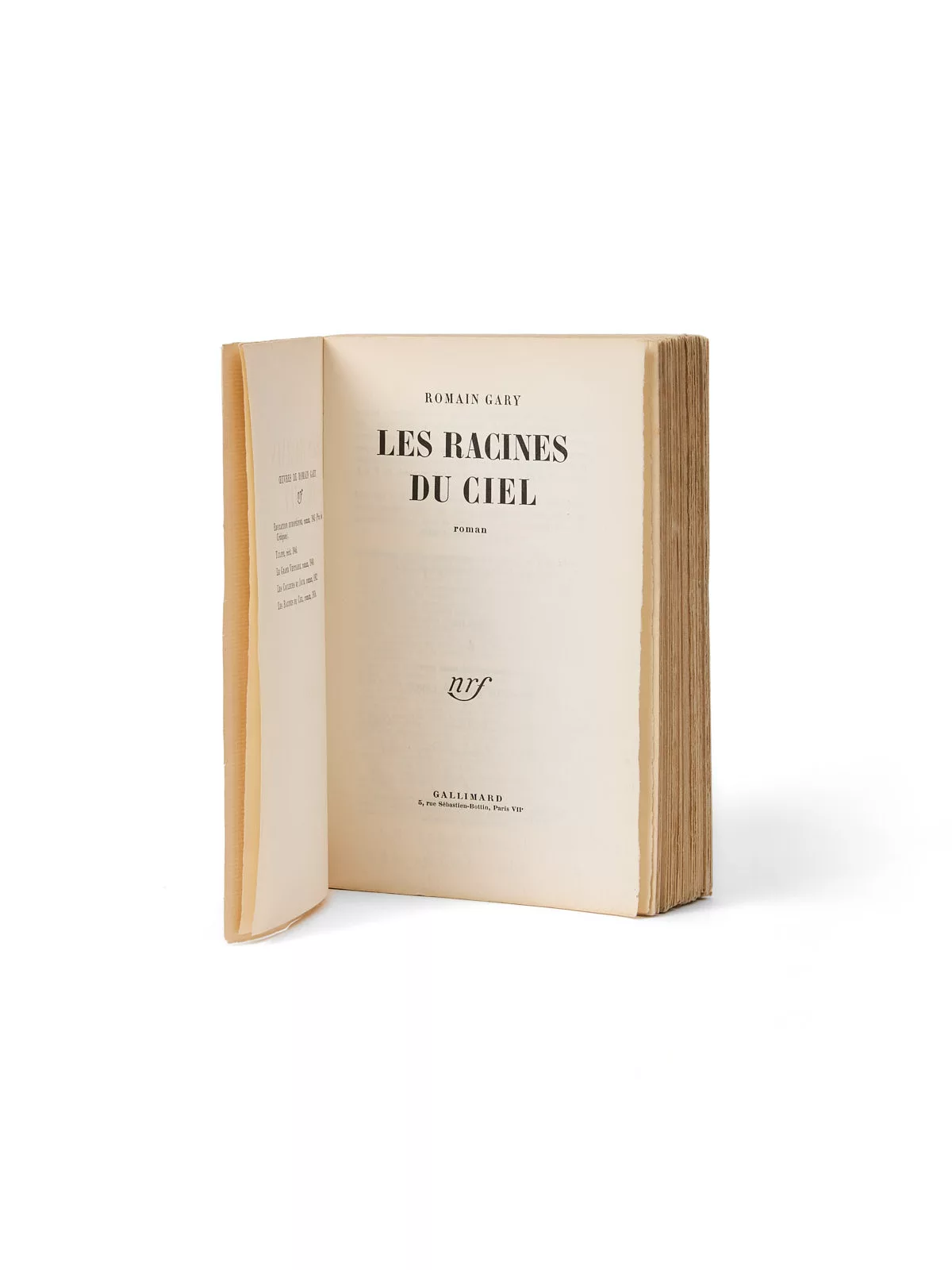
Les Racines du ciel
The first 10 copies were reserved for members of the Académie Goncourt, copy “k” is Gary's own, and the last four were for the publisher.
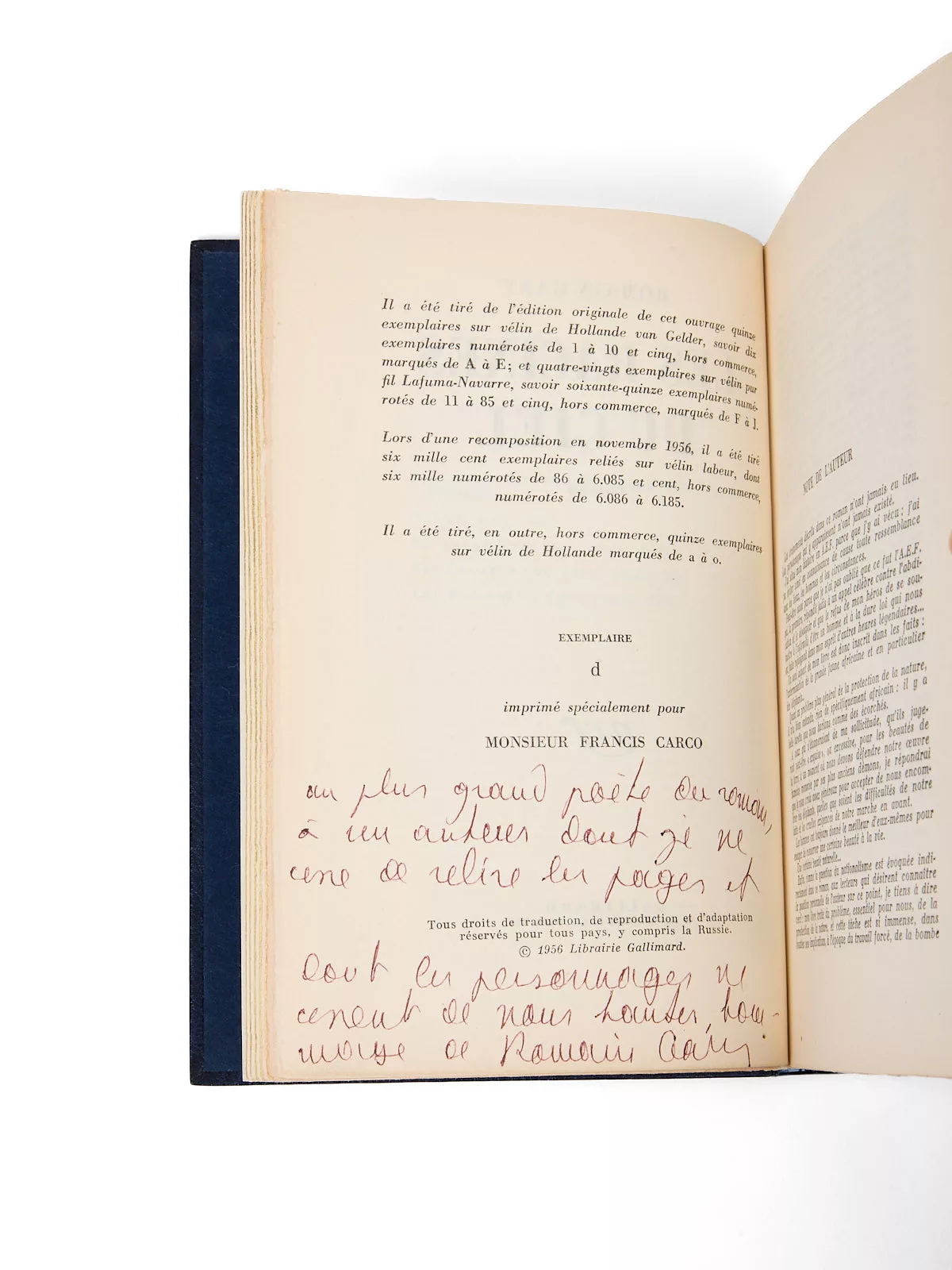
Nominative copy for Francis Carco (copy d).
Signed presentation inscription: “au plus grand poète du roman, à un auteur dont je ne cesse de relire les pages et dont les personnages ne cessent de nous hanter, hommage de Romain Gary.”
“I am torn between the joy of being awarded the Prix Goncourt and the sadness of realizing that the ideal of human freedom and dignity I defend in my book has never been more threatened”: these were Romain Gary’s first words when a representative of Agence France-Presse informed him that Les Racines du ciel had just won him the Prix Goncourt. “One thing alone,” he added, “would give me as much personal joy as receiving the Prix Goncourt: that the Nobel Prize be awarded to André Malraux.” The first novel to take the protection of nature as its openly central subject, Les Racines du ciel is also — still — a novel of resistance: “resistance to everything that oppresses man, wherever and however it may occur.” This is why Gary wrote, in December 1956 after Russian tanks entered Budapest: “The Hungarian elephants must be saved. One day they will resume their triumphal march” (Larat, Romain Gary, Une trajectoire dans le siècle, II, p. 48).
Romain Gary was in La Paz when the announcement was made — as French consul in Los Angeles, he had been assigned a brief interim posting at the French embassy in Bolivia — and he obtained a two-week leave from the Quai d’Orsay for the end of December 1956. In the meantime, his publisher had the text reset, correcting a number of spelling and stylistic errors present in the edition originally published in September 1956. Indeed, the original text seemed hardly to have been proofread at all: an unusually high number of misprints remained, and critics delighted in mocking its clumsiness and heaviness. Several newspapers reported rumors that Gary’s style was deplorable: “It does seem that Gary let a number of errors slip through in his manuscript […]. Gary had asked for the proofs to be checked ‘by a seasoned grammarian.’ This correction may never have taken place, which would explain the extent of the errors found in the first edition” (Larat, II, note p. 52, citing a letter from Romain Gary dated 5 October 1956, preserved in the Gallimard Archives).
The December reprintings improved matters somewhat, just as Gary, granted a short leave by the Quai d’Orsay, was able to return to Paris. Gallimard organized interviews and public appearances, including a participation in Lecture pour tous, in which he returned to the subject.
For this reprinting, Gallimard produced a new deluxe issue: as with the September first edition, it was limited to 15 copies. The first ten were reserved for members of the Académie Goncourt, of which the following copies are presently known: Bauer, Hériat, Mac Orlan, Queneau, Salacrou, and this one, for Francis Carco. Those of Billy, Dorgelès, Giono and Lanoux remain to be discovered.
For his own copy, Romain Gary inscribed it to himself with a perfectly self-referential dedication: “À mon cher Romain Gary, mon bon compagnon de lutte, en témoignage de profonde affection, Romain Gary.”
Carco’s copy is equally exceptional, containing a strikingly eloquent inscription — something absent from the other known copies.