

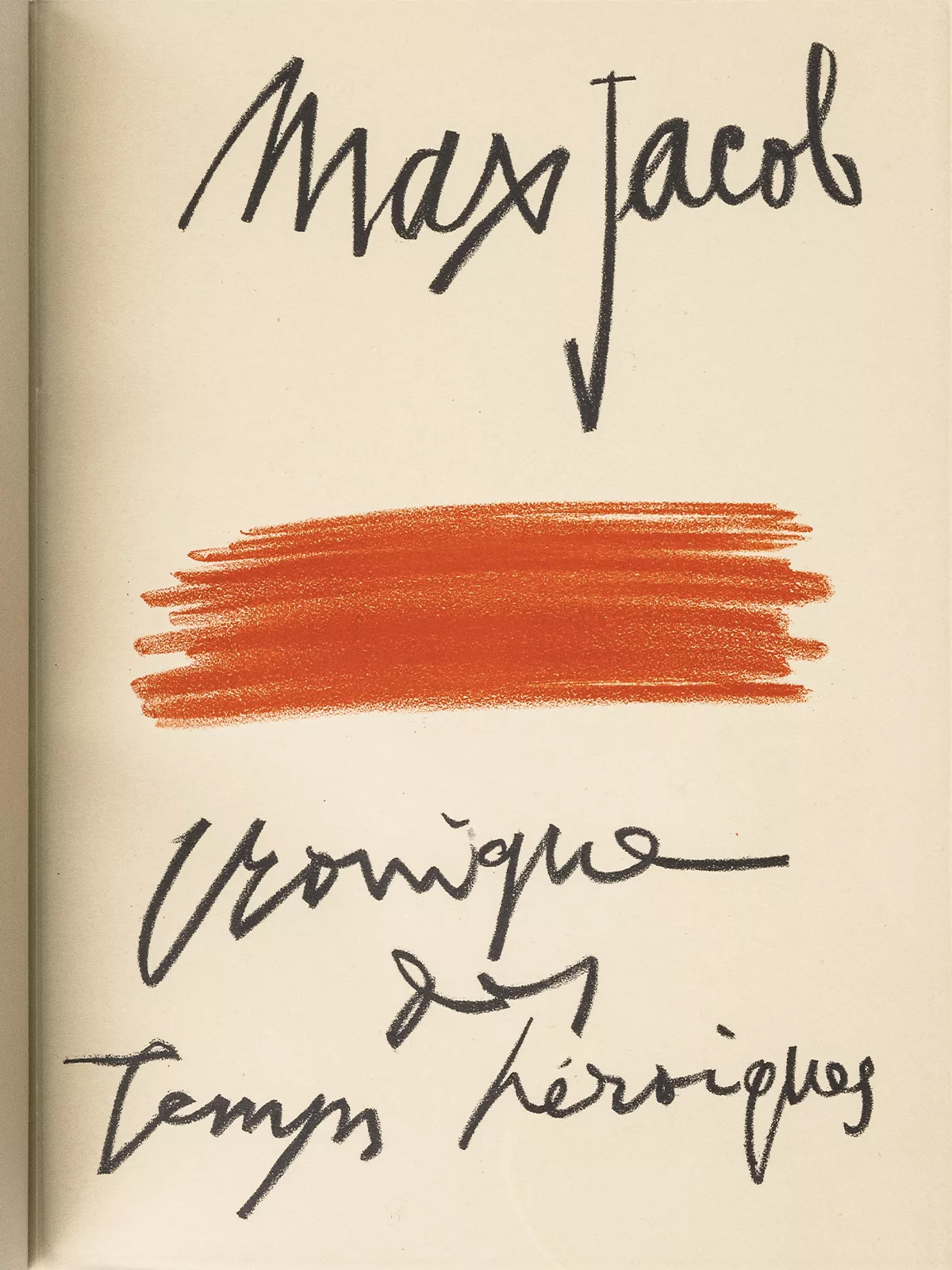
Chronique des temps héroïques
The first 30 copies are enriched with a suite of the three drypoints.
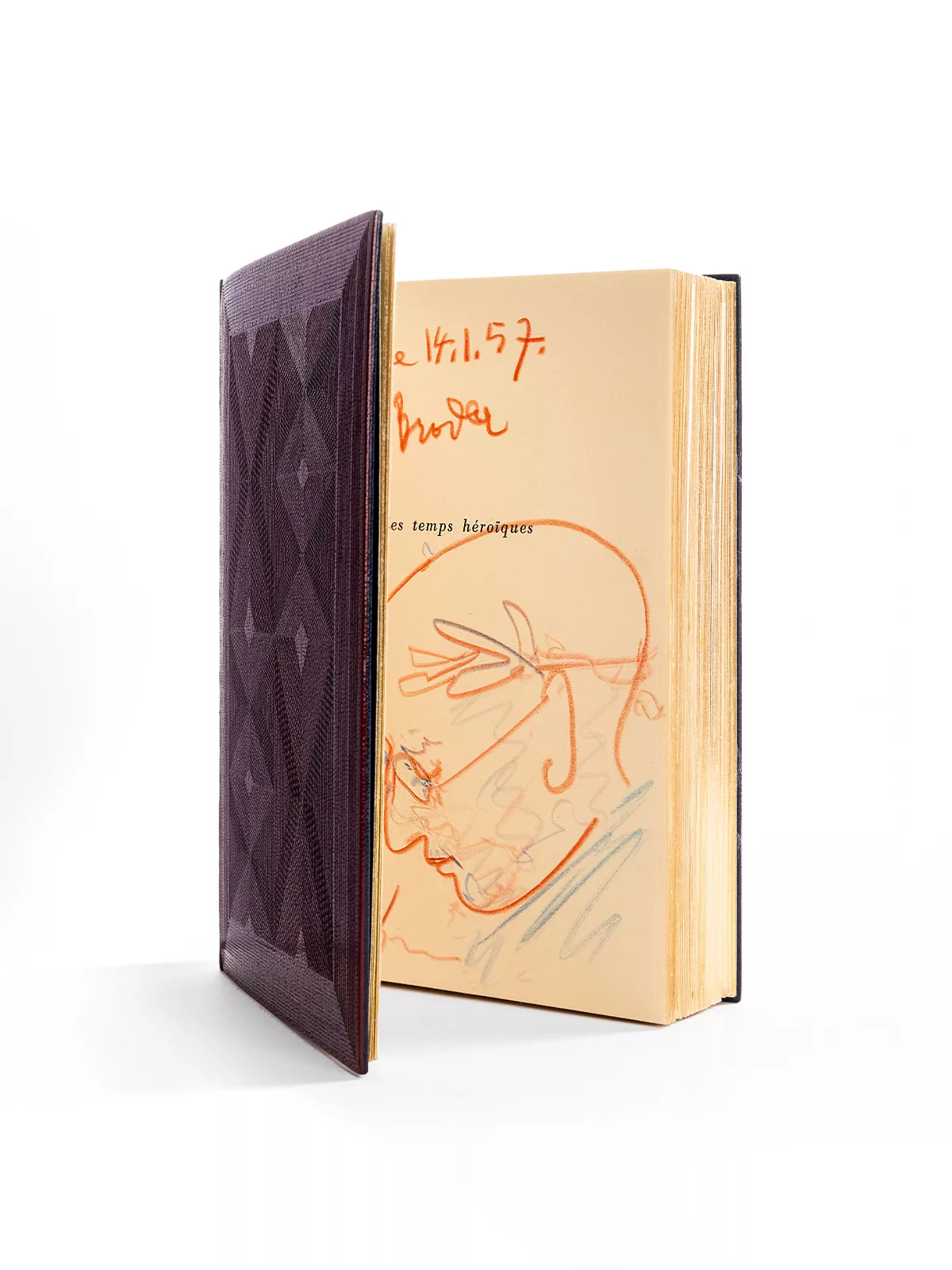
This copy, composed for and by Louis Broder, contains in addition the following pieces:
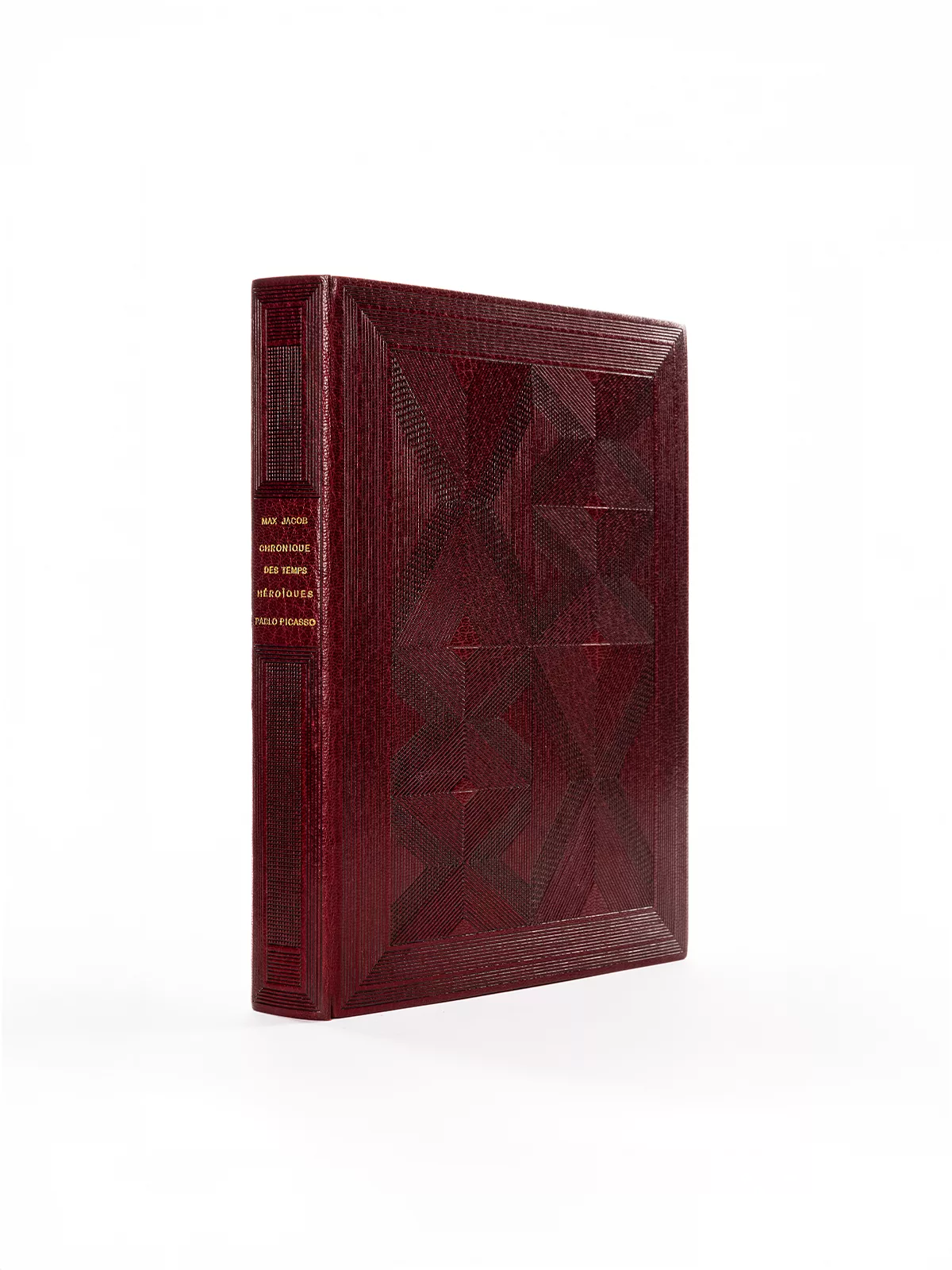
– the lithographed cover, printed on Japanese paper;
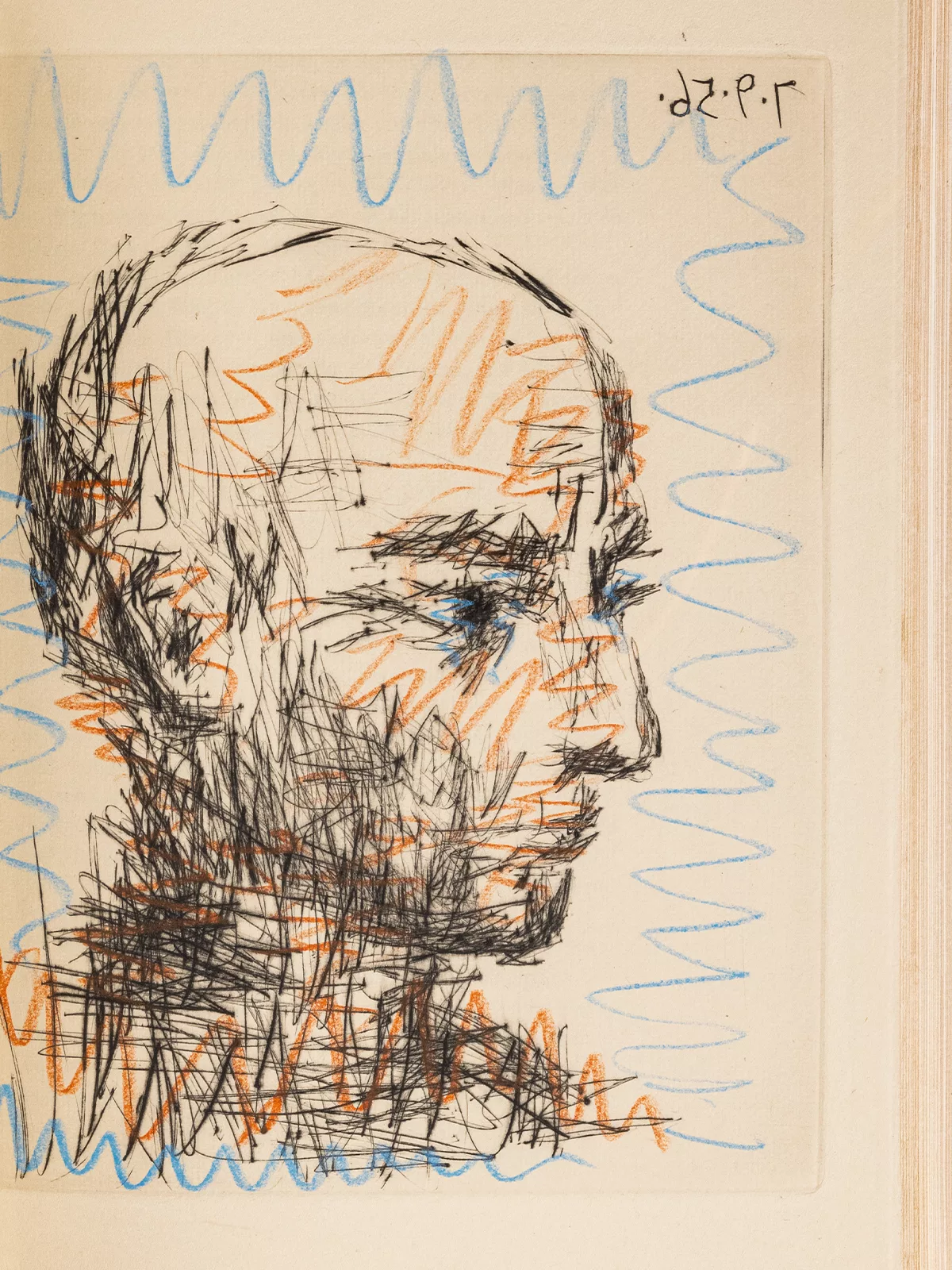
– the lithographed frontispiece portrait, on Japanese paper, here hand-heightened in color by Picasso;
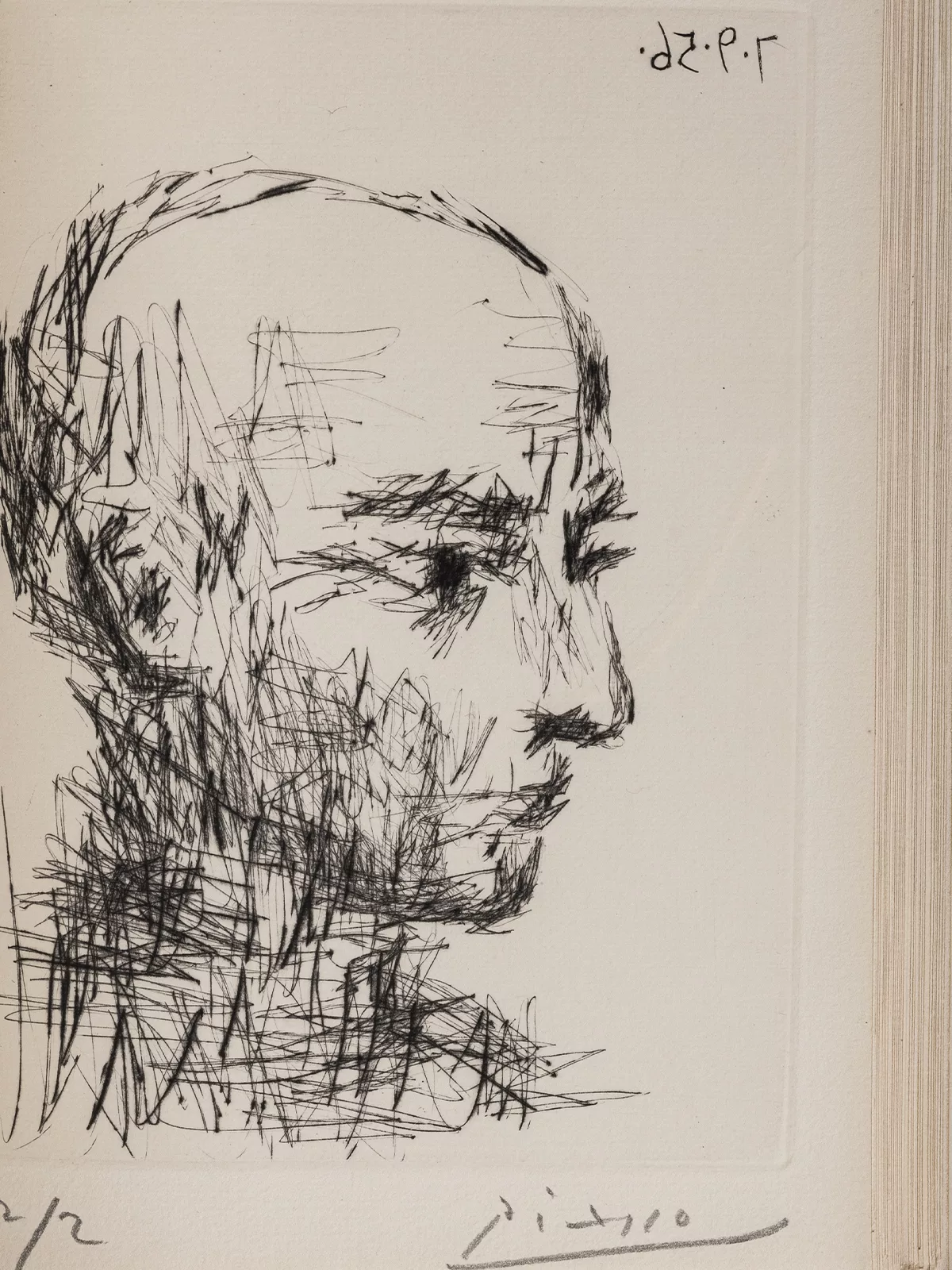
– the frontispiece portrait on Montval laid paper, justified 2/2 and exceptionally signed;
– the frontispiece portrait on strong vellum — the only known proof on this paper;
– the 3 drypoints, also on Japanese paper, here likewise exceptionally hand-heightened in color by Picasso;
– the 3 drypoints on Montval laid paper, exceptionally signed by the artist. No other signed suite of these three drypoints is known, apart from the Broder proofs, which bear the artist’s autograph note in pencil: “Bon à tirer / Picasso / Cannes le 10.9.56” (Aguttes, September 2021, no. 442). The suite present in the 30 copies of the deluxe issue is unsigned in any known copy;
– the lithographed cover of the slipcase, in triple state;
– the subscription leaf, on Japanese paper;
– an additional state of the lithograph for the second board of the slipcase;
– the suite of the 24 wood engravings by Aubert on Montval laid paper.
The text of this Chronique was commissioned in 1935 from Max Jacob by the widow of the art dealer Paul Guillaume, in his memory. She turned to the man best placed to recount the era of the avant-garde that he had helped initiate and had lived through alongside Apollinaire, Picasso, Salmon and Braque.
“The project would become this fundamental account of Cubism: La Chronique des temps héroïques, begun in 1935, of which only the opening appeared during Max Jacob’s lifetime, in 1937. It was in 1956 that Louis Broder produced this limited edition, on the occasion of the poet’s eightieth birthday, with etchings by Picasso, based on a complete manuscript of the eight chapters. The text of this edition had never been reprinted since. Yet there exists no testimony as vivid and direct on the adventure of modern art, from the Montmartre bohemia to the excesses of the Roaring Twenties.”
Picasso created 3 plates for this book, in drypoint, dated 7 September 1956 (according to the bon à tirer of the frontispiece): each depicts Max Jacob writing, nude, seen from behind, and also in profile with head bowed. Picasso had also made a profile portrait of his friend while in Vallauris, on 23 September 1953 — the one he chose to use here as the frontispiece: the bon à tirer of this lithograph is dated “Cannes, 10.09.56.” For the cover and the slipcase, Picasso created two further original color lithographs, then added 24 wood engravings, executed by Georges Aubert after drawings in the spirit of the illustrations for Le Chef-d’œuvre inconnu, the text by Balzac that Picasso had illustrated in 1931 for Ambroise Vollard.
“It can be said that not only was Max Picasso’s first French friend, generously offering Pablo all the culture he carried within him, but that for twenty years they lived side by side in a friendship stronger than is generally recognized, sharing all the ‘battles’ and great moments of a new art of which they saw themselves as leaders, beginning with Cubism.”
Max Jacob (born 1876) was the friend with whom Picasso published his second illustrated book, the celebrated Saint Matorel, a masterpiece commissioned by Henry Kahnweiler in 1911. They met in 1901 in Paris, Jacob having come from his native Quimper, Picasso newly arrived from Barcelona. The poet discovered the painter’s work at the gallery of Ambroise Vollard, who was exhibiting the young Pablo Ruiz Picasso for the first time. The two men shared a room on the Boulevard Voltaire before Picasso moved to the Rue Ravignan, to the address that would become legendary as the “Bateau-Lavoir,” a name coined by the poet. At number 7 of the same street, Max Jacob would even rent a small room for a time, to make his daily visits to his friend’s studio easier. After the war, it was again Picasso whom Jacob asked to be his godfather at baptism (16 February 1918, at the Chapelle Notre-Dame-de-Sion in Paris), before Picasso in turn asked him to be his witness at his marriage to Olga Khokhlova six months later, at the Orthodox Church of Saint-Alexandre-Nevsky.
Twelve years after the poet’s tragic death at the Drancy camp in 1944, Louis Broder enabled Picasso to pay him the finest possible posthumous tribute, a testimony to fifty years of friendship reaching back to the earliest days of their long association. At the age of seventy-five, Picasso worked here as never before for the great companion of his early years — the man to whom Éluard had once inscribed a copy of Cours naturel: “To Louis Broder, who loves books even more than I do.” Broder left a mark on the world of fine-press publishing as brief as it was significant: a dozen books and two series, “Miroir du poète” and “Écrits et gravures” — of which this Chronique is the second publication — were enough to distinguish the Éditions Louis Broder in the publishing landscape of his time.
In 1956, Picasso collaborated on no fewer than ten books, providing one or more original illustrations for each. Original drawings adorned the covers of the Mourlot catalogue raisonné, Picasso lithographe III (Monte-Carlo, André Sauret), and of two solo exhibition catalogues: Picasso (Cannes, Galerie 65) and Picasso dessins d’un demi-siècle (Paris, Berggruen & Cie). For other books, Picasso illustrated Roch Grey’s Chevaux de minuit, published by Iliazd, and René Crevel’s Nuit, published by PAB, as well as two tribute volumes for three of his closest friends: Cocteau’s Témoignage, published by Pierre Bertrand; Éluard’s Un poème dans chaque livre, published by Louis Broder; and this Chronique des temps héroïques, the culmination of thirty years of friendship with Max Jacob.