

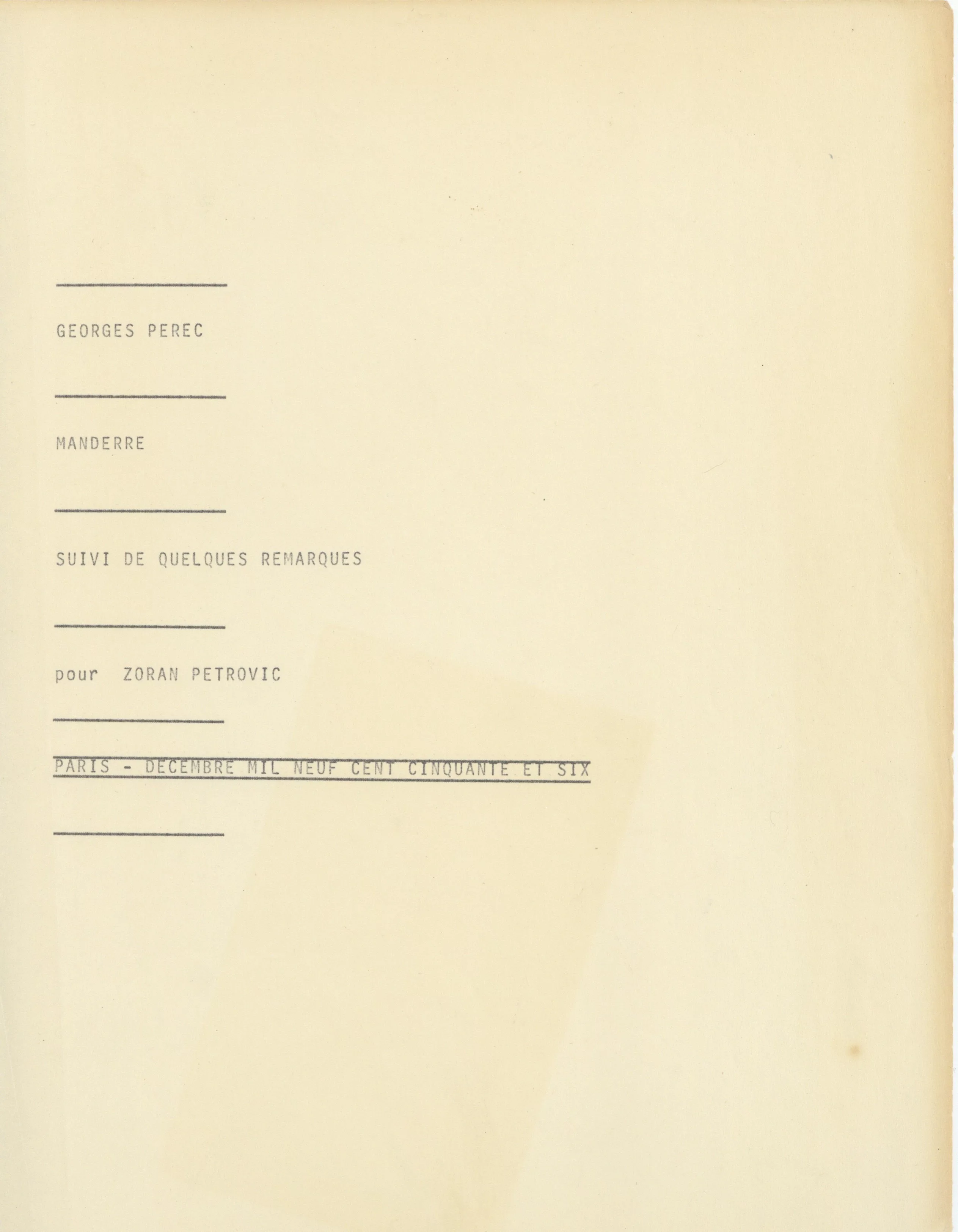
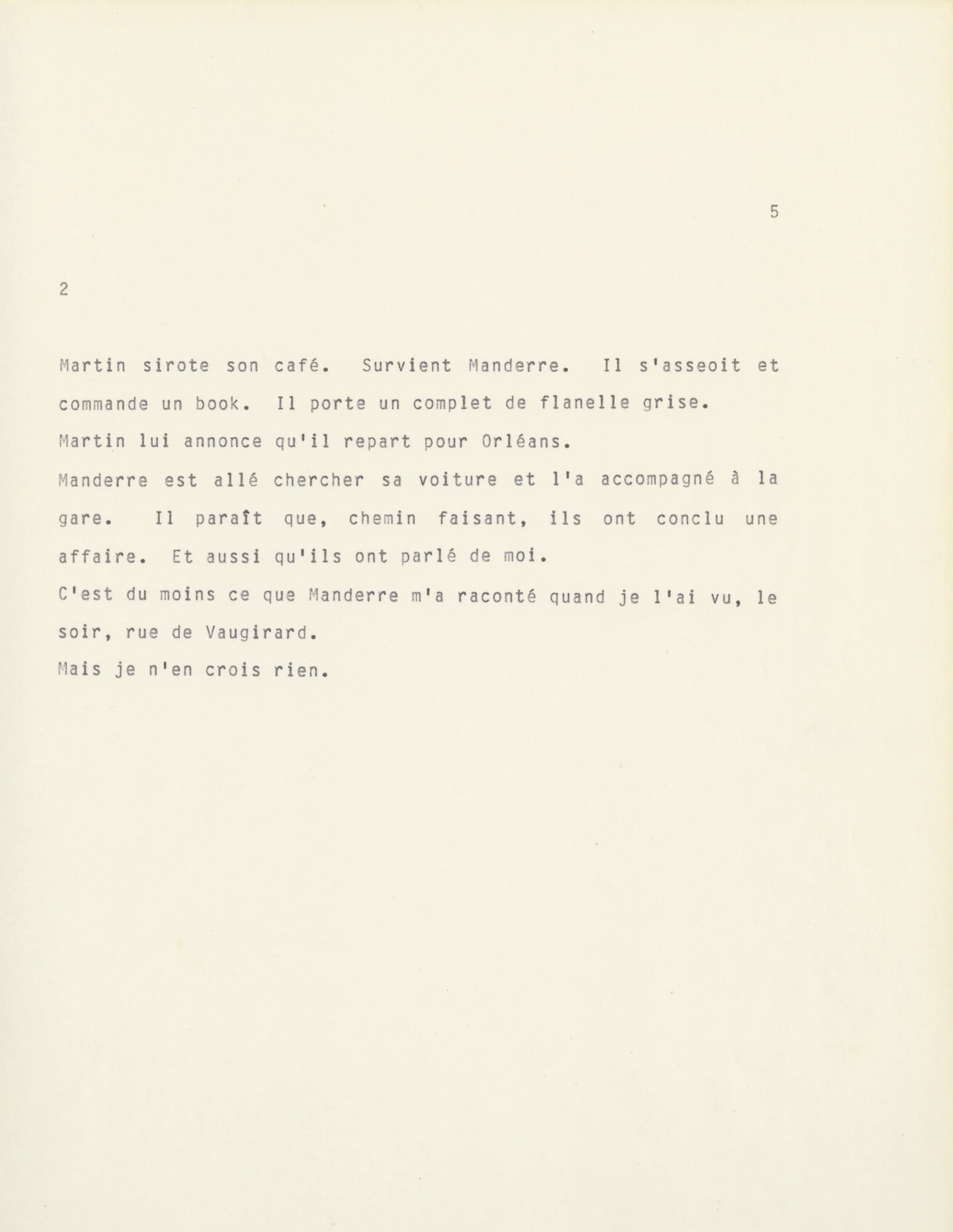
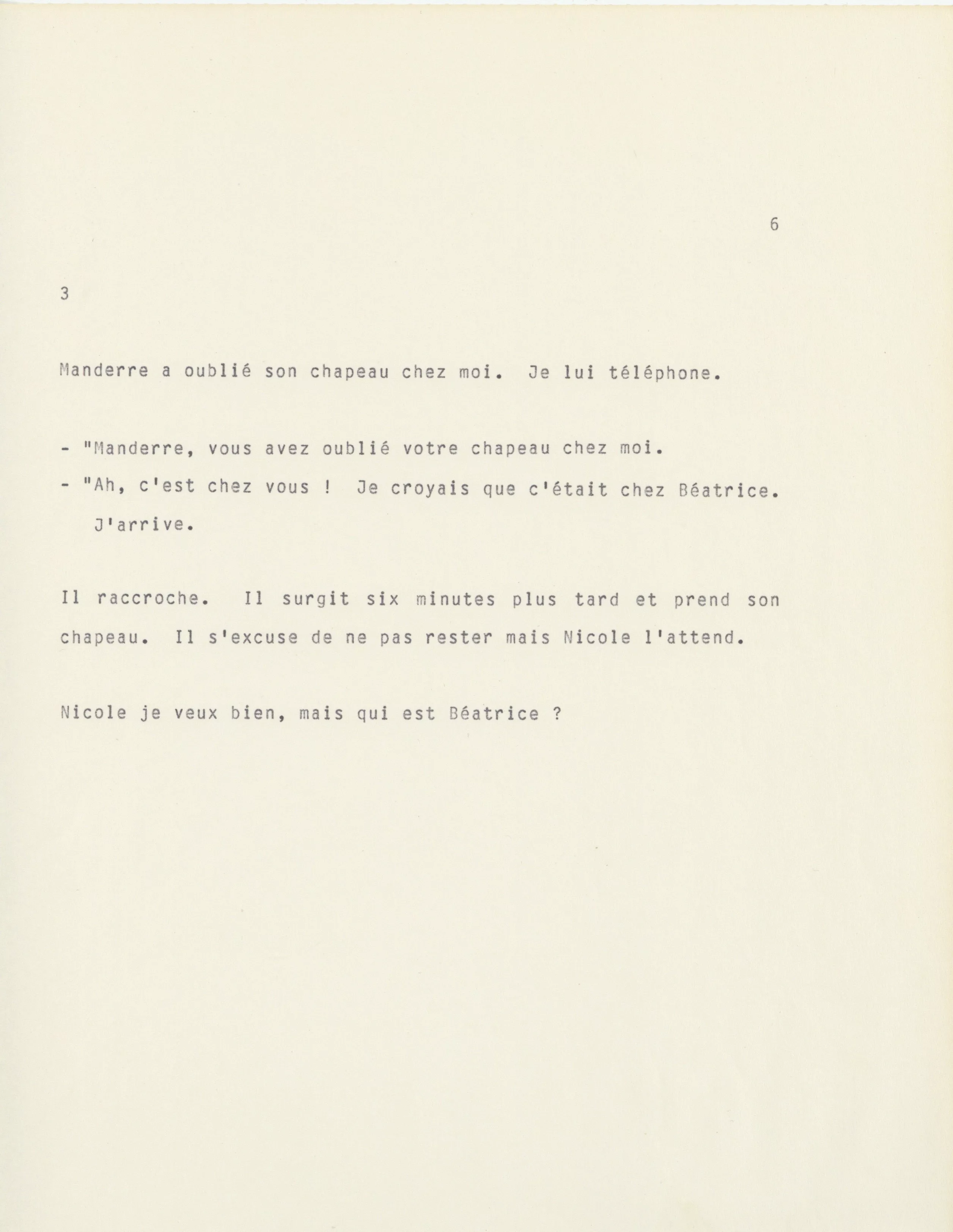
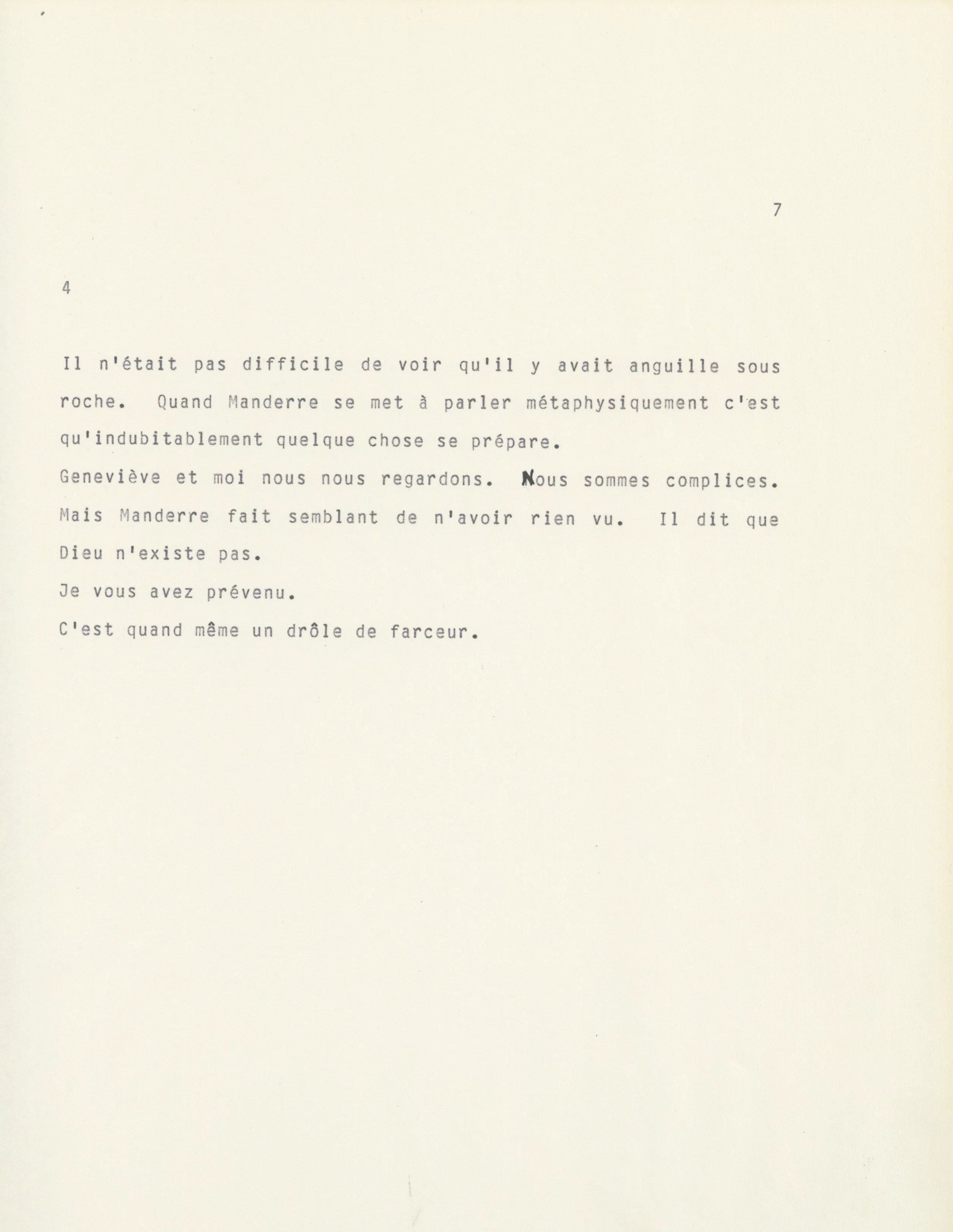
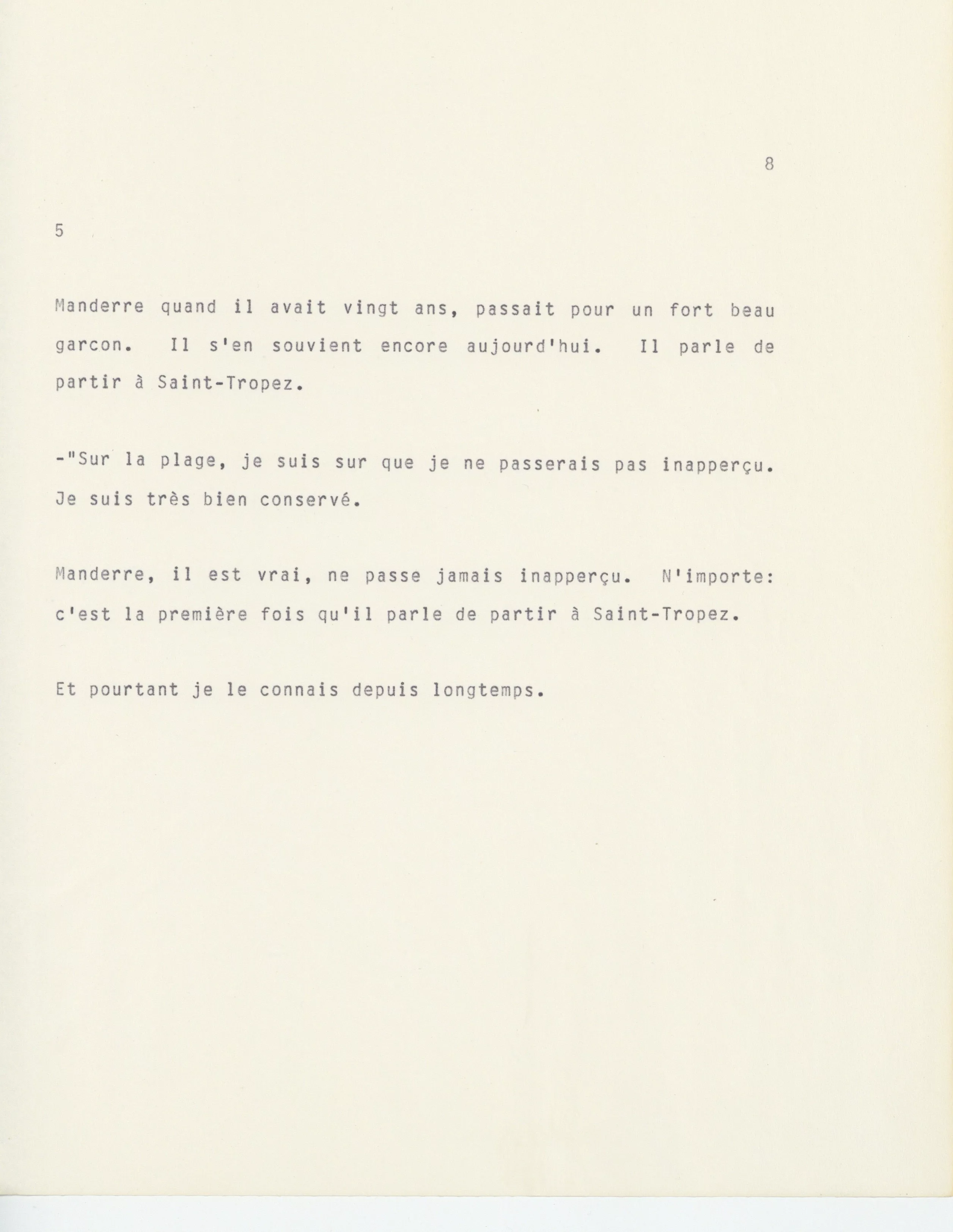
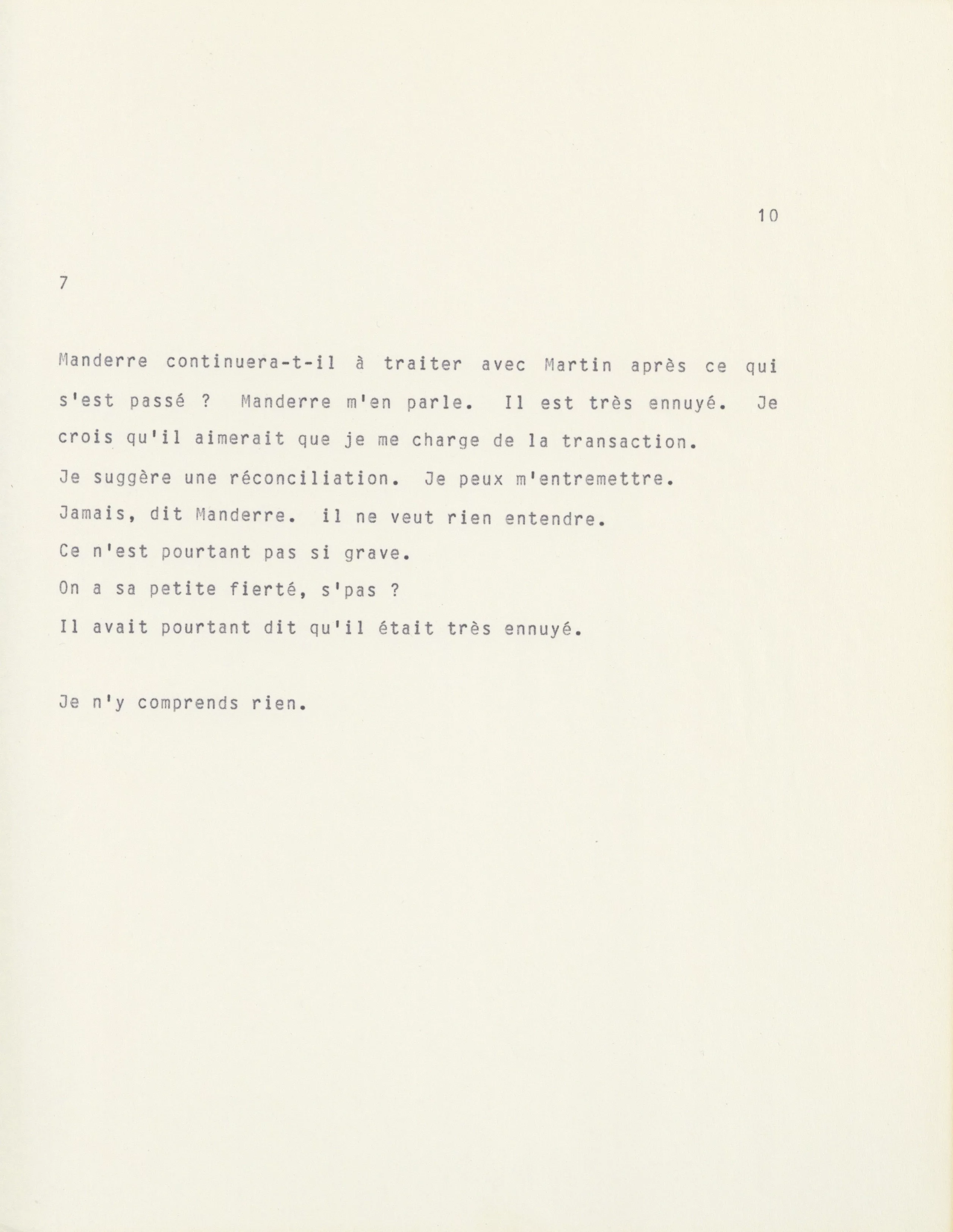
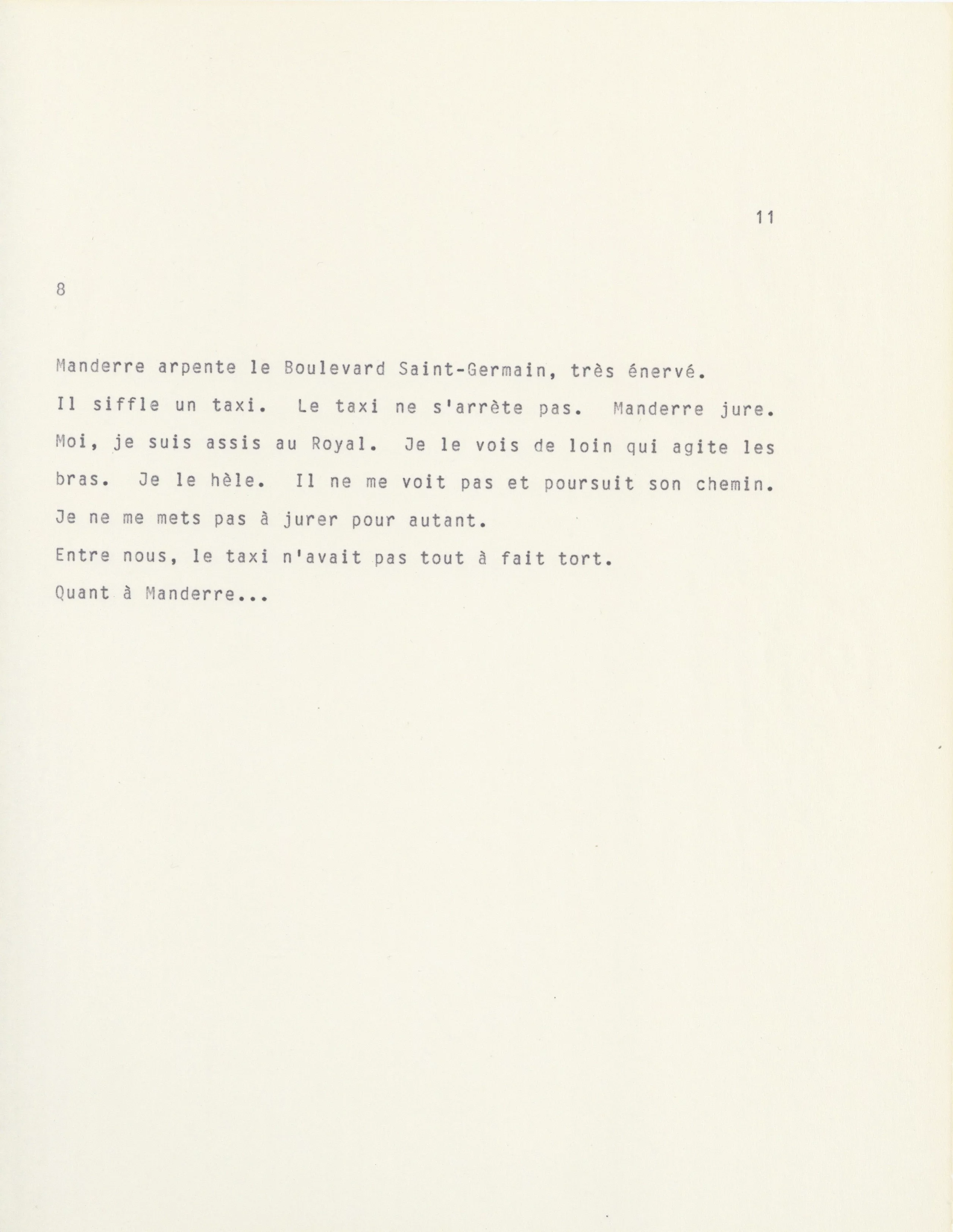
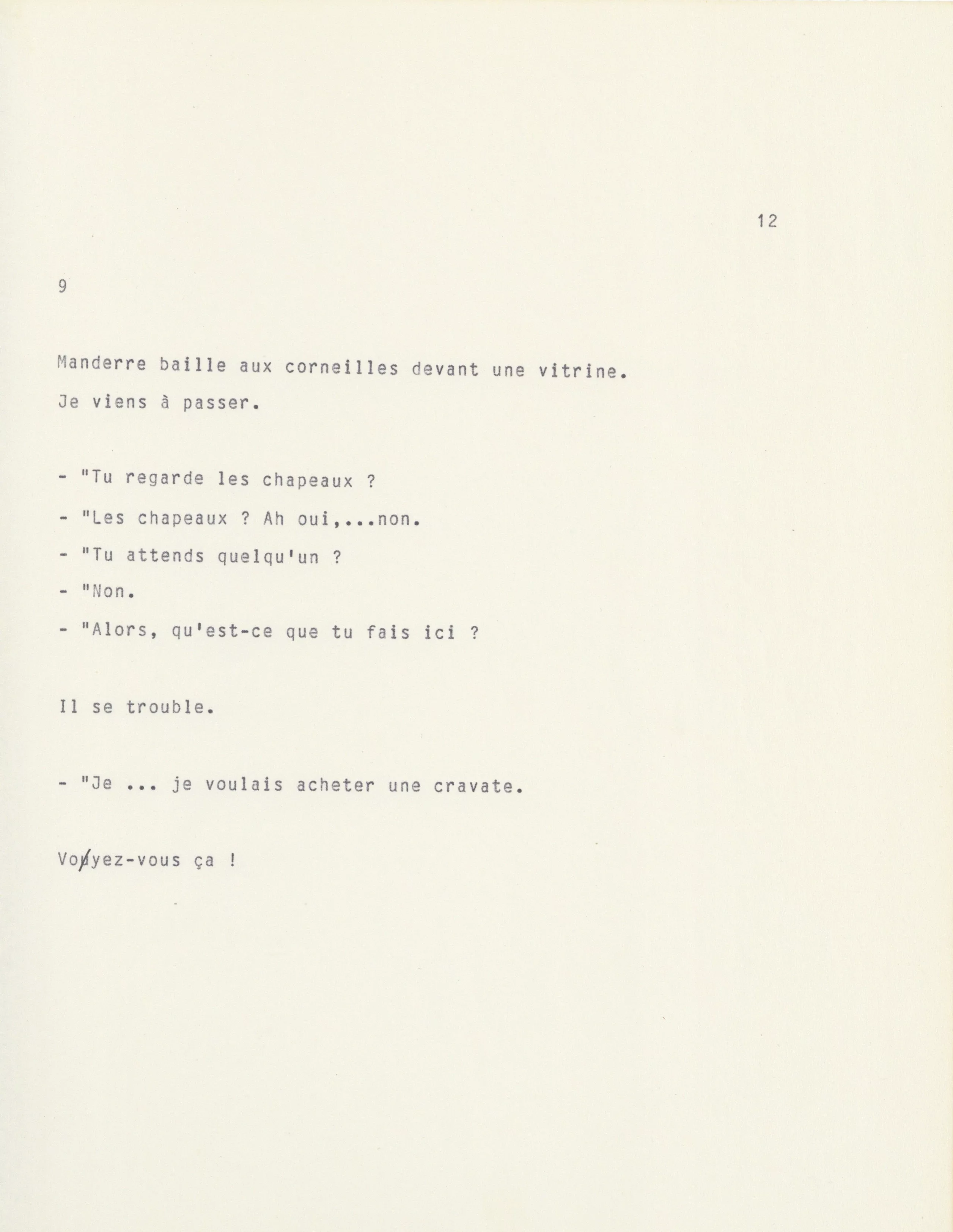
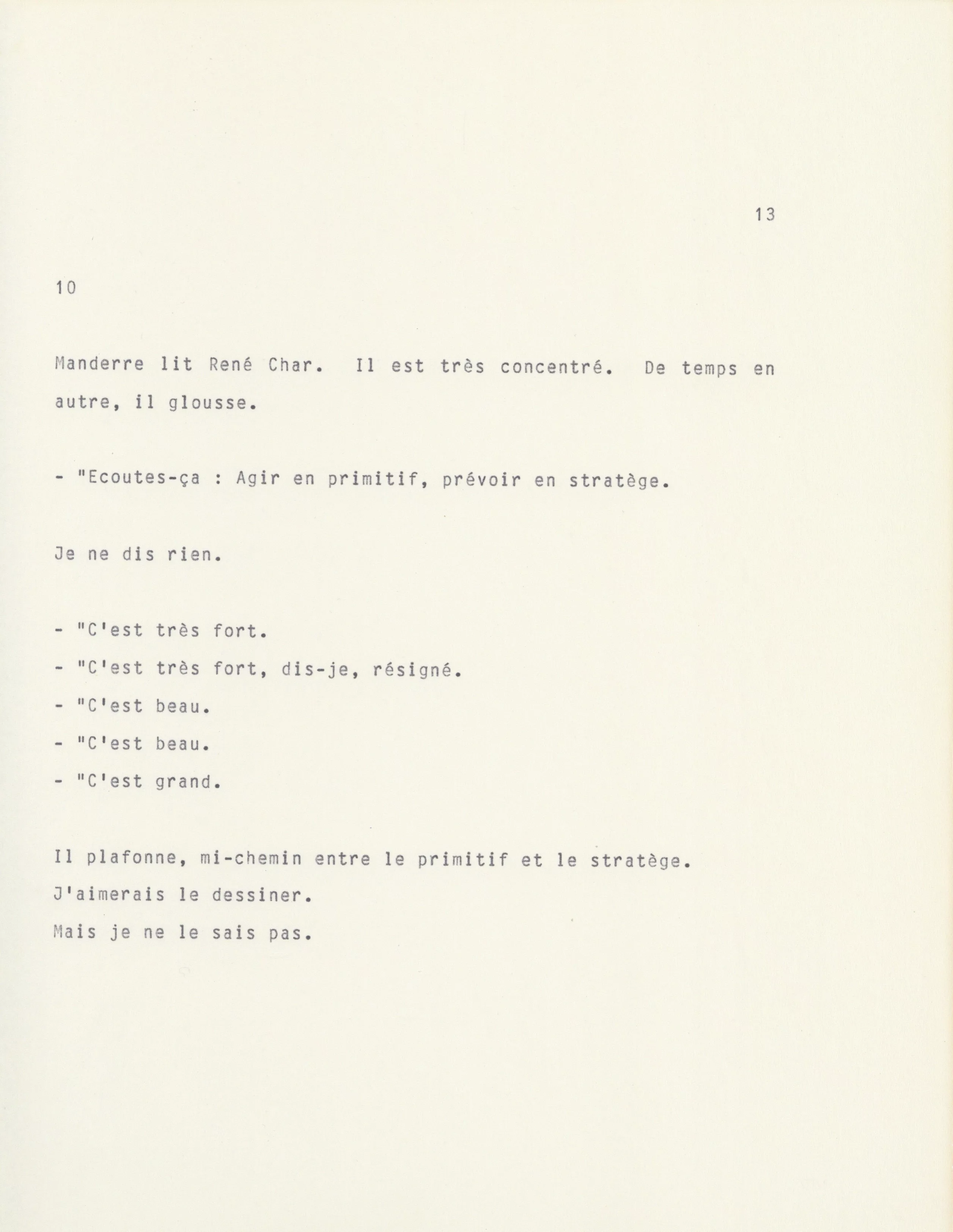
Manderre
A text long considered lost, the earliest mention of Manderre appears in the “Bibliographie approximative des œuvres de Perec” (L’Arc, no. 76, 1979), annotated by Perec himself. He returned to the subject later in Lieux (p. 128): “For a long time I scrupulously kept all my texts. At one point they were all in a small papier-mâché suitcase. I sorted them and looked through them periodically. […] I don’t know when I threw away the suitcase and/or its contents, but the fact is that I noticed, either when leaving the rue de Quatrefages or when moving into the rue du Bac, that almost all the texts written before ’63 (or ’62) had disappeared.” While he supposes he may have “thrown away duplicates,” he does not believe he consciously destroyed these early texts — perhaps some, “but certainly not L’Attentat de Sarajevo, nor texts such as Les Barques, Manderre, La Procession; and above all not the various versions of Gaspard pas mort – Le Condottière.” They were never found, and for most of them only the duplicates Perec had given to close friends at the time of writing are known.
None was ever published.
Of Manderre, there has only ever been this single original typescript. It had only two successive owners: it was given, probably in the summer of 1957, to the woman Perec was then courting, Milka Canak. It was at her home in Belgrade that it was discovered in 1989, nearly thirty years later, by a researcher and passionate admirer of Perec’s work, David Bellos. Milka gave him the typescript at that time — a major discovery, but one that went unnoticed amid the other texts David Bellos, then deep in research for his biography of Perec, was trying to assemble.
He had two photocopies made of the original typescript: one was given to the person who then held the rights to Perec’s estate (until her death in 2016), Ela Bienenfeld (daughter of Esther and David Bienenfeld, Perec’s uncle and aunt and, above all, his legal guardians from the age of nine), to whom he also gave copies of all the other texts “recovered” through his research; the other, made partly as a precaution and partly so he could study it at leisure during his research, remained in Bellos’s archive until he bequeathed it in 2005 to the Lilly Library at Indiana University, Bloomington. This copy of the “rediscovered” typescript came to public attention in 2012, cited in the Bulletin de l’Association Georges Perec (no. 61) by one of its correspondents: “Renata Lopes Araujo has sent the AGP an unpublished early text by Perec entitled Manderre, the original of which is in Belgrade [it was in fact no longer there]. It was written in 1956, and David Bellos describes it as a pastiche of Gide’s first published work, Paludes […]. Renata Lopes Araujo obtained a photocopy from Indiana University, through the manuscripts department of the Lilly Library.”
Finally, Manderre was published for the first time four years later, in the Cahier de l’Herne devoted to Georges Perec. It was probably, in fact — contrary to what David Bellos states in his own article in the same Cahier — based on the Lilly Library copy rather than Ela Bienenfeld’s, that the publication was prepared. It should be noted that the copy given to Ela Bienenfeld is not part of her archive, now held in the Perec collection at the Bibliothèque de l’Arsenal, which is also the seat of the Association des Amis de Georges Perec.
Sylvia Richardson and Marianne Saluden (heirs following Ela’s death in 2016) authorized this disclosure (and publication), while probably retaining in Ela’s own archive the photocopied document provided by David Bellos, who initiated and organized this publication.
It remains a fact that this original typescript was unknown and presumed lost for nearly fifty years, to all researchers, publishers and even to Perec’s closest friends from the time of its writing — as one of them, Jacques Lederer, would later recount: “The first text I ever held in my hands, which he dedicated to me, was a short story called Les Barques (autumn 1954); then came Manderre (December 1956), L’Attentat de Sarajevo (1957), Le Condottière […] I don’t know what became of it.” Lederer omits — probably because he was unaware of them — the comic strip Enzio (1955) and the two texts Les Errants (Christmas 1955) [lost] and Le Fou (autumn 1956) [now held at the Royal Library of Sweden].
History of Milka Canak’s typescript:
The typescript offered here is thus a survivor; its journey is as singular as it is moving, and it took the persistence of a researcher, and his affection for the work of the author of Les Choses, to trace it in 1989.
David Bellos, translator into English and leading scholar of Georges Perec’s work, and his biographer, recounted the story of this mislaid typescript in his article “Manderre retrouvé.” We learn that during his move in 1966 — when he left the apartment on the rue des Quatrefages for one on the rue du Bac — Georges Perec mislaid a number of working papers and carbon copies, including that of Manderre, to which, he would later write, he was particularly attached. Against this background, the discovery of Manderre at the home of the woman to whom Perec had given the original typescript was, as David Bellos would later recount, accompanied by profound emotion.
At the time Manderre was written, Jacques Lederer — his “closest friend, blood brother,” whom he met while still at school — recalls that Perec should be pictured as a young writer trying to place his first pieces, already displaying the personality he would later be known for: tenacious, cheerful, seductive and capable of great empathy. “[…] he already had an audience: he achieved a certain notoriety well before he was published. There was a circle around him, the members of ‘La Ligne générale,’ but also others who were devoted followers. […]”
Perec finished writing Manderre in December 1956, announcing it in a letter to his friend and fellow hypokhâgne student Bernard Quilliet. Their paths had diverged: Perec had left the ranks of the classe préparatoire in June 1954, for lack of good results, to join the Sorbonne, with no greater success: “As for the Sorbonne, I go there every day for three or four minutes, except on Fridays when I stay for a quarter of an hour. I realized at the start of November that I had gone astray there. I have accordingly sent Clio packing to devote myself to Melpomene, who, incidentally, proved too tough for me. My unfinished tragedy […] therefore lies in a drawer, while I have, without pausing for breath, written a burlesque play [and] a collection of 30 short texts [Manderre] […] and am now setting to work on a novel.” (Letter to Bernard Quilliet, 19 December 1956, unpublished).
At this time Perec was still living in the small maid’s room under the roof of the apartment belonging to his adoptive “parents,” his uncle and aunt the Bienenfelds. Around this time (toward the end of 1955), and thanks to his cousin Ela Bienenfeld, he met, at the Sorbonne, a group of Yugoslav intellectuals, all students in Paris on scholarships. Manderre is dedicated to one of them, the painter Zoran Petrović (1921–1996), who had just arrived in Paris in November 1956: he was exhibiting works he titled “Machines” at the Palais Berlitz (now the Galerie Yougoslave). Perec, who visited the venue regularly, there met the woman with whom he would fall in love and to whom he would give this typescript some time later, Milka Canak; a year later she would become the character of Mila in L’Attentat de Sarajevo (another lost early text, recently rediscovered and published in 2016).
Milka Canak kept the original of Manderre for over thirty years, tied with the ribbon with which Perec had given it to her.
The text and the calling
In writing Manderre, whose title remains, for specialists of the work, wrapped in mystery, Perec was pastiching Gide’s Paludes (1895), and, almost as he wrote, was already commenting on his own work.
“Manderre is nothing less than the typescript of the earliest known text by Perec: Les Errants was finished on 26 January 1956.” Perec never submitted the manuscript (now lost) to a publisher. He then wrote a short story titled ‘Les Barques’ (…). He went through a period of depression, from which he would later draw, in part, the material for Un homme qui dort. It was also for Perec a time of intense cinephilia, as he watched as many as four films a day. He wrote a short story inspired by Gide’s Paludes: Manderre.” (Pléiade, chronology, p. xxxii).
Hence this remark at the end of the typescript: “Now that this text is far behind me, I am beginning to find it less good. But I am nonetheless quite pleased to have written it. The important thing, surely, is not to stop — above all, not to stop. And to keep on searching, again and again, until the day I arrive at the work (that’s a rather grand word).”
At this time Perec was still full of doubts about his possible career as a writer — and although he had already contributed reading reports to the Nrf and then to Les Temps modernes, his own texts and projects remained private. To the man who would later publish his first novel at Denoël in 1965 — Maurice Nadeau, then editor of the review Les Lettres nouvelles — the young Perec confided his deep desire to write: “[…] because despite my own failures, despite the climate of contempt or total incomprehension that surrounds me in my family, I believe I can write; I know, at any rate, that it is for me the only way to reconcile myself with myself and with the world, to be happy, or, more simply still, to live.”
This typescript bears three corrections in black ink, in the author’s hand.
Sources: Bulletin des Amis de G. Perec, 2012; L’Herne, Perec, 2016; David Bellos, Perec, une vie dans les mots, revised and expanded ed., 2022; G. Perec, Lieux, posthumous ed., 2022; interview with David Bellos.