

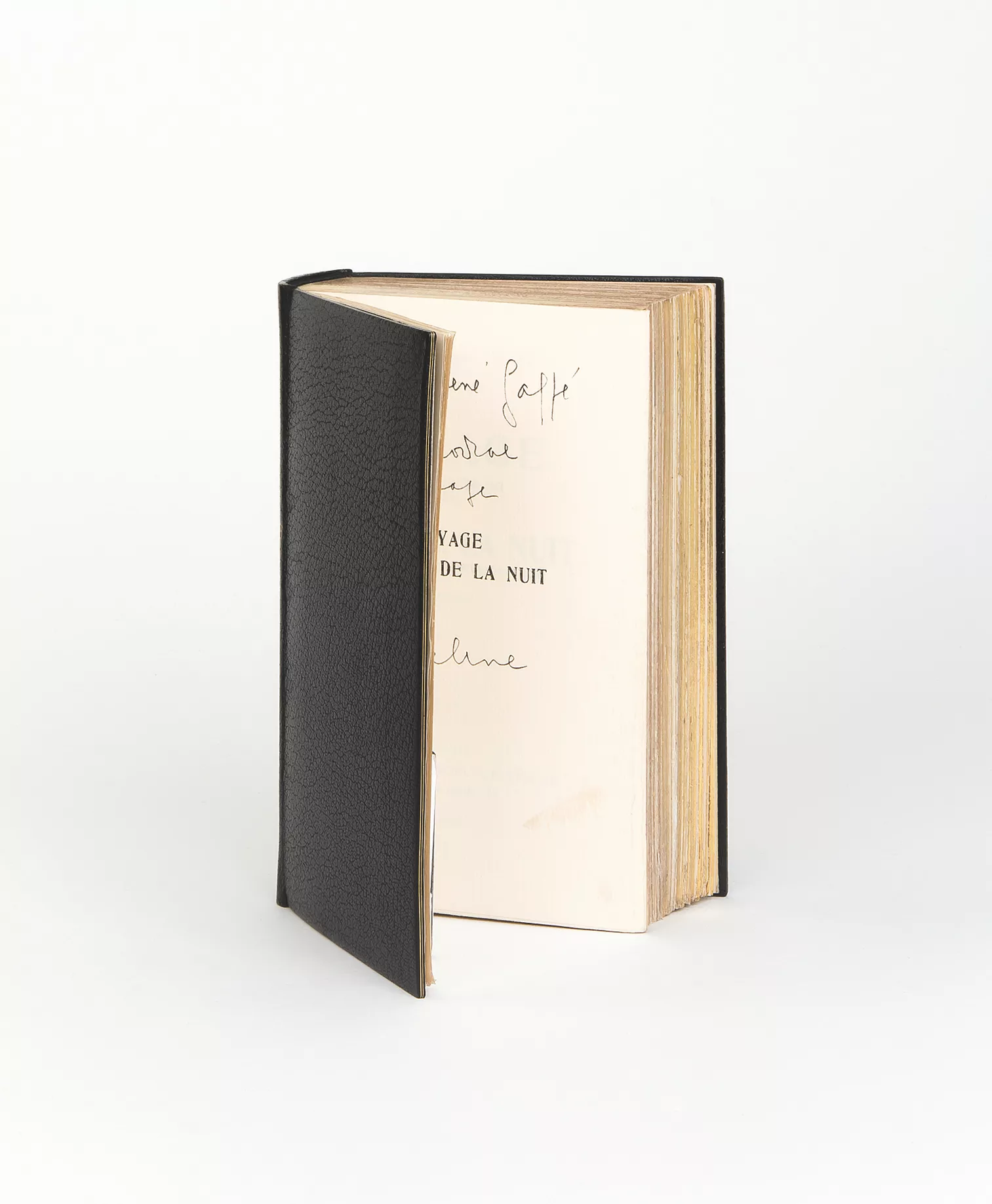
Voyage au bout de la nuit
Our census supplements the lists and research of Henri Thyssens and Pascal de Saadeler, as well as the Dauphin-Fouché bibliography on the subject:
No. 1. In wrappers (Librairie Bernard Loliée; Artcurial, 2013; private collection).
No. 2. In wrappers (Librairie Loewy, 1933, no. 66; Librairie Vrain, attributed to Léon Daudet in 2008, without supporting evidence; Librairie Hérodote, 2020).
No. 3. Bound. Jules Exbrayat copy (bound by Semet et Plumelle, sale, 1962, I, no. 166, rebound by Maylander for Hayoit, passed through his sale, 2001, then Sourget, 2004; Beaufour collection).
No. 4. Bound. Frédéric Lefèvre copy, with inscription (Tranchimand collection, then Renaud-Giquello sale, 2004, no. 22; binding by Devauchelle).
No. 5. In wrappers. Lucien Descaves copy (binding by Miguet).
No. 6. In wrappers (located, without inscription, private collection).
No. 7. In wrappers (located, without inscription, Sotheby’s, February 2023, no. 62).
No. 8. Bound. Roland Saucier copy (with inscription, bound by Cerutti, then Chauveau copy, then Ragazzoni, then Campbell-White, then Sotheby’s, 2014, no. 66).
No. 9. Bound. José David copy (Brussels bookseller and collector); with a later inscription mounted on an added leaf. Binding by Huser. Sale, van der Perre, 1954; Bourbon-Condé bookplate; Jean-Paul Kahn Library (III, 2021, Bergé, no. 120).
No. 10. Bound. Gaston Roussel copy (bound by Paul Bonet in 1934, Carnets, 253).
Hors commerce copies (the [numbers] are given for reference only, as these copies are not numbered):
[1] – Bernard Steele, bound by Devauchelle (cat. Coulet-Faure, 1958),
[2] – Robert Beckers, bound by Alix, Sicklès copy (sale, 1983, no. 76),
[3] – Max Dorian, cited by Thyssens — only these three copies are nominative, reserved for “collaborators of the house.” This copy is bound by Paul Bonet (Carnets, 975), sold at public auction in 1943.
[4] – Copy inscribed but the dedicatee unknown. Bound by P.-L. Martin (Coulet-Faure, June 56, no. 19), perhaps presented to another member of the Académie Goncourt? Among those who did not receive one: the Rosny brothers, Roland Dorgelès, Pol Neveux, Léon Hennique and Raoul Ponchon.
[5] – Gaston Chéreau, bound by Cretté (cat. Matarasso, 1938, then Lardanchet, 1951, then Coulet-Faure, 1958 and 1970),
[6] – Max Descaves, bound by Martin, Louis de Saadeler copy, then Frédéric Lefèvre,
[7] – Mme [Françoise] Lucien Descaves, in wrappers [the only rebound of the ten hors commerce copies], Loliée copy (Bibliothèque R. & B. L., IV, 2014, no. 41, unsold, then Sotheby’s, June 2025, no. 223. The copy has been washed and restored).
[8] – Jean Ajalbert, bound by Huser, then Simonson-Moureau copy and subsequent (Pierre Bergé, 2005, Bibliothèque d’un amateur, no. 141),
[9] – Gaston Chéreau, bound by Cretté (cat. Matarasso, 1938), then catalogue Lardanchet, 1951, then Coulet-Faure, 1958 and 1970,
[10 – our copy] – René Gaffé, whose provenance remains mysterious: it was not presented “like the others,” since its only dedication is to René Gaffé, and it appears on the correct limitation leaf (so it cannot be assumed that one dedication replaced another); at the date of Gaffé’s request, it had already left the publishing house, since Robert Denoël stated that none remained available to him. Or could it have been Denoël’s own copy? It seems surprising that Dorian, Beckers and Steele each had theirs, but not Denoël. Céline himself did not have one either, since he was still regretting this five days earlier. Setting aside the Denoël hypothesis, where could the Gaffé copy have come from? Even if the collector’s networks were vast, he must have moved heaven and earth to obtain what was probably then the only still-uninscribed hors commerce copy… and to have Céline inscribe it immediately! Neither Céline’s inscription nor Huser’s binding is dated, but both are consistent with the 1930s. The matter was therefore concluded quickly.
As with the P.-L. Martin copy, the only unattributed hors commerce copy, one might imagine that it could otherwise have been presented to one of the Goncourt members — but without an inscription, which would be surprising. Gaffé may have sought very quickly, a year later, to buy it, directly or indirectly. This is another hypothesis.
This copy also contains the famous Denoël “attestation,” often cited; more than an attestation, it is in fact a typewritten letter signed by the publisher and addressed to René Gaffé, dated 29 July 1933 (five days after Céline’s letter to the same Denoël), in which Denoël mentions and confirms that there does exist “a hors-commerce printing on fine Arches paper [in Denoël’s own hand] of only ten copies. These copies were reserved for the author and for the collaborators of the house; perhaps two or three were sent to critics […].” The author, as we know, did not have one. So were they truly “reserved for the collaborators of the house,” from which Denoël would have excluded himself?
In any case, René Gaffé made a point of obtaining this hors commerce copy, which he then had inscribed by Céline to him. This is one of the rare occasions on which Gaffé approached a writer directly — apart from his Surrealist friends. Or, if the Denoël hypothesis holds, through Denoël’s intervention.
A native of Brussels, René Gaffé, a spy during the Great War, was first a journalist and founder of L’Echo belge, a fashionable daily of the early century. A renowned businessman, he became, from the 1920s, an inveterate collector, and his meeting with Paul Éluard and André Breton proved to be a genuine turning point. They introduced him to primitive and modern art, and he began acquiring works directly from the artists themselves, who became close friends: Picasso, Magritte, Miró, Erp and Ernst, thus assembling a collection of modern and tribal art comprising some fifty masterpieces, which he always insisted on keeping close to him, refusing to disperse it or lend works for exhibitions.
A bibliophile, and a precursor of the great names of Belgian bibliophily such as Simonson, Hayoit and Marcel de Merre, he was one of the first collectors of Surrealist books, on a par with Jacques Doucet, obtaining works directly from the poets and writers of the movement. They would reserve for him the most precious copies, richly enriched with letters or inscriptions. René Gaffé also had connections with many publishers and booksellers, who could reserve deluxe copies for him. A wealthy industrialist, he assembled an important collection and owned several significant manuscripts, including that of La Condition humaine.
The sale of his collection, in April 1956, remains a landmark reference.
It was only thirty-three years after René Gaffé’s death (which occurred in 1968) that his collection of paintings was put up for sale, following the death of his second wife. In accordance with his will, Jeanne Gaffé instructed Christie’s New York to sell 25 masterpieces, offered without reserve: 60 million dollars were raised, for the sole benefit of Unicef. This remains, to this day, one of the most generous bequests ever made to the institution.
His bookplate, worthy of his exceptional collection, consisted of a full-page leaf on China paper, mounted at the front of copies by the greatest binders he employed: Georges Mercier, Maylander, Semet et Plumelle, Huser, and of course Paul Bonet, whose decisive meeting with Gaffé allowed him to approach the shores of Surrealism, inspiring him with an innovative approach to decoration: he then became the almost official interpreter of the Surrealist poets for nearly two decades. Paul Bonet was the one who designed, executed and engraved this bookplate for René Gaffé — no fewer than six versions were made by the master, one of which was chosen as the basis for the definitive version (cf. Tajan sale, May 2013, lot 486).
Provenance: René Gaffé (inscription and sale, 1956, no. 48); Marcel de Merre (sale, 2007, no. 312). En français dans le texte, 366; Dauphin & Fouché, 32A1.