

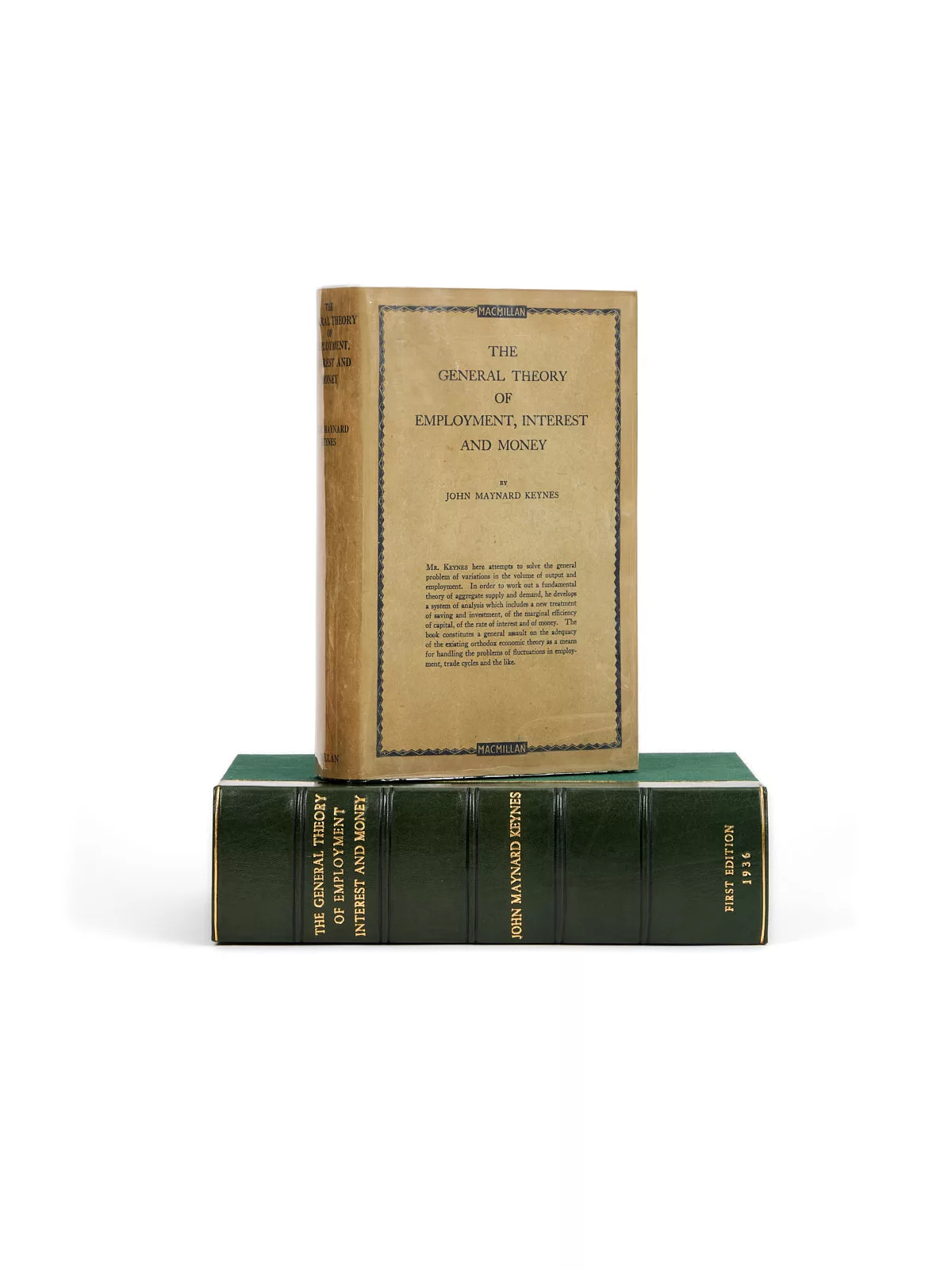

The General Theory of Employment, Interest and Money
Manuscript ownership inscription “K. S. Venkataraman” on the first leaf.
A brilliant student, born in Cambridge, John Maynard Keynes entered the prestigious King’s College in 1902, at the age of nineteen. Although this milieu also gave rise to the Bloomsbury Group, of which he would become a member, his inclinations remained strongly scientific: a gifted mathematician, he went on to prepare for the British civil service examinations, particularly those connected with the Treasury. Posted to the India Office, he began work on what would become the Treatise on Probability and undertook the study of economics under Alfred Marshall, before becoming, at only thirty, a lecturer in political economy. In 1913 he published his first economics book, Indian Currency and Finance, which established his reputation for mastering technical, political and human problems alike. This book led to his appointment to the Royal Commission on Indian Currency and Finance (1913–1914), an important position that opened the doors of the Treasury to him the following year, and he quickly became the principal adviser to Chancellor of the Exchequer Reginald McKenna.
It was at this time, and probably for this reason and his knowledge of India, that he was contacted by an economics student at the University of Madras, S. Venkataraman: the archives of King’s College, Cambridge, where the John Maynard Keynes papers are held, contain a letter from Venkataraman to Keynes, dated 28 October 1913, in which the young student asks for advice on the study of economics and on how he might expand the university library’s holdings on the subject.
Twenty years later, by then a respected academic and economist, Venkataraman published (in 1935) several important articles on the handloom weaving industry in India, in The Madras University Journal (vols. 7–8, 1935–36), later revised and expanded for publication as The Hand-Loom Industry in South India (Madras: Dept. of Economics, Madras University, 1940). The Madras Presidency was then the second-largest cotton-growing province in the country, with 850,000 hectares under cultivation. After the war, India would become the world’s leading cotton producer and the second-largest textile producer after China.
The publication of The General Theory, written in the aftermath of the Great Depression, at a time when the old economic order was widely regarded as having failed, could not leave Venkataraman indifferent. Keynes argued that government intervention in the economy — directing wages, investment and demand — was necessary to achieve full employment and end the boom-and-bust cycle. Keynes’s system of managed capitalism shaped much of twentieth-century economic doctrine, being adopted by both left and right in Western Europe and the United States; his theories became the nearly unchallenged economic orthodoxy of the postwar decades, until the counterattack of the monetarist and neoliberal schools.
Provenance: K. S. Venkataraman, J.C.S. (manuscript ownership inscription, dated June 1938).
Moggridge A10.1; Printing and the Mind of Man, 423.